
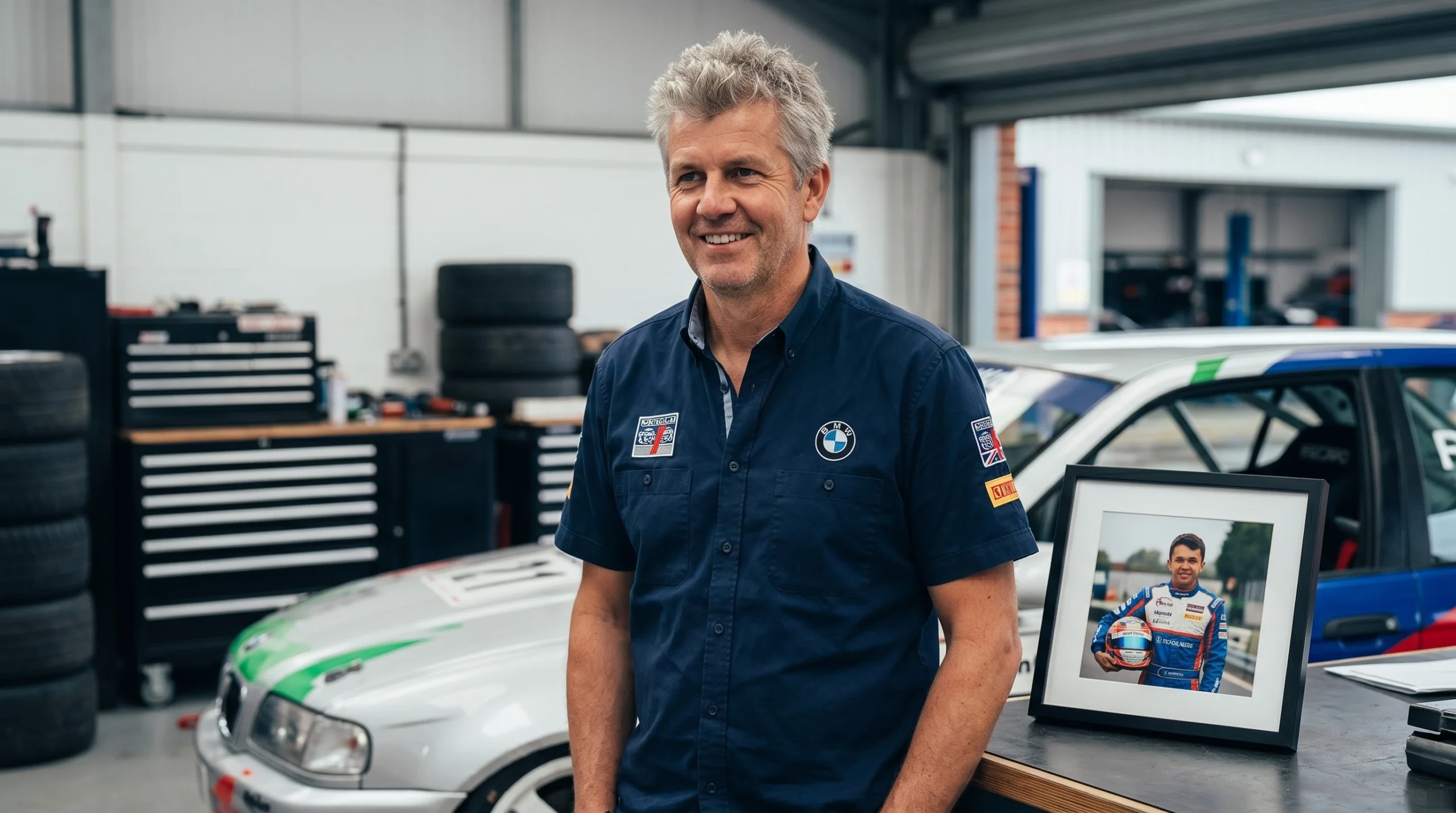
Nigel Albon is best known to many motorsport fans as the father of Formula 1 driver Alex Albon, but that description tells only part of the story. Before his surname became familiar to a global F1 audience, Nigel had built a racing career of his own across British touring cars, Renault Clios, GT machinery, endurance racing, and Porsche competition in Asia. His record is not the record of a Formula 1 celebrity, and it should not be inflated into one. It is the more grounded story of a committed racer whose career unfolded in some of the sport’s toughest and least forgiving categories.
Public curiosity about Nigel Albon usually begins with Alex. Fans see Alex racing under the Thai flag for Williams, hear references to his British father and Thai mother, and want to understand the family background that shaped one of modern Formula 1’s most resilient drivers. Nigel’s role in that story is important, but it is also easy to oversimplify. He was not merely a parent watching from the sidelines; he was a racer whose own life around cars helped make motorsport part of Alex’s childhood world.
Early Life and Background
Nigel Peter Albon was born on 8 February 1957 and is publicly identified as British. Much of his early personal history remains private, which is not unusual for drivers whose careers developed outside the highest levels of international single-seater racing. Unlike Formula 1 stars, club racers, touring car privateers, and regional GT drivers often leave behind results sheets rather than long public biographies. That means the responsible account of Nigel’s life has to begin with what can be verified and avoid dressing gaps in the record as fact.
What is clear is that Nigel became deeply involved in motorsport long before his son reached the professional ranks. His racing life included several different forms of competition, each requiring different skills and resources. Touring cars demanded close-contact racecraft, GT and endurance racing required patience and mechanical sympathy, and one-make Porsche racing rewarded consistency because the cars were closely matched. That variety says something useful about him as a driver: he was not tied to a single narrow discipline.
Nigel’s public story is also tied to the wider Albon family’s connection with racing. Alex Albon has spoken about growing up around cars and race tracks, with his father’s racing forming part of the everyday background of family life. That kind of environment matters in motorsport, where early exposure can make a technical, expensive, and intimidating world feel familiar. For Alex, racing was not an abstract dream seen only on television; it was something his father actually did.
A Career Built Across Practical Racing Categories
Nigel Albon’s racing career is best understood as a working driver’s career rather than a ladder aimed cleanly at Formula 1. Public racing records place him in Renault Clio Cup UK in the early 1990s, the British Touring Car Championship in 1994, FIA GT competition in 2001, the Malaysia Merdeka Endurance Race in 2002, and Porsche Carrera Cup Asia during the 2000s. Those series did not all serve the same purpose. Some were highly competitive domestic championships, while others were international or regional contests built around GT cars and endurance formats.
His movement across those categories shows the path taken by many capable racers who do not become global stars. Motorsport is full of drivers with talent, persistence, and strong results who never become famous outside specialist circles. Funding, timing, machinery, team strength, and market conditions shape careers as much as pure speed. Nigel’s record reflects that reality more honestly than a mythic rise-and-fall story would.
The cars he raced also tell part of the story. Renault Clios and touring cars are physical, crowded, and often bruising. Porsche GT cars demand a different feel, especially in endurance settings where a driver has to balance pace with preservation. Porsche Carrera Cup competition adds another test because similar machinery leaves fewer hiding places. In that sense, Nigel’s career shows adaptability as much as ambition.
The British Touring Car Championship Years
For many British racing fans, Nigel Albon’s most recognizable entry is his 1994 British Touring Car Championship season. He raced a Renault 19 16V for Harlow Motorsport during a period now remembered as one of the BTCC’s most competitive eras. The championship in the 1990s drew strong manufacturer involvement, serious engineering talent, and drivers who became major names in touring car history. It was a hard place for any privateer or smaller operation to make a mark.
Nigel’s BTCC results were modest, and that should be stated plainly. Records from the season show him competing at circuits such as Thruxton, Brands Hatch, Snetterton, Silverstone, Donington Park, Knockhill, and Oulton Park. His finishing positions included results in the middle and lower parts of the field, along with retirements and non-starts. Those details do not diminish the effort; they place it in the real conditions of the series.
A privateer Renault 19 was not the same weapon as the best-supported cars on the grid. In the super touring period, budgets, factory backing, testing, and engineering depth could make a large difference. Drivers outside the leading teams were often fighting not just competitors, but reliability, set-up limits, and the economics of simply appearing at the next round. Nigel’s BTCC chapter sits squarely inside that demanding world.
That experience still carries weight. Racing in the BTCC at that time required nerve, competence, and a willingness to compete in close quarters against deeply prepared opposition. It also placed Nigel in one of the most watched and respected touring car championships of its era. Even without headline results, it remains an important line in his biography because it shows him testing himself in a serious professional environment.
GT Racing and the Move Toward Porsche Competition
After his British touring car period, Nigel’s public racing record becomes more closely associated with GT and Porsche competition. He appeared in FIA GT’s N-GT class in 2001, driving Porsche machinery, and then achieved one of his most notable recorded results the following year. In 2002, he was part of a winning effort in the Malaysia Merdeka Endurance Race, driving a Porsche 996 GT3 Cup with Jaseri Racing. That victory stands out as one of the clearest achievements in his career.
Endurance racing rewards a different temperament from sprint touring car racing. A driver has to think beyond a single lap or a single pass, managing tyres, brakes, fuel, traffic, and the condition of the car over a longer distance. Mistakes can cost not only the driver but also teammates and crew. A win in that setting is not a decorative detail; it points to discipline and execution.
Nigel’s Porsche years continued through Porsche Carrera Cup Asia, where his strongest season appears to have come in 2003. Public records show him finishing second overall that year with three wins across the season. That result is worth separating from the more vague claim that he simply raced in Porsche series. A runner-up finish in a one-make championship shows competitive pace, consistency, and the ability to deliver across multiple race weekends.
He remained active in Porsche Carrera Cup Asia into the mid-2000s, with later results placing him inside the top ten and, in 2007, fourth overall. These seasons gave his career a regional international dimension beyond the British circuits where he first appeared in public records. They also help explain why his racing history is more substantial than many casual F1 fans realize. Nigel Albon was not a household name, but he was a legitimate racing figure with results that can be traced.
Marriage, Family, and Alex Albon’s Childhood
Nigel Albon is the father of Alexander Albon, the Formula 1 driver born in London on 23 March 1996. Alex has a British father and a Thai mother, Kankamol Albon, often known publicly as Minky. He races under the Thai flag, a choice that has made his family background part of his public identity in Formula 1. Nigel’s presence in that story begins not with publicity, but with the household Alex grew up in.
Alex has described a childhood saturated with cars. He loved toy cars, racing games, Scalextric, and the sounds and rhythms of race tracks. His father’s career meant motorsport was not distant or theoretical; it was close, noisy, physical, and normal. That early exposure did not guarantee a Formula 1 career, but it gave Alex an unusually direct introduction to the culture of racing.
The family dynamic around Alex’s racing was not one-dimensional. Public accounts have described his mother as serious about education and concerned about the dangers of racing, while Nigel was the parent whose experience made him the natural racing reference point. That tension is familiar in many sporting families, where passion, risk, money, school, and future security pull in different directions. In Alex’s case, the pull toward racing eventually won.
Nigel’s influence should be described with care. It would be too strong to say he engineered Alex’s career from start to finish, because Alex’s path later involved karting teams, junior programmes, Red Bull, DAMS, Toro Rosso, Red Bull Racing, DTM, and Williams. But it is fair to say Nigel helped create the early setting in which Alex first understood motorsport. For a child with talent, that setting can matter deeply.
Alex Albon’s Rise and the Family Name
Alex Albon began karting as a child and soon built a reputation as one of the strongest young drivers of his generation. He won major karting titles, joined Red Bull’s junior system early, and later raced in Formula Renault, European Formula 3, GP3, and Formula 2. His rise was not perfectly smooth, and that is part of why fans have connected with him. Alex’s career has included setbacks, recoveries, and second chances rather than a simple march upward.
He reached Formula 1 with Toro Rosso in 2019 and was promoted to Red Bull Racing during his rookie season. That promotion placed him under one of the sport’s brightest lights, alongside Max Verstappen, in a team known for high expectations and quick judgments. Alex scored podiums with Red Bull but lost his full-time race seat after the 2020 season. He then spent time as a Red Bull reserve driver, raced in DTM, and returned to Formula 1 with Williams in 2022.
This arc changed the way people searched for Nigel Albon. As Alex became more visible, fans began looking backward to understand where he came from. They wanted to know about his father’s racing, his Thai-British background, and the family conditions that shaped his character. Nigel became part of a larger search for origins, not because he sought celebrity, but because his son’s career made the family story public.
The father-son comparison also has limits. Nigel raced in categories where survival, funding, and craft mattered more than global fame. Alex reached the most visible racing championship in the world and became a national sporting figure for Thailand as well as a familiar name to British fans. Their careers sit at very different levels of public attention. Yet there is a clear line between them: a racing father, a racing household, and a son who grew up close enough to the sport to imagine it as his own future.
Public Setbacks and Family Scrutiny
The Albon family has also faced public scrutiny because of events involving Alex’s mother. Kankamol Albon was convicted in 2012 in a fraud case linked to high-value cars and was sentenced to prison. The case was covered by British media at the time and has often resurfaced in later profiles of Alex. It is a painful part of the public family record, and it should be handled with restraint.
There is no fair reason to use that case as a shortcut for judging Nigel Albon’s racing career or personal character. Public reporting connected the criminal case to Alex’s mother, not to Nigel as a convicted party. Any biography that folds those events loosely into Nigel’s story without care risks turning context into insinuation. A responsible account states the public record and stops where the evidence stops.
For Alex, that period became part of a broader story of resilience. He continued racing through family upheaval, financial uncertainty, and the pressure that follows young drivers when private struggles become public. Nigel’s role during that time is not extensively documented in reliable public sources, and that lack of detail should be respected. Private family responses to public crisis are not the same as race results; they do not belong to the public in the same way.
What can be said is that the Albon family story is more complex than the usual sporting biography. There is achievement, pressure, migration between cultures, legal trouble, sporting ambition, and the strange emotional math of a child trying to build a career while adults around him face consequences. Nigel’s public identity sits within that complexity. The best biography does not flatten it into scandal, nor does it pretend it never happened.
Money, Work, and Net Worth
There is no credible public estimate of Nigel Albon’s personal net worth that should be treated as fact. Some online celebrity-style sites may attach figures to family members of famous athletes, but those numbers are often unsourced and unreliable. For a person like Nigel, whose racing career took place mostly outside the top commercial tier of motorsport, net worth claims require special caution. Without verified financial records, business filings, or direct reporting, exact figures should not be presented as known.
Nigel’s known income sources would have included racing-related activity, though the public record does not give a full picture of his work, business interests, or private finances. Motorsport itself is not always a simple income source for drivers outside the elite level. Many drivers bring sponsorship, family money, business backing, or personal funding to compete, while others earn through instruction, team roles, dealerships, engineering contacts, or related ventures. Publicly available records do not provide enough detail to place Nigel cleanly in any one category.
This matters because readers often assume that anyone connected to Formula 1 must come from great wealth. The truth is usually more mixed. Karting and junior racing are expensive, but families fund them in different ways, sometimes through business success, sponsors, loans, sacrifices, or shifting support networks. Alex Albon’s later career was shaped by major teams and junior programmes, but his early exposure came from a racing family rather than from a fully documented financial empire.
The honest answer is that Nigel Albon’s net worth is not publicly confirmed. His value to the Albon story is not best measured in money anyway. It lies in the racing knowledge, access, and environment he brought into Alex’s childhood. Those things are not the same as a bank balance, but in motorsport they can shape a young driver’s first sense of what is possible.
Public Image and Privacy
Nigel Albon has never had the public persona of a celebrity parent. He does not occupy the same media space as parents who appear constantly in paddock interviews, documentaries, or social media clips. Most of what is known about him comes from racing databases, old results, and references in Alex Albon profiles. That relative privacy has helped preserve a separation between Nigel’s own life and the public demands placed on his son.
This limited public image can create a vacuum that less careful sites try to fill. Search results sometimes repeat thin details, vague family claims, or unsupported descriptions of his personality and private life. The safer portrait is more restrained. Nigel was a British racing driver, he competed in several serious categories, he is Alex Albon’s father, and his racing background helped shape Alex’s early environment.
There is dignity in that restraint. Not every person connected to a famous athlete is trying to become a public figure. Nigel’s importance does not depend on interviews, branding, or constant visibility. In fact, the sparse record may reflect a more ordinary truth: many people who help shape famous lives do so away from the camera, before the fame exists.
His public standing among F1 fans is usually respectful, though indirect. People mention him because they are trying to understand Alex, not because Nigel has courted attention. That makes accuracy even more important. The less a person speaks publicly, the more careful writers should be about what they claim on his behalf.
Where Nigel Albon Is Now
Nigel Albon is best described today as a former racing driver. Public racing records do not show recent active competition at a significant professional level after his Porsche Carrera Cup Asia years in the 2000s. His son Alex remains the public face of the family in motorsport, with a continuing Formula 1 career at Williams. Nigel’s own current day-to-day work, residence, and private life are not widely documented in reliable public sources.
That absence of detail should not be treated as mystery for its own sake. Many former racing drivers return to private business, family life, coaching, informal motorsport circles, or other work without leaving a searchable trail. Unless Nigel gives interviews or appears in official team coverage, his current life will naturally remain less visible than Alex’s. Public curiosity does not create a right to private detail.
What remains current is his place in the story of Alex Albon. As Alex continues racing in Formula 1, fans will keep looking back at the family background that formed him. Nigel’s racing career gives that background substance. It shows that Alex grew up not only with enthusiasm for racing, but with a father who understood the sport from inside the cockpit.
For now, Nigel’s legacy is split between record and influence. The record includes BTCC starts, GT competition, an endurance race win, and strong Porsche Carrera Cup Asia results. The influence is harder to measure, but easier to feel in Alex’s own descriptions of childhood. Together, they make Nigel Albon more than a footnote in a Formula 1 biography.
Frequently Asked Questions
Who is Nigel Albon?
Nigel Albon is a British former racing driver and the father of Formula 1 driver Alex Albon. His own racing career included appearances in the Renault Clio Cup UK, the British Touring Car Championship, FIA GT competition, endurance racing, and Porsche Carrera Cup Asia. He is most widely searched today because of Alex’s Formula 1 career, but Nigel had a real motorsport record before his son became famous.
Was Nigel Albon a Formula 1 driver?
No, Nigel Albon was not a Formula 1 driver. His racing record is connected to touring cars, GT cars, endurance racing, and Porsche one-make competition rather than F1. The Formula 1 driver in the family is his son, Alex Albon, who has raced for Toro Rosso, Red Bull Racing, and Williams.
What racing series did Nigel Albon compete in?
Nigel Albon competed in several series and events, including Renault Clio Cup UK, the British Touring Car Championship, FIA GT’s N-GT class, the Malaysia Merdeka Endurance Race, and Porsche Carrera Cup Asia. His 1994 BTCC season placed him in one of Britain’s most competitive touring car eras. His later Porsche results in Asia gave him some of the strongest finishes of his career.
What was Nigel Albon’s best result?
One of Nigel Albon’s clearest career highlights was winning the 2002 Malaysia Merdeka Endurance Race in a Porsche 996 GT3 Cup. Another major result was finishing second overall in Porsche Carrera Cup Asia in 2003, a season in which he recorded multiple wins. Those results stand out more strongly than his British Touring Car Championship record, which was modest by comparison.
How did Nigel Albon influence Alex Albon?
Nigel influenced Alex by making motorsport part of his early life. Alex grew up around racing, race tracks, toy cars, and the practical culture of motorsport because his father was a racer. That did not guarantee Alex’s success, but it gave him early access to the rhythms, language, and demands of a sport that later became his career.
Who is Alex Albon’s mother?
Alex Albon’s mother is Kankamol Albon, often known publicly as Minky. She is Thai, while Nigel Albon is British, which is why Alex is often described as Thai-British and races under the Thai flag. Her 2012 fraud conviction has been reported publicly, but that should be treated as part of the wider family background rather than as a claim about Nigel.
What is Nigel Albon’s net worth?
Nigel Albon’s net worth is not publicly confirmed. Any exact figure online should be treated carefully unless it is backed by reliable financial reporting or records. His known public identity comes from racing and family background, not from a clearly documented public business fortune.
Conclusion
Nigel Albon’s life sits just outside the brightest lights of modern motorsport, which may be why it is so easy to misread. He was not an F1 driver, not a celebrity figure, and not a man whose full private history has been laid out for public inspection. He was a British racer who competed across demanding categories and later became known to a wider audience because his son reached Formula 1.
The most meaningful parts of his story are also the most grounded. He raced in the BTCC during a hard era, found stronger results in Porsche and endurance racing, and brought the atmosphere of motorsport into Alex Albon’s childhood. That is a real legacy, even if it is quieter than the one attached to podiums, contracts, and television coverage.
A fair biography of Nigel Albon does not need to exaggerate him. His record is enough to show a serious racer, and his place in Alex’s beginnings is enough to explain why fans still search his name. In a sport built on family sacrifices as much as speed, Nigel remains part of the first chapter of Alex Albon’s remarkable racing life.