
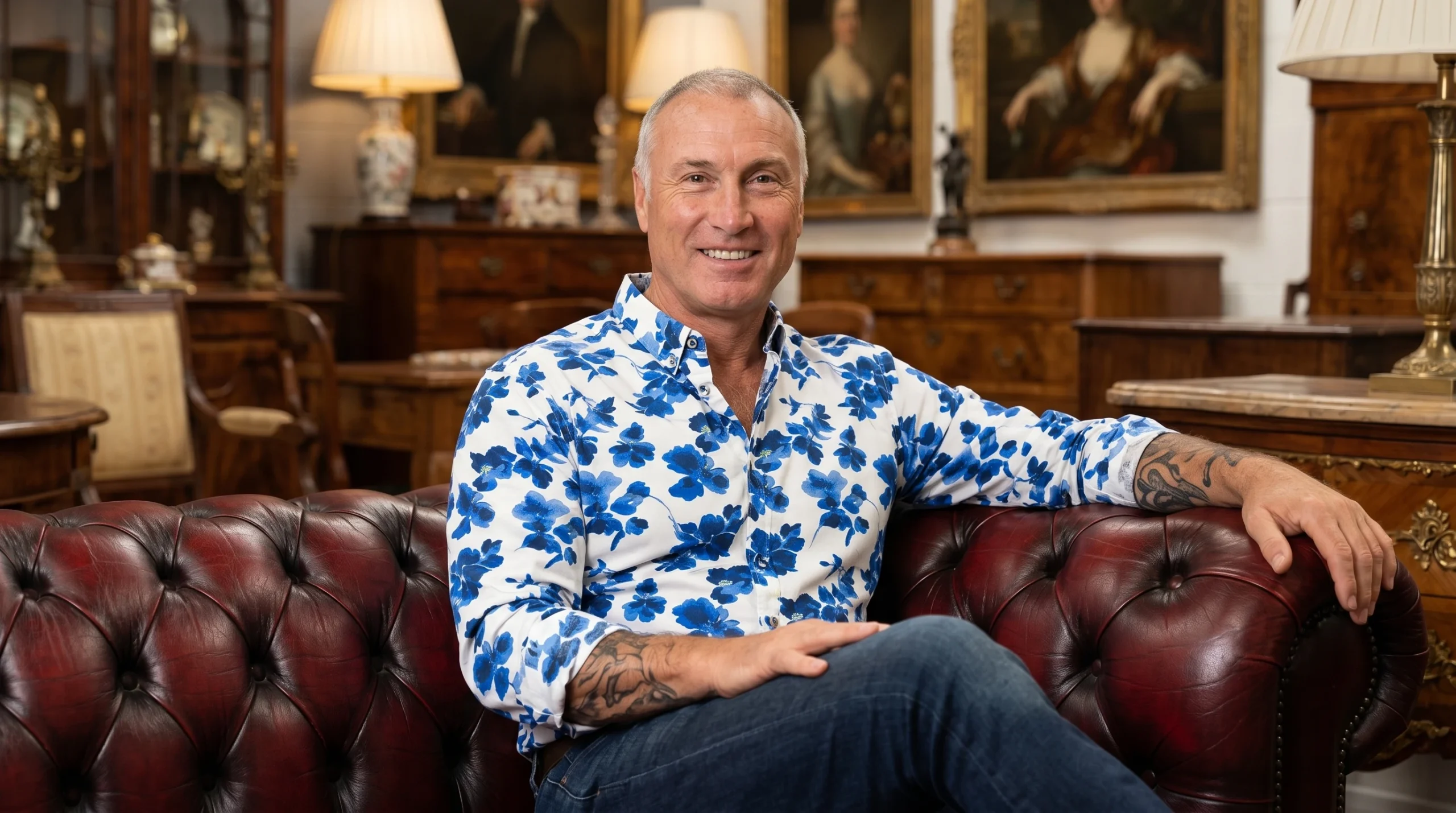
Ian Humphries is the kind of antiques dealer viewers remember before they can always place his name. On British television, where the antiques trade is still often imagined through tweed jackets, auction-room manners, and polished tradition, Humphries arrives with visible tattoos, a dealer’s confidence, and a taste for objects that carry character. That contrast has made him one of the more distinctive faces connected with BBC antiques programming, especially for viewers who know him from The Bidding Room.
The phrase “Ian Humphries tattoos” says a lot about why people search for him. They are not only asking what designs he has or what they mean. They are trying to understand the man behind a look that feels unusual in a field often associated with old houses, inherited furniture, and quiet expertise.
Humphries’s tattoos are part of his public image, but they are not the whole story. He is also a long-working antiques dealer, a business owner, a television personality, and a man whose private life is less publicly documented than many search results suggest. The most honest biography has to hold those facts together: the tattoos made him visually memorable, but his career rests on years of buying, selling, judging, and living with old things.
Who Is Ian Humphries?
Ian Humphries is a British antiques dealer best known to many viewers as a dealer on BBC One’s The Bidding Room. His public profile is tied to Manormonkeys Antiques, a business associated with antiques, vintage furniture, decorative pieces, and unusual stock. He has also been linked with other antiques and salvage television formats, which helped bring his trade knowledge to a wider audience.
Unlike celebrities who become famous first and then build a lifestyle brand around antiques, Humphries appears to have come from the trade itself. His reputation is built around years of dealing, not simply television visibility. That distinction matters because antiques television depends on personalities who can entertain, but the market still rewards people who know how to buy well.
For viewers, his appeal is easy to understand. Humphries looks distinctive, speaks with the relaxed authority of someone used to handling stock, and doesn’t seem trapped by the old image of what an antiques expert should look like. His tattoos give him instant recognition, but his credibility comes from the practical world of furniture, salvage, decorative antiques, and market judgment.
Early Life and Background
Detailed public information about Ian Humphries’s early life is limited. Unlike actors, politicians, or major public figures, antiques dealers often become known through their work rather than through heavily documented childhood biographies. Publicly available profiles tend to focus on his trade, television appearances, and business identity, not his parents, schools, or childhood home.
That lack of detail should not be filled with guesswork. Many online pages attempt to give exact claims about his age, family, or personal life without showing strong evidence. A careful biography should say plainly that his early years, family background, and education are not widely confirmed in reliable public sources.
What can be said is that Humphries’s adult identity is strongly tied to the antiques trade. His career suggests a long-running interest in objects with age, craft, and visual force. Whether that interest began through family, local markets, early work, or private collecting has not been publicly explained in enough detail to treat as settled fact.
Finding a Life in Antiques
Humphries’s career makes most sense when seen through the daily realities of dealing. An antiques dealer does not simply admire old objects; a dealer has to read condition, fashion, demand, price, restoration costs, transport, and resale value. The work is part scholarship, part instinct, and part hard commercial discipline.
His business identity has been associated with Manormonkeys Antiques, a name that itself feels less formal than the traditional antiques shop label. That suits Humphries’s public style. He is not selling the fantasy of hushed rooms and inherited wealth as much as the pleasure of finding pieces with personality.
The stock associated with his business has included furniture, decorative items, vintage pieces, architectural antiques, and objects with strong visual appeal. That range fits the world he occupies on television. He is not presented as a narrow specialist locked into one period or one category, but as a dealer comfortable moving across styles and price points.
The Breakthrough Through Television
Television gave Humphries a wider public face, especially through The Bidding Room. The BBC format brings sellers into a room of dealers who compete to buy antiques and collectables. It depends on expertise, but also on personality, timing, and the small drama of negotiation.
Humphries fits that format because he is both visually memorable and commercially believable. He does not need to overperform to stand out. The tattoos, the direct manner, and the dealer’s eye do much of that work before a bidding round even begins.
For many viewers, The Bidding Room was the first time they connected his name with his look. In a room filled with dealers, Humphries became easy to identify. That kind of recognition is valuable on television, but it can also narrow public curiosity to one feature, which is why searches for his tattoos often outpace more serious searches about his career.
Ian Humphries Tattoos and Public Image
Ian Humphries’s tattoos are a confirmed part of his public image, but the full meaning of each design is not fully documented in the public record. Some online profiles describe specific designs and claim details about his first tattoo, but many of those claims are repeated without clear sourcing. The safest and most respectful approach is to say that he is publicly known for visible tattoos without pretending to know every private story behind them.
The tattoos matter because they change how viewers read him. In a profession still shaped by class signals and old-fashioned ideas of taste, visible body art can feel like a quiet challenge to expectation. Humphries appears comfortable carrying both identities at once: the tattooed individual and the experienced antiques dealer.
That combination is part of why he draws attention. His tattoos do not look like a gimmick pasted onto a television role. They feel like part of a long-held personal style that happens to sit well beside a career built around objects with marks, scars, history, and character.
What Do Ian Humphries’ Tattoos Mean?
The honest answer is that the full personal meaning of Ian Humphries’s tattoos has not been clearly established in widely available, reliable sources. Tattoos can be memorials, aesthetic choices, travel memories, artistic commitments, or simply designs that appealed at a certain time in life. Without direct confirmation from Humphries, it would be wrong to assign emotional meaning to each one.
That said, viewers naturally read tattoos as signals. On Humphries, they suggest individuality, confidence, and comfort with strong visual expression. Those qualities also match the kind of antiques world he seems to occupy: less stiff, more character-driven, and open to the beauty of wear and age.
There is a useful parallel between tattoos and antiques. Both are about marks that stay. A tattoo records a choice on the body, while an antique records years of handling, repair, fashion, ownership, and survival.
Why His Look Works in the Antiques World
Humphries’s appearance works because antiques are not really about perfection. The best old objects often carry dents, fading, repairs, uneven surfaces, and signs of use. A dealer who values those qualities can understand why personal marks on the body might also become part of a person’s story.
The antiques trade has always had room for characters, even if television sometimes presents it as genteel. Dealers need confidence, patience, and a tolerance for risk. They also need a strong sense of what will catch another person’s eye.
Humphries’s tattoos support that image rather than distracting from it. They suggest someone who is not afraid of visual commitment. For a dealer, that can be an asset, because buying antiques often means trusting an instinct before the wider market catches up.
Manormonkeys Antiques and Business Life
Manormonkeys Antiques is central to Humphries’s public career. The business name appears across his public identity and is associated with antiques, vintage furniture, decorative stock, and unusual pieces. It gives viewers a link between the television dealer and the working trade behind the screen.
Running an antiques business is different from appearing on a television panel. The day-to-day work involves sourcing stock, assessing damage, arranging transport, pricing correctly, handling buyers, and knowing when to walk away from a piece. It also involves judging whether an item has enough appeal to justify the money and space it will take up.
Humphries’s public business image suggests a dealer who likes objects with presence. That can include furniture, decorative pieces, salvage, and items that help a room feel less anonymous. His tattoos, in that context, are not a separate brand flourish; they fit a broader attraction to character and visual confidence.
Money, Income Sources, and Net Worth
There is no credible public figure for Ian Humphries’s net worth. Some biography sites offer estimates, but those numbers should be treated with caution because they are usually not backed by financial records, tax filings, verified interviews, or detailed business data. For a dealer whose income can come from stock sales, television appearances, private clients, events, and business activity, outside estimates are especially unreliable.
His income sources are easier to discuss in general terms. Humphries likely earns through antiques dealing, resale, business operations connected with Manormonkeys Antiques, and paid television or media work. He may also earn from appearances, talks, or related professional opportunities, but specific fees are not publicly confirmed.
Antiques businesses can look wealthier or less successful from the outside than they really are. Stock may be valuable but slow to sell, and turnover does not equal profit. For that reason, any exact net worth claim about Humphries should be labeled as an estimate unless he or a verified financial source confirms it.
Marriage, Family, and Private Life
Ian Humphries keeps much of his private life away from broad public view. Searches often ask about his wife, partner, children, and family, but reliable public information on those details is limited. That privacy deserves respect, especially because his fame is tied to professional expertise rather than a life lived in tabloid coverage.
Some websites make claims about his relationship status, but they do not always provide dependable sourcing. A responsible profile should not turn those claims into fact. Unless a relationship, marriage, or family detail has been publicly confirmed by Humphries or a reliable outlet, it is better to describe it as unverified.
That privacy also tells us something about his public identity. Humphries seems to occupy the space of a working television expert rather than a celebrity who offers every part of his life for attention. His tattoos may invite curiosity, but they do not entitle the public to the rest of his personal world.
The Appeal of a Different Kind of Expert
Humphries’s public appeal comes from the way he complicates a familiar type. The antiques expert is often imagined as older, formal, and slightly removed from ordinary life. Humphries offers a version that feels more relaxed, more visual, and less bound by inherited rules of presentation.
That matters because antiques television has changed the way people enter the trade. Many viewers now come through decorating, salvage, vintage markets, social media, or sustainability rather than through formal collecting. They may be interested in old objects without wanting the social codes that once surrounded them.
Humphries gives those viewers a bridge. He looks like someone who could value a Victorian chair, a painted cupboard, a salvaged sign, or an odd decorative piece without making the buyer feel foolish for asking questions. That warmth is part of what makes him effective on screen.
Public Records and Career Caution
Public records connected to business activity can sometimes appear in searches for Humphries, including company filings under his name. Such records can be useful, but they should be handled carefully. A filing can confirm a company’s legal status, but it does not automatically explain the full story of a person’s career, finances, or current work.
This matters because search users often jump from one official-looking fact to a broader conclusion. A dissolved company, for example, does not necessarily mean a person left a trade or stopped operating in related ways. Business structures change, and antiques dealers often work through different channels over time.
The same caution applies to television credits. Appearing on a show confirms a public role, but it does not tell the full shape of a dealer’s business. Humphries’s story sits between those two worlds: the public one viewers can see and the working one that happens away from the camera.
Why Search Interest Centers on Tattoos
Search interest around “Ian Humphries tattoos” is partly about recognition. Viewers see him on television, notice the ink, and want a quick answer. They may remember the tattoos before they remember the business name or the exact programme.
The query also reflects a larger curiosity about identity. People want to know whether the tattoos connect to his work, whether they tell a personal story, or whether they are simply part of his style. In a visual medium, those questions are natural.
But here’s the thing. The most interesting answer is not a list of designs pulled from weak sources. It is the fact that Humphries’s tattoos have become part of how audiences understand authority, individuality, and taste in a trade still shaped by old expectations.
Common Misunderstandings About Ian Humphries
One misunderstanding is that the tattoos are the main reason Humphries is on television. They may make him memorable, but they do not replace expertise. Antiques programmes need dealers who can assess objects, make offers, and create credible tension in the room.
Another misunderstanding is that a tattooed dealer must specialize only in edgy or unusual stock. Personal style does not create a fixed buying category. A dealer can have bold tattoos and still appreciate traditional furniture, period craftsmanship, and quiet decorative pieces.
The third misunderstanding is that all biography details online are equally reliable. Humphries has enough public visibility to attract repeated profile pages, but not enough major interview material to confirm every claim. That gap is where rumor, guesswork, and copied information tend to grow.
Where Ian Humphries Is Now
Ian Humphries remains best known publicly as an antiques dealer and television personality associated with The Bidding Room and Manormonkeys Antiques. His current public image is still built around the same combination that made him recognizable: trade experience, distinctive style, and a clear eye for characterful objects. For viewers, he represents a less predictable version of the antiques expert.
His work sits within a trade that has become more open to different buyers and sellers. Online shops, auction platforms, Instagram interiors, salvage culture, and vintage furniture markets have brought new energy into antiques. Humphries’s image fits that shift because he does not make the trade feel closed or overly precious.
The tattoos remain part of the fascination, but they are best understood as one visible clue rather than the whole biography. They tell viewers that Humphries is comfortable being seen on his own terms. His career tells them that style only matters when it is backed by knowledge, judgment, and years in the trade.
Frequently Asked Questions
Does Ian Humphries have tattoos?
Yes, Ian Humphries is publicly known for having visible tattoos. They are one of the features that make him easy for viewers to recognize on antiques television. His tattoos have become part of his public image, especially among people who know him from The Bidding Room.
What do Ian Humphries’ tattoos mean?
The full meaning of Ian Humphries’s tattoos has not been clearly explained in reliable public sources. Some online profiles describe possible designs and stories, but many do not show strong sourcing. The most accurate answer is that the tattoos appear to be a personal part of his style, while their private meaning remains largely his own.
Is Ian Humphries from The Bidding Room?
Yes, Ian Humphries is widely known as one of the dealers associated with BBC One’s The Bidding Room. The programme introduced him to many viewers who may not have known his antiques business before seeing him on television. His direct manner and distinctive appearance helped him stand out among the dealers.
What is Manormonkeys Antiques?
Manormonkeys Antiques is the business name most closely associated with Ian Humphries’s antiques work. It is linked with antiques, vintage furniture, decorative pieces, and unusual objects. The name has become part of his public identity as both a working dealer and a television figure.
Is Ian Humphries married?
Ian Humphries’s marriage or relationship status is not clearly confirmed in reliable public sources. Some online pages make claims about his private life, but those claims should be treated carefully unless they come from Humphries himself or a dependable publication. His public reputation is based mainly on his antiques work rather than his personal relationships.
What is Ian Humphries’s net worth?
There is no verified public net worth figure for Ian Humphries. Any number found online should be treated as an estimate unless it is backed by clear financial evidence or direct confirmation. His likely income sources include antiques dealing, business activity, television work, and related appearances.
Why do people search for Ian Humphries tattoos?
People search for Ian Humphries’s tattoos because they are one of his most visible and memorable traits. In the traditional world of antiques television, his tattooed look stands out. The interest is also about what his style says about changing ideas of expertise, taste, and personality in the antiques trade.
Conclusion
Ian Humphries is more than the tattooed antiques dealer viewers remember from television. He is a working figure in a trade built on patience, judgment, risk, and the ability to see value where others may see only age. His tattoos make him memorable, but his career gives that image weight.
The fascination with his tattoos is understandable because they sit at the point where personal style meets public authority. They challenge an older idea of what an antiques expert should look like without turning that challenge into a performance. Humphries simply appears as himself, and that is part of the appeal.
What remains private should stay private unless he chooses to explain it. The visible tattoos, the business identity, and the television work are enough to understand why he stands out. In a field devoted to objects with stories, Ian Humphries has become a reminder that people carry their own histories just as visibly.