
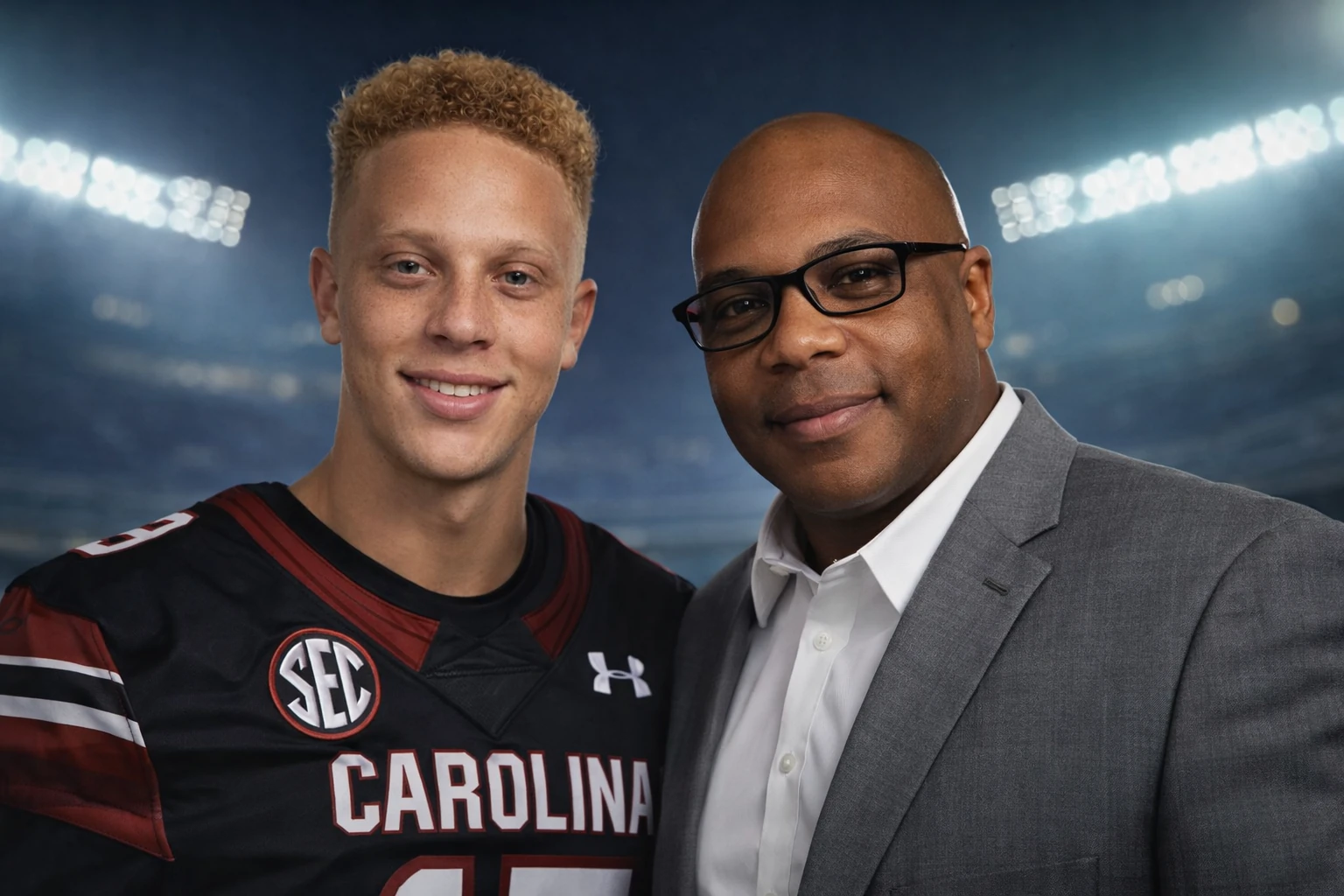
Long before his son ever threw a pass in a sold-out college stadium or took snaps under NFL lights, Mike Rattler was already watching closely. He noticed small things first—the way a toddler gripped a Nerf football, the instinct to throw instead of run, the unusual calm under attention. Those early observations would become part of a family story that eventually reached national television, college football headlines, and the professional ranks. Yet Mike himself never became a public figure in the traditional sense. He remains, even now, a quiet presence whose influence is easier to trace than to fully document.
Mike Rattler is best known as the father of Spencer Rattler, the former five-star quarterback who played at the University of Oklahoma and the University of South Carolina before entering the NFL. But reducing him to that role alone misses the broader reality. He has been a hands-on sports parent, a youth coach, a steady family anchor, and, at key moments, a protective voice when his son’s reputation drifted into public scrutiny. His story sits in the space between visibility and privacy—a place many sports parents occupy, but few are examined closely enough to understand.
Early Life and Background
Unlike his son, whose athletic journey has been tracked in detail since high school, Mike Rattler’s early life is not extensively documented in public records. What is known comes mostly through references in family-related materials and occasional mentions in sports reporting tied to Spencer’s career. His full name is generally identified as Michael Rattler, and he is married to Susan Rattler. Together, they raised their children in Arizona, where Spencer grew into one of the most closely watched high school quarterbacks in the country.
There is no widely confirmed, primary-source-backed record of Mike Rattler’s childhood, education, or early professional life. Some online profiles attempt to fill in these gaps, often repeating claims about his career or academic background, but many of those details lack clear sourcing. The truth is more restrained. What can be said with confidence is that by the time his children were growing up, Mike was deeply involved in youth sports and family life, especially in the Phoenix area.
That absence of a fully mapped biography is not unusual for someone outside public office or entertainment. It does, however, shape how his story is told. Rather than a linear account of personal milestones, Mike Rattler’s biography is built through moments—coaching sessions, sidelines, decisions made during his son’s career—that reveal character through action.
Family Life and Parenting Approach
Mike Rattler’s most consistent public identity is that of a father who took an active role in shaping his children’s athletic development. Reports from Arizona-based sports outlets describe him as a regular presence in local youth leagues, often coaching or organizing teams. He encouraged his children to participate in multiple sports rather than specializing too early, a philosophy that has become more widely discussed in youth athletics over the past two decades.
Spencer Rattler’s development reflects that approach. Before becoming a quarterback prospect, he played soccer, baseball, and basketball, building coordination and competitive instincts across different environments. Mike’s influence appears in how those experiences were framed—not just as recreation, but as preparation. He reportedly emphasized discipline, repetition, and accountability, values that carried into Spencer’s high school and college years.
At home, the family dynamic extended beyond football. Spencer’s sister, Olivia Rattler, went on to compete in collegiate beach volleyball at Missouri State University, where she achieved success in her own right. Her official college bio identifies Mike and Susan as her parents, reinforcing the picture of a household where sports were part of daily life but not limited to one child or one path.
The broader portrait is of a structured but supportive environment. Mike was not an absent observer, nor was he described as overly controlling in credible reporting. Instead, he appears as a parent who believed in preparation, competition, and staying involved—principles that often define families navigating high-level youth sports.
Recognizing Spencer’s Talent Early
One of the most frequently cited anecdotes about Mike Rattler involves his early recognition of Spencer’s throwing ability. According to interviews and feature stories, Mike noticed unusual arm strength and control when Spencer was still very young, even before organized sports became a central part of his life. These stories, while sometimes repeated in simplified form, align with the broader timeline of Spencer’s rapid rise through youth football.
By middle school and early high school, Spencer was already attracting attention from scouts and recruiters. He would go on to become the starting quarterback at Pinnacle High School in Phoenix, where he set Arizona state records for passing yards and touchdowns. Mike’s role during this period was less about public commentary and more about behind-the-scenes guidance—helping manage expectations, supporting training routines, and navigating the increasing attention from college programs.
That period also introduced the family to a new level of visibility. Recruiting rankings, highlight videos, and media coverage began shaping Spencer’s public image. For Mike, this meant adapting from local coach-parent to someone operating within a national sports conversation, even if he did not actively seek that spotlight.
The QB1 Era and Public Perception
Spencer Rattler’s appearance on the Netflix series QB1: Beyond the Lights marked a turning point in how the public perceived the family. The show followed top high school quarterbacks and presented a mix of athletic achievement and personal drama. For Spencer, it brought both recognition and criticism, as viewers formed opinions based on edited scenes and limited context.
Mike Rattler did not emerge from the series as a central character, but his influence lingered in the background. The confidence Spencer displayed on screen—often interpreted as arrogance by critics—was consistent with the mindset described by those who knew him. That mindset, shaped in part by his upbringing, reflected a belief in self-assurance and competitive intensity.
The truth is, reality television rarely captures the full picture. Coaches and teammates who later worked with Spencer often described him differently than the show suggested. For Mike, this period likely reinforced the challenge of raising a young athlete under public scrutiny. It also highlighted a tension that would follow Spencer into college: the gap between perception and reality.
Oklahoma, Setbacks, and Family Resilience
Spencer Rattler began his college career at the University of Oklahoma, where he entered as one of the most highly regarded quarterback prospects in the country. He became the starting quarterback and showed flashes of the talent that had made him a top recruit. But college football is rarely predictable, and the 2021 season brought a major setback when Spencer was benched in favor of Caleb Williams.
This moment stands as one of the most defining episodes in Spencer’s career—and, by extension, in Mike Rattler’s story as a parent. Reports from ESPN indicate that Mike initially wanted his son to leave Oklahoma immediately after the benching. Spencer, however, chose to remain with the team for the rest of the season before entering the transfer portal.
At the same time, the family was dealing with a serious personal challenge. Susan Rattler was undergoing treatment for cancer, adding emotional weight to an already difficult period. Spencer later spoke about how that experience reshaped his understanding of adversity. For Mike, it meant balancing support for his son’s football decisions with concern for his wife’s health.
These overlapping pressures reveal a side of Mike Rattler that is rarely captured in simple profiles. He was not just reacting to a sports storyline; he was navigating a family crisis while his son’s career unfolded in public.
The Transfer Process and Public Response
After leaving Oklahoma, Spencer Rattler entered the transfer portal, drawing interest from multiple programs. During this period, Mike Rattler briefly stepped into the public conversation to address rumors surrounding potential destinations. One widely reported instance involved claims that Arizona State had declined to pursue Spencer due to financial demands related to name, image, and likeness opportunities.
Mike responded by disputing that narrative, stating that the situation had been misrepresented and that the family had made its own decisions based on changing circumstances. His comments were not part of a broader media strategy; they were targeted responses aimed at correcting specific claims.
This moment offers insight into how Mike approaches public visibility. He does not appear frequently, but when he does, it is often to protect the accuracy of his son’s story. That selective engagement has kept him largely out of the spotlight while still allowing him to influence the narrative when necessary.
South Carolina and a Second Chapter
Spencer Rattler ultimately transferred to the University of South Carolina, where he rebuilt his reputation as a quarterback. His time there was marked by improved performance, leadership growth, and a renewed sense of direction. While Mike Rattler remained out of the public eye during this period, his earlier influence continued to shape how Spencer approached the game.
The transition to South Carolina represented more than a change of schools. It was an opportunity to reset a narrative that had become complicated by expectations and setbacks. Spencer’s development during these years suggested a maturation process, one that likely drew on the foundation built at home.
For Mike, this phase reinforced the long-term nature of his role. Parenting a high-level athlete is not about a single breakthrough moment; it is about guiding through highs and lows, often without recognition. His presence during this quieter chapter may not have generated headlines, but it remained essential.
Entry into the NFL
In April 2024, Spencer Rattler was selected by the New Orleans Saints in the fifth round of the NFL Draft. The selection marked the culmination of a journey that began in youth leagues and passed through both acclaim and adversity. It also brought renewed attention to the people who had supported him along the way.
Mike Rattler’s role at this stage is less visible but no less relevant. As Spencer transitions into professional football, the family dynamic shifts. The influence of parents becomes less direct, but the values instilled over years of development continue to matter. Discipline, resilience, and confidence—traits often linked to Mike’s approach—remain central to navigating the NFL.
The public record does not show Mike stepping into the professional spotlight. Instead, he appears to have maintained the same position he held throughout Spencer’s career: present, supportive, and largely private.
Career, Business, and Net Worth
One of the most searched aspects of Mike Rattler’s biography is his professional background and financial status. This is also the area where reliable information is most limited. Various online sources claim that he has worked in sales or business-related roles, but these details are often repeated without clear attribution or verification.
There is no widely confirmed public record of his exact occupation, income, or net worth. Any figures circulating online should be treated as estimates at best and unverified claims at worst. Unlike public figures in entertainment or sports, Mike Rattler has not disclosed financial information, nor has it been extensively reported by major outlets.
This lack of data is not unusual for private individuals. It does, however, highlight the importance of distinguishing between documented facts and speculative content. In Mike Rattler’s case, his influence is better understood through his actions and family role than through financial metrics.
Public Image and Media Presence
Mike Rattler’s public image is defined as much by absence as by presence. He is not active on major public platforms in a way that attracts media coverage, and he has not cultivated a personal brand separate from his family. This stands in contrast to some sports parents who become media figures in their own right.
What emerges instead is a consistent pattern of low-profile involvement. He attends games, supports his children, and occasionally speaks when necessary. This approach has allowed him to remain largely out of controversy while still playing an important role in Spencer’s career.
Media portrayals of Mike tend to reflect the moments when he intersects with larger stories. These portrayals are generally neutral or positive, focusing on his dedication as a parent rather than attributing broader narratives to him.
Where Mike Rattler Is Now
As of recent public information, Mike Rattler continues to live a private life while supporting his family. His son Spencer is pursuing an NFL career with the New Orleans Saints, and his daughter Olivia has completed a successful collegiate athletic career. The family’s public presence remains tied primarily to Spencer’s professional trajectory.
There are no confirmed reports of Mike seeking a more visible role in media or business. His current status reflects continuity rather than change. He remains a background figure in a story that continues to evolve on a larger stage.
Frequently Asked Questions
Who is Mike Rattler?
Mike Rattler, also known as Michael Rattler, is best known as the father of NFL quarterback Spencer Rattler. He has been involved in his son’s athletic development from an early age and has occasionally appeared in media coverage related to Spencer’s career. Beyond that role, he maintains a largely private life with limited publicly verified biographical details.
What does Mike Rattler do for a living?
There is no fully confirmed public record of Mike Rattler’s current occupation. Some online sources suggest he has worked in sales or business-related roles, but these claims are not consistently supported by primary reporting. As a result, his professional background should be considered partially undocumented in reliable public sources.
Is Mike Rattler married?
Yes, Mike Rattler is married to Susan Rattler. The couple has two children, Spencer and Olivia. Susan has been mentioned in public reporting, including coverage of her successful cancer treatment during Spencer’s college years.
How did Mike Rattler influence Spencer Rattler’s career?
Mike Rattler played a direct role in Spencer’s early athletic development by coaching youth teams and encouraging multi-sport participation. He emphasized discipline, confidence, and preparation, which became key aspects of Spencer’s playing style. His influence continued through high school and into college, particularly during moments of transition.
Did Mike Rattler speak publicly during Spencer’s transfer?
Yes, Mike Rattler publicly addressed rumors during Spencer’s transfer from Oklahoma. He disputed claims related to Arizona State’s recruitment decisions, offering his version of events to correct what he saw as inaccurate reporting. This remains one of his few direct appearances in the media.
What is Mike Rattler’s net worth?
There is no verified public information about Mike Rattler’s net worth. Any figures available online are speculative and not supported by reliable sources. As a private individual, he has not disclosed financial details, and they have not been widely reported.
Conclusion
Mike Rattler’s story is not one of public ambition or personal spotlight. It is a quieter narrative, built on years of involvement in youth sports, steady parenting, and a willingness to step in when his family needed support. His influence is most visible through the career of his son, but it extends beyond any single achievement.
The truth is, many of the qualities associated with Spencer Rattler—confidence, resilience, and competitiveness—did not appear by accident. They were shaped over time, in part by a father who believed in preparation and stayed engaged through every stage of development. That influence does not require headlines to be meaningful.
What remains is a portrait of a man who chose to stay in the background while playing a central role in a very public journey. Mike Rattler may never be a widely recognized name on his own, but his impact is written into the story of a quarterback who continues to evolve. For readers looking to understand that story fully, his presence is impossible to ignore, even if it is rarely front and center.
In a world that often rewards visibility, Mike Rattler stands as a reminder that influence can exist without it. His biography is not defined by personal accolades or public milestones, but by the steady, often unseen work of guiding a family through the pressures of modern sports. That kind of legacy is harder to measure, but no less real.