
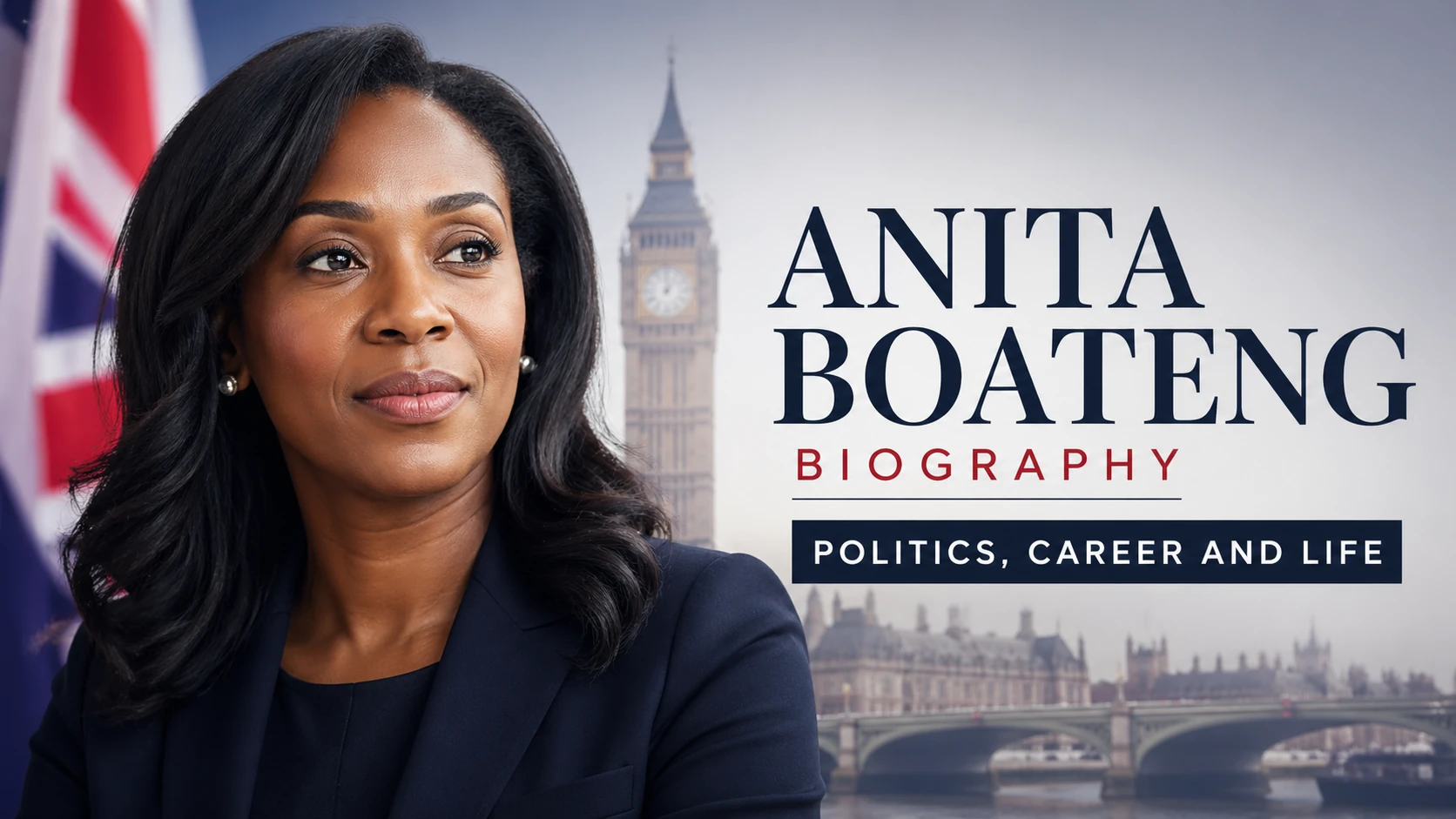
Anita Boateng has built a public life in the places where politics is made, explained, defended, and contested. She has worked behind the scenes in government, helped produce one of Britain’s best-known political television programmes, served as a Conservative councillor, stood for Parliament, and become a senior figure in strategic communications. Her name is familiar to Westminster watchers, public affairs professionals, political journalists, and viewers who have seen her analyse the day’s arguments on television. For many others, the question is simpler: who is Anita Boateng, and why does her career matter?
The answer is not found in one job title. Boateng is a British political strategist, communications adviser, commentator, former government special adviser, and former local councillor whose career sits across media, Whitehall, party politics, and public affairs. She is also part of a visible generation of British-Ghanaian professionals who have entered national political life without following a single traditional route. Her story is about ambition, identity, discipline, and the quiet authority that comes from understanding how institutions work from the inside.
Early Life and Family Background
Anita Boateng is widely described as British-Ghanaian, and public profiles have connected her early life with Hackney in east London. Accounts of her upbringing have described a working-class family background, with parents who worked hard in ordinary jobs and placed a strong value on education, discipline, and opportunity. Some biographical profiles say she later moved with her family to Redbridge, an area that would become part of her own political story years later. These details help explain the strong connection between her public career and questions of representation, social mobility, and belonging.
Like many public figures who work in politics rather than entertainment, Boateng has kept much of her private family life out of the public record. Her parents’ full names, her detailed childhood household, and the private rhythms of her family life are not widely confirmed in reliable public sources. That privacy should be treated with care, because the absence of detail is not an invitation to invent it. What can be said is that her background has often been framed around a family story of aspiration and the experience of growing up as a Black British woman with Ghanaian roots.
Her Ghanaian heritage has become a meaningful part of how writers and community publications have discussed her career. She has appeared in profiles about British-Ghanaian participation in politics, especially as public life in Britain has become more visibly diverse. That context matters because Boateng’s career does not fit lazy assumptions about who enters Conservative politics or how Black British political identities are supposed to look. Her public life reflects both the possibilities and the pressures that come with being visible in spaces where people like her have not always been well represented.
Education and First Ambitions
Boateng studied Philosophy, Politics and Economics at the University of Oxford, one of the most famous academic routes into British public life. PPE has long been associated with politicians, advisers, civil servants, journalists, and policy professionals, but the degree itself does not explain her career. The more important point is that it placed her in a setting where political ideas, argument, and institutional ambition were part of daily life. For someone already drawn to public affairs, Oxford offered both intellectual training and a clear view of the networks that shape British politics.
Public profiles have suggested that Boateng once considered medicine before committing herself more fully to politics and public life. That detail, where reported, is revealing because it points to a person whose early ambitions were serious and service-oriented, even before they took a political form. Medicine and politics may look like very different paths, but both require stamina, judgment, and comfort with high-pressure decisions. In Boateng’s case, the turn toward politics appears to have led her toward institutions where communication and public trust mattered as much as policy knowledge.
After university, she is reported to have spent time in Ghana’s Parliament, gaining early exposure to another political system connected to her family heritage. That experience is often mentioned as part of her wider political formation, though her later public career unfolded mainly in Britain. Still, it helps explain why her identity is not just a footnote in her biography. It is part of the wider frame through which she has been understood by readers interested in African diaspora influence in British politics.
From Political Media to Westminster
One of Boateng’s most important early career steps was her work as a political producer on BBC Question Time. The programme is a British political institution, known for putting politicians, commentators, campaigners, and public figures in front of audiences ready to challenge them. Working behind the scenes on such a programme requires sharp editorial judgment and a strong sense of what will matter to viewers. It also demands an understanding of how political arguments sound once they leave party headquarters and meet the public.
That kind of work can be a powerful training ground for a future political adviser. A producer learns how to frame arguments, anticipate pressure points, judge personalities, and understand the emotional temperature of public debate. These are not abstract skills in Westminster; they are the everyday tools of modern political communication. Boateng’s time in media gave her a practical education in how politics is seen, heard, questioned, and sometimes rejected by ordinary voters.
Moving from political television into advisory work was a natural progression. The two worlds are different, but they constantly watch each other. Politicians need to understand the media, journalists need to understand politics, and advisers often serve as the bridge between policy intention and public presentation. Boateng’s later career suggests that she learned early how much political success depends not only on what is decided, but also on how that decision is explained.
Work as a Government Special Adviser
Boateng’s work as a government special adviser is one of the strongest markers of her influence. Special advisers, often called SpAds in Westminster, are political appointees who work inside government departments to support ministers. They are not neutral civil servants, but they operate within government and help ministers navigate the political side of policy, communication, parliamentary management, and public reaction. The job is demanding because it requires loyalty, discretion, speed, and the ability to read risk before it becomes a crisis.
Public professional profiles state that Boateng served three Cabinet ministers between 2016 and 2019. That period was one of the most unstable in recent British political history, shaped by the aftermath of the Brexit referendum, internal Conservative Party tensions, and intense pressure on Theresa May’s government. Advising ministers during that period would have required far more than message writing. It meant understanding policy disputes, media scrutiny, parliamentary arithmetic, and the mood of a country that had become sharply divided.
The ministers linked with her advisory work have included senior figures in areas such as the Cabinet Office, justice, and work and pensions. These were not quiet corners of government. The Cabinet Office sat close to the centre of power, justice carried constitutional and legal weight, and work and pensions touched millions of households directly. Working across those areas placed Boateng near some of the hardest questions government faces: how to make decisions, how to defend them, and how to keep political authority intact when trust is fragile.
Special advisers are often misunderstood by the public. They are sometimes reduced to the idea of “spin,” as if their job is only to sell decisions after they have been made. In reality, the best political advisers help ministers think through how a policy will land, who will object, where the weak points are, and what choices are politically possible. Boateng’s later move into public affairs makes sense in that light, because the same instincts are valuable to organizations trying to understand government from the outside.
Conservative Politics and Local Government
Boateng’s Conservative politics became more public through her work in Redbridge. In 2018, she was elected as a Conservative councillor for Bridge ward in the London Borough of Redbridge. Local government is not as glamorous as Westminster, but it is often more immediate. Councillors deal with the practical concerns that shape daily life: housing, waste collection, planning, roads, safety, schools, local budgets, and the steady stream of casework that residents bring to their representatives.
Winning a council seat gave Boateng a democratic mandate of her own. Until then, much of her political influence had come through media production and appointed advisory work. As a councillor, she became directly accountable to voters in a local area connected to her own background. That shift matters because public service feels different when people can stop you in the street, write to you about a personal problem, or judge you at the ballot box.
Her election also attracted attention because of what she represented within Conservative local politics. Profiles have described her as a Black, African, female Conservative councillor in Redbridge, a combination still uncommon enough to be remarked upon. That visibility can be double-edged. It can inspire others who have not seen themselves reflected in party politics, but it can also create pressure to stand for more than any one person reasonably can.
The 2024 Parliamentary Campaign in Bridgend
Boateng later stood for Parliament as the Conservative candidate for Bridgend in the 2024 UK general election. Bridgend, in South Wales, was a politically serious contest held during a national election that proved disastrous for the Conservative Party. Labour’s Chris Elmore won the seat, Reform UK placed second, and Boateng finished third as the Conservative candidate. The result reflected not only local dynamics, but also the wider collapse of Conservative support after 14 years in government.
Standing for Parliament is a major step for any political figure. It requires personal exposure, relentless campaigning, local engagement, and the willingness to carry a party label through public anger as well as support. For Boateng, the campaign moved her profile beyond Westminster and London into a Welsh constituency with its own priorities and political memory. It also placed her in the difficult position of campaigning for a governing party at the end of a long and unpopular period in office.
Although she did not win, the campaign remains an important part of her biography. It showed that she was willing to move from advising ministers and commenting on politics to asking voters for their trust directly. Not every adviser chooses that path, and not every commentator is willing to stand on a doorstep and defend a party record. The Bridgend campaign gave Boateng another form of experience, even in defeat.
Public Affairs and Strategic Communications
Boateng’s current professional standing is closely tied to her work in public affairs and strategic communications. She has held senior roles in the communications industry, including work connected with FTI Consulting and later Portland Communications. Portland lists her as a Managing Partner, a senior position that reflects her experience across government affairs, policy, reputation, and corporate communication. Her work focuses on helping organizations understand political risk and communicate under public pressure.
Public affairs is sometimes treated with suspicion because it sits close to power. Yet the field is broader than private lobbying or access to ministers. It includes policy analysis, stakeholder mapping, crisis preparation, regulatory advice, campaign planning, and the difficult task of telling clients when their preferred message will not survive contact with reality. Someone with Boateng’s background can read political problems from several directions at once: as a former producer, adviser, councillor, candidate, and commentator.
This career stage also reveals the commercial value of political knowledge. Organizations need people who can explain what government is likely to do, how public opinion is shifting, and how a decision might be received by regulators, journalists, campaigners, and customers. Boateng’s experience gives her credibility in that world because she has seen political pressure from the inside. That does not make her merely an insider; it makes her someone whose professional value depends on judgment formed across several demanding arenas.
Media Commentary and Public Voice
Boateng has also become known as a political commentator, appearing in broadcast discussions and public analysis of British politics. Her commentary draws on her experience in Conservative politics, government advising, communications, and media production. This gives her a perspective different from that of career journalists or elected politicians. She can speak about politics as someone who has been close to decision-making, but also understands how it is packaged for public debate.
Her public voice is measured rather than theatrical. In an era when political television often rewards outrage, that matters. Commentators with insider experience can be useful when they explain why a party made a certain choice, what a minister is trying to signal, or where a government’s argument may be weak. Boateng’s value as an analyst comes from that kind of practical fluency.
Television appearances have also made her more visible to casual viewers. A person may see her on a politics programme and search her name to understand whether she is a politician, journalist, adviser, or consultant. The answer, in her case, is that she has been close to all those worlds without fitting neatly into any single category. That complexity is one reason her biography attracts attention.
Marriage, Children, and Private Life
There is limited reliable public information about Anita Boateng’s marriage, children, or romantic relationships. Unlike entertainers or high-profile elected politicians whose personal lives are often reported in detail, Boateng has kept her private life largely separate from her professional profile. That is not unusual for people who work in political advisory and communications roles. Many such figures are public enough to be recognized, but private enough to keep family matters out of the press.
Because the public record is limited, claims about her husband, partner, or children should be treated cautiously unless confirmed by Boateng herself or a reliable source. Search engines often reward speculation, and many biography pages try to answer personal questions without evidence. A careful biography should not turn curiosity into false certainty. The most accurate statement is that her family and relationship status are not widely confirmed in the public record.
This privacy also tells us something about the kind of public figure she is. Boateng’s reputation has been built through work, not exposure. Her career has not depended on personal branding in the celebrity sense, even though she has appeared in media and public life. That distinction is important because it helps explain why some personal questions remain unanswered while her professional record is far better documented.
Money, Income Sources, and Net Worth
Anita Boateng’s net worth is not publicly verified. Some websites may publish estimates, but such figures usually lack clear evidence and should not be treated as fact. She has held senior roles in communications consulting and public affairs, and she has worked in government, media, commentary, and politics. Those roles point to a successful professional career, but they do not provide a reliable basis for calculating personal wealth.
Her income sources have likely included salaries from professional roles, consulting work, media appearances where paid, and public service allowances during elected office. The exact amounts are not fully public, and they may vary across time depending on employment, advisory work, and outside engagements. Senior communications roles in London can be well paid, especially at established firms, but a responsible profile should avoid guessing a private financial figure. Money is part of her career story only to the extent that it reflects the professional market for political expertise.
The better question is not what Boateng is worth in a speculative number, but why her skills are valuable. People who understand government, media, and public trust are in demand because organizations face political scrutiny more often than they once did. A policy change, a regulatory investigation, a social media backlash, or a ministerial announcement can affect reputations quickly. Boateng’s career has placed her in the professional category of people paid to understand those risks before they become public problems.
Public Image and Representation
Boateng’s public image is shaped by three overlapping identities: political strategist, Conservative woman, and British-Ghanaian public figure. Each matters, but none tells the whole story. She is often discussed in the context of diversity in British politics, especially because Black Conservative women remain relatively rare in high-profile political and public affairs roles. Yet reducing her to representation alone would flatten a career built through work, strategy, and institutional skill.
The Conservative Party has long faced questions about its relationship with ethnic minority voters, even as it has promoted a number of senior minority figures in recent decades. Boateng’s career sits inside that wider debate. Her presence challenges assumptions about Black political identity, but it also raises harder questions about what representation means inside parties with contested records on race, immigration, welfare, and social policy. She occupies that space not as an abstract symbol, but as a person with her own politics and professional record.
There is also a generational element to her career. Boateng belongs to a group of British political professionals whose influence is not confined to Parliament. They move between media, government, consulting, local politics, and commentary, shaping public life through several channels. That movement reflects how modern politics works. The person on screen may also have been the person in the ministerial office, the campaign room, the council chamber, and the client strategy meeting.
Controversies, Setbacks, and Public Scrutiny
Boateng has not been defined by a major personal scandal in the public record. The more significant setbacks in her public career are political rather than personal, especially her unsuccessful 2024 parliamentary campaign in Bridgend. Losing an election can be bruising, but it is also part of political life. Many serious public careers include defeats, and those defeats often become part of the experience that shapes later choices.
The larger scrutiny around her has tended to concern party identity, representation, and the role of political advisers. Conservative politics attracts strong views, particularly after years of austerity, Brexit conflict, leadership turmoil, and the party’s 2024 defeat. A Black British-Ghanaian Conservative woman will inevitably be read through those debates by some observers. That scrutiny can be unfair when it treats an individual as a stand-in for every decision made by a party or government.
That said, public figures who choose party politics cannot expect to be free from political challenge. Boateng has worked in senior Conservative settings and has stood as a Conservative candidate, so her public record is open to scrutiny like that of any political actor. The fair approach is to assess her work, roles, arguments, and decisions without resorting to personal speculation. That balance matters in writing about anyone whose public life sits between identity and ideology.
Where Anita Boateng Is Now
Anita Boateng is best understood today as a senior communications and public affairs professional with continuing influence in British political discussion. Her role at Portland places her in a field where former advisers and political specialists help clients understand government and reputation. She remains part of the wider Westminster conversation through commentary, public analysis, and her established Conservative background. Her 2024 parliamentary campaign also means she remains a figure to watch in future political cycles.
Whether she returns to elected politics is not something the public record can answer with certainty. Many people who stand unsuccessfully for Parliament later try again, while others return fully to professional life or take on party, advisory, or public roles outside the Commons. Boateng has the experience to move in several directions. That flexibility is one of the defining features of her career.
What seems clear is that her influence does not depend on a single office. She has already worked in places where decisions are prepared, defended, interpreted, and challenged. That kind of career can continue even without a parliamentary seat. In British public life, power often belongs not only to those who hold the microphone, but also to those who understand what should be said before it is switched on.
Frequently Asked Questions
Who is Anita Boateng?
Anita Boateng is a British political strategist, communications adviser, commentator, former government special adviser, former Conservative councillor, and former parliamentary candidate. She is widely associated with UK politics, public affairs, and media commentary. Her career has included work with BBC Question Time, senior government ministers, Redbridge Council, and major communications firms.
What is Anita Boateng’s background?
Boateng is widely described as British-Ghanaian and has been linked in public profiles with Hackney and Redbridge. She studied Philosophy, Politics and Economics at the University of Oxford, a degree often associated with British political and public life. Her early background is often framed around social mobility, education, and the experience of entering elite political spaces from a less traditional route.
Did Anita Boateng work in government?
Yes, Boateng worked as a government special adviser between 2016 and 2019, serving senior Cabinet ministers. Special advisers are political appointees who help ministers with strategy, communication, policy presentation, and political judgment. Her time in government came during the difficult post-Brexit referendum period, when the Conservative government faced major internal and national pressure.
Was Anita Boateng elected as a councillor?
Yes, Boateng was elected as a Conservative councillor for Bridge ward in the London Borough of Redbridge in 2018. That role gave her direct experience in local government and voter accountability. It also connected her public career to an area associated with her own background and family life.
Did Anita Boateng run for Parliament?
Yes, Boateng stood as the Conservative candidate for Bridgend in the 2024 UK general election. She did not win the seat, which was taken by Labour’s Chris Elmore during a national election that produced a major defeat for the Conservatives. Her candidacy remains an important part of her political profile because it showed her willingness to move from advising and commentary into direct electoral competition.
Is Anita Boateng married?
There is no widely confirmed reliable public information about Anita Boateng’s marital status, husband, partner, or children. She has kept her private life largely separate from her professional profile. Because of that, claims about her relationships should be treated carefully unless they come from a trusted and verifiable source.
What is Anita Boateng’s net worth?
Anita Boateng’s net worth is not publicly verified. Some websites may publish estimates, but those figures are not strongly supported by public financial records. Her income has likely come from senior communications roles, political work, consulting, media contributions, and public service, but no credible public source establishes a precise personal wealth figure.
Conclusion
Anita Boateng’s biography is not a story of sudden celebrity. It is the story of a political professional who learned how public life works from several angles and then built a career across them. She has been behind the camera, inside government, on the council ballot, in a parliamentary race, in consulting rooms, and on political panels. That range is the reason her name continues to draw interest.
Her career also says something broader about modern British politics. Influence now travels through media, advisory networks, local government, public affairs, and commentary as much as through Parliament itself. Boateng has worked across those spaces with a public identity that carries both professional authority and symbolic weight. She is part of a generation changing what political expertise looks and sounds like in Britain.
The most respectful way to understand her is to stay close to the facts. Her work is well documented, while much of her private life remains private. That boundary should be accepted, not filled with guesses. What remains is still a serious public story: a British-Ghanaian woman who entered powerful rooms, learned their rules, and made a career out of reading politics before it reaches the front page.