
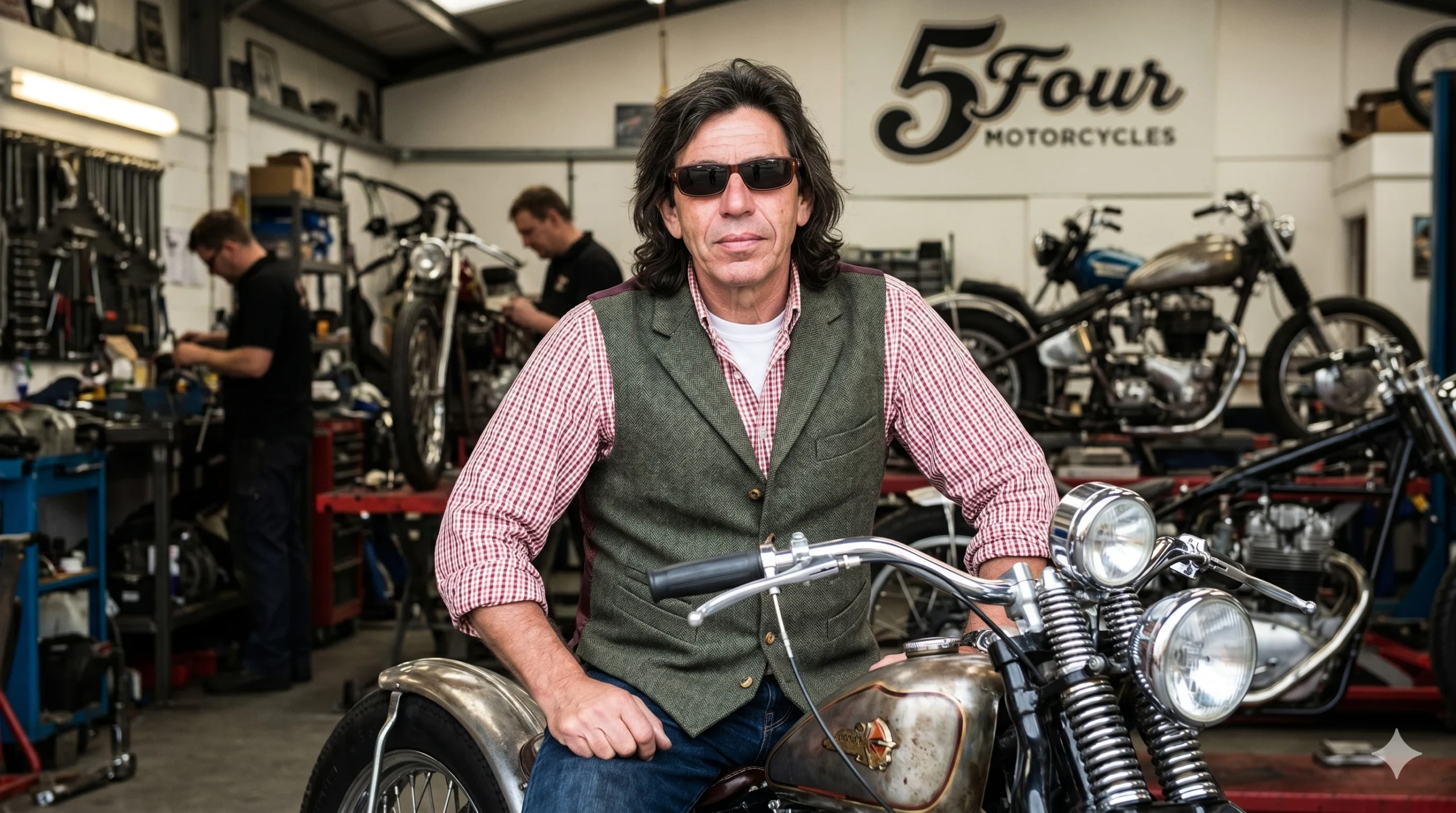
Guy Willison is the kind of motorcycle figure who became familiar without ever seeming hungry for fame. On television, he is often the calm, practical presence beside Henry Cole, the man who can look at an old machine and see both its flaws and its promise. Away from the camera, he is better known among enthusiasts as a designer, builder, and the creative force associated with 5Four Motorcycles. His appeal comes from that combination: craft, restraint, road sense, and a clear understanding of why riders become attached to machines.
To most viewers, Willison is Guy “Skid” Willison from The Motorbike Show and Shed and Buried. To many riders, he is the builder behind limited-edition motorcycles linked to Honda, Norton, and Henry Cole’s Gladstone projects. His public story is not a celebrity biography filled with red carpets and confessions. It is a working life built around motorcycles, television workshops, British engineering romance, and a reputation for making bikes feel more personal without making them silly.
Early Life and Background
Guy Willison’s private early life is not widely documented in reliable public sources. Public company records list his date of birth as October 1962, and he is known as a British motorcycle builder and designer. Beyond that, details about his childhood, parents, schooling, and hometown have not been clearly confirmed through major interviews or official biographies. That absence matters because many online profiles fill the space with claims that are difficult to verify.
What can be said with confidence is that Willison’s public identity is rooted in hands-on motorcycle culture rather than show-business polish. Honda’s own profile material has described him as having worked as a despatch rider, mechanic, and tuner before becoming widely known on television. That background helps explain his authority on screen, because he comes across as someone who learned motorcycles through use, repair, and problem-solving. His work has always carried the feel of a rider’s eye, not just a stylist’s eye.
The nickname “Skid” follows him through television listings and motorcycle media. It fits the world he belongs to, where nicknames often last longer than formal job titles. The public record confirms the nickname more readily than it explains its origin. Like much about Willison, it has become part of the workshop persona without being turned into a polished personal myth.
From Working Rider to Motorcycle Craftsman
Before Guy Willison was a recognizable television face, he belonged to the practical side of motorcycling. Despatch riding, mechanical work, and tuning all demand a different kind of knowledge from casual enthusiasm. They teach what breaks, what lasts, what feels right, and what becomes irritating after a few hours on the road. That practical foundation runs through the motorcycles later associated with him.
His design work rarely seems interested in shock value. Instead, it tends to clean up a bike’s lines, sharpen its stance, and make the whole machine feel more considered. That kind of judgment usually comes from long familiarity with real bikes, not just admiration for photographs of them. It is why his specials often feel purposeful rather than theatrical.
British custom motorcycle culture has always made room for builders who combine taste with mechanical discipline. Willison fits that tradition, but he also belongs to a more modern version of it. He has worked with television, manufacturers, and limited-run production rather than only one-off private commissions. That has made his work visible to a wider audience without stripping it of its workshop character.
Television Breakthrough with Henry Cole
Guy Willison became known to a broader public through his work with Henry Cole, one of Britain’s most familiar motorcycle presenters. Their partnership on programmes such as The Motorbike Show introduced Willison to viewers who might not follow specialist motorcycle builders. In that setting, he was not presented as a loud character or comic foil. He was there because he knew what he was looking at and could help turn ideas into running machines.
The Motorbike Show gave viewers a mix of road trips, restorations, history, and workshop projects. Willison’s role suited the programme’s tone because he brought practical credibility without slowing the story down. He could explain a mechanical decision in plain language, then get on with the job. For viewers, that made him trustworthy.
Shed and Buried extended that public image. The programme’s appeal lies in the search for neglected objects that might still have life in them, and Willison’s skill set fits that premise naturally. He can assess condition, potential, cost, and charm without pretending every rusty machine is a treasure. That kind of judgment is central to why audiences warmed to him.
Television also gave Willison’s later business work a stronger platform. Viewers had already seen him solve problems, talk through builds, and handle machinery with quiet confidence. When his name appeared on limited-edition motorcycles, it meant something beyond branding. It carried the accumulated trust of years spent in front of viewers as a working motorcycle man.
The Gladstone and Norton Years
Willison’s public career is closely tied to Henry Cole’s Gladstone motorcycle projects. Gladstone was built around classic British motorcycle feeling, hand-built appeal, and a sense of heritage. Willison is widely credited by his own 5Four biography as a driving force behind those machines. The projects helped establish the design values that later became clearer under the 5Four name.
The Norton Commando 961 Street brought his work into a more visible manufacturer-linked setting. The bike began as a custom vision associated with Henry Cole and Guy Willison, then became an official limited-edition Norton model. It was based on the modern Commando 961 platform but altered with a new tank, seat, tail unit, handlebars, and selected parts to give it a sharper street character. The result connected British motorcycle history with a more direct, muscular modern look.
That Norton project mattered because it showed Willison could shape a production motorcycle into something more individual without losing the identity of the original bike. Many custom builds either go too far or not far enough. The Commando 961 Street sat in a more interesting place, where the changes were visible and meaningful but still tied to a roadgoing machine. That balance would become central to his later collaborations.
The limited-run nature of the Norton also foreshadowed 5Four. Small numbers create intimacy, but they also put pressure on the builder’s judgment. Every choice matters more when buyers are paying for a numbered machine rather than a standard model. Willison’s later work would keep returning to that idea of scarcity with purpose.
Founding 5Four Motorcycles
5Four Motorcycles became the clearest public expression of Guy Willison’s identity as a builder. The company was formed in 2018 and presented itself as a maker of individually numbered, hand-built, limited-edition motorcycles. Its own language, “for the few, not the many,” neatly captures the point. These were not meant to be ordinary showroom bikes with a sticker pack.
The 5Four idea works because it sits between two worlds. On one side is the reliability and engineering base of a major manufacturer’s motorcycle. On the other is the personality of a custom machine shaped by a known builder. That middle ground is attractive to riders who want something rare but do not want the headaches that can come with a fully bespoke build.
Willison’s name gives 5Four its center of gravity. The company is not just selling paint, parts, or scarcity. It is selling a point of view about what a motorcycle should look like and how it should feel. The best 5Four bikes have the sense that someone has gone back over a production model with a sharper eye and a rider’s instincts.
The business also shows how modern motorcycle culture has changed. Enthusiasts still care about engines, frames, brakes, and suspension, but they also care about story and identity. A limited-edition motorcycle linked to a recognizable builder answers that desire. It gives the owner a machine with a human signature attached.
The Honda CB1100 RS 5Four
The Honda CB1100 RS 5Four was one of the defining projects in Willison’s public career. Based on Honda’s air-cooled CB1100 RS, it drew on the deep emotional pull of Honda’s classic four-cylinder road bikes. The model already had a strong retro character, which made it a natural canvas for Willison’s style. His task was not to disguise the Honda but to draw out a more focused and collectable version of it.
The CB1100 RS 5Four was produced as a limited-edition collaboration with Honda UK. Reports around the launch placed the run at 54 bikes, a number that echoed the 5Four name and helped build a sense of club-like ownership. The motorcycle used the standard Honda as its foundation but added special bodywork, paint, detailing, and finish. It was aimed at riders who wanted Honda dependability with a more personal, hand-finished character.
What made the project effective was its restraint. The CB1100 did not need to be shouted over, because its appeal was already rooted in memory, proportion, and mechanical honesty. Willison’s work gave it a more exclusive presence while respecting the base bike’s identity. That is harder than a dramatic rebuild, because small changes have to be judged with great care.
The CB1100 RS 5Four also strengthened the link between Willison and Honda. It showed that a large manufacturer could work with a British builder in a way that felt credible to enthusiasts. The result was not a concept bike meant only for display. It was a limited motorcycle that real buyers could own, ride, and keep.
The Honda CB1000R 5Four
After the CB1100 RS, Willison and 5Four turned to the Honda CB1000R. This was a different kind of donor bike, more modern in tone and more aggressive in performance. The shift was important because it showed 5Four was not limited to retro machines. Willison could apply his eye to a contemporary naked motorcycle as well as a heritage-style roadster.
The CB1000R 5Four kept the production bike’s strong mechanical base while changing its visual and tactile character. The project focused on stance, finish, detailing, and rider appeal. It treated the Honda as a serious modern motorcycle rather than a nostalgic object. That gave the finished machine a different energy from the CB1100 RS 5Four.
Practicality remained part of the thinking. One of the telling details around the CB1000R 5Four was that it could retain real-world usability, including the option to return to pillion-friendly seating. That may sound minor, but it says a great deal about Willison’s approach. He is not simply designing motorcycles to be admired under lights; he is thinking about how owners actually live with them.
The CB1000R project also showed how a limited-edition motorcycle can add personality to a current platform. Manufacturers often struggle to make special editions feel genuinely special. Willison’s contribution was the sense of hand and judgment that a normal factory variant can lack. For riders, that is the difference between a trim package and a bike with a story.
The CB1000 Hornet SP 5Four and Recent Work
More recently, the 5Four story continued with the Honda CB1000 Hornet SP 5Four, a project linked with Doble Motorcycles. The Hornet SP gave Willison another modern Honda platform to reinterpret. It was a strong donor bike because it offered performance, value, and a clear naked-bike identity. That made it well suited to the 5Four formula of limited numbers, sharper finish, and a more individual presence.
This project matters because it shows Willison’s work has not remained frozen in the style of the CB1100 era. He has continued to move with current motorcycles rather than only revisiting old shapes. The Hornet SP has a different personality from the CB1100 RS, but the design problem is similar. The challenge is to make a capable production machine feel rarer and more emotionally specific.
The reported price premium over the standard Honda also makes the 5Four proposition clear. Buyers are not simply paying for transport or performance figures. They are paying for a limited build, a distinctive specification, and the association with Willison’s design judgment. That does not suit every rider, but it speaks directly to collectors and enthusiasts who want something less common.
The current status of Guy Willison is best understood through this continuing work. He remains publicly connected to motorcycles, 5Four, and the specialist world that made him known. He has not turned himself into a celebrity brand detached from the workshop. The bikes remain the center of the story.
Design Style and Reputation
Guy Willison’s design style is defined by control. He tends to avoid excess, even when working on motorcycles that could easily be pushed into louder custom territory. His changes often focus on proportion, cleanliness, finish, and the relationship between rider and machine. The result is usually a motorcycle that feels edited rather than disguised.
That approach has earned him respect among riders who distrust superficial custom work. Enthusiasts can be unforgiving when a build looks good but rides badly, or when a special edition feels like marketing rather than craft. Willison’s reputation rests on avoiding those traps. His work suggests he understands that the motorcycle has to function first.
There is also a Britishness to his taste, though not in a narrow flag-waving sense. His bikes often carry an interest in restraint, mechanical honesty, and heritage without becoming museum pieces. Even his modern Honda projects have a certain discipline in the way they are finished. They do not try to look like every other custom on social media.
Publicly, Willison’s image is warm but guarded. Viewers know his manner, his nickname, and his work, but not every private detail of his life. That distance may be part of his appeal. He appears on television because he has something to do there, not because he seems eager to turn himself into the subject.
Marriage, Family, and Private Life
Guy Willison has kept his family life largely private. There is no widely verified public record confirming his current marital status, spouse, or children. Some online biography pages make claims about his relationships, but those claims are often thinly sourced or not sourced at all. A careful biography should not treat them as fact.
This does not mean there is some hidden scandal or mystery. It simply means Willison has not made his private family life a major part of his public identity. Many people who work in television-adjacent fields choose that boundary, especially when their fame comes from skill rather than personal exposure. In his case, the work is public and the family life appears to remain private.
That distinction is important for readers searching his name. Curiosity about a public figure is normal, but not every private detail is available or relevant. Willison’s career can be understood without speculation about his home life. The respectful answer is that reliable information about his marriage and children has not been publicly confirmed.
Health Rumors and Public Record
Search interest around Guy Willison sometimes includes questions about illness. As with his family life, there is no strong public basis for making firm claims about his health. Some websites repeat health-related speculation, but repetition is not evidence. Medical information requires a much higher standard than ordinary career reporting.
If Willison or his representatives were to speak publicly about a health issue, that would be different. In the absence of a direct statement or reliable reporting, the fairest approach is caution. It is not responsible to turn rumor into biography, especially when the subject is a living person. Readers deserve clarity, not recycled uncertainty dressed up as fact.
What the public record does show is continued association with motorcycle projects and the 5Four name. Recent 5Four-linked Honda work suggests that his professional identity remains active in the motorcycle world. That is the relevant public point. Anything more personal should be handled only if properly confirmed.
Business Interests and Net Worth
Guy Willison’s income likely comes from several connected areas: motorcycle design, limited-edition builds, television appearances, and brand collaborations. His most visible business interest is 5Four Motorcycles, which was formed in 2018 and is associated with limited-run hand-built motorcycles. He has also been linked to projects involving Honda, Norton, and Henry Cole’s motorcycle ventures. These activities suggest a specialized career with multiple revenue streams.
There is no verified public net worth figure for Guy Willison. Many online estimates should be treated with care because they do not show a method, source documents, or direct confirmation. A person can be well known in a specialist field without having the kind of wealth that celebrity-net-worth websites imply. For that reason, any precise claim about his fortune would be unreliable.
The better financial lens is the value of his work rather than a guessed personal number. Limited-edition 5Four motorcycles can sell at premiums above standard donor bikes because they carry hand-built features, scarcity, and association with a known builder. That does not automatically translate into a clear personal net worth. It does show that Willison has created a brand identity with commercial value among serious motorcycle enthusiasts.
Public Image and Cultural Influence
Guy Willison’s public image is built on credibility rather than spectacle. He does not project the personality of a presenter who happens to stand near machines. He seems more like a builder who became useful to television because the work itself was interesting. That difference has helped him hold the respect of motorcycle viewers.
His cultural influence is modest in mainstream celebrity terms but meaningful inside British motorcycle culture. He represents a type of craft figure who can move between workshop, screen, and manufacturer collaboration. That is not easy to do. Too much television can weaken a builder’s credibility, while too little public visibility can limit the audience for specialist work.
Willison has managed that balance by keeping the machines central. The Norton Commando 961 Street, Honda CB1100 RS 5Four, CB1000R 5Four, and CB1000 Hornet SP 5Four are the proof points. They give the public something concrete to judge. His reputation does not rest only on charm or nostalgia.
That is why his name continues to attract searches. People want to know the man from the programmes, but they also want to understand the bikes and the business behind him. The best answer is not a gossip profile or a dry company note. It is the story of a working motorcycle builder whose taste found a wider audience.
Where Guy Willison Is Now
Guy Willison remains best known today as the British motorcycle builder associated with 5Four Motorcycles and his television work with Henry Cole. His more recent public activity is tied to 5Four’s ongoing limited-edition motorcycle projects, including modern Honda-based builds. He continues to be discussed by riders, collectors, and viewers who follow British motorcycle television. His name remains strongest in that space rather than in general celebrity culture.
The public picture is of a specialist figure who has kept his focus. He has not become famous by constantly revealing himself. Instead, he has built recognition through repeated appearances, credible projects, and a steady design language. That gives his career a quieter durability.
For readers searching “guy willison,” the most useful current answer is this: he is active enough in the motorcycle world to remain relevant, but private enough that not every personal detail is confirmed. His career is clearer than his home life, and his machines tell the story better than rumor pages do. That is not a limitation; it is part of why his profile feels different from ordinary celebrity coverage.
Frequently Asked Questions
Who is Guy Willison?
Guy Willison is a British motorcycle builder, designer, and television personality. He is widely known as Guy “Skid” Willison through programmes such as The Motorbike Show and Shed and Buried. He is also closely associated with 5Four Motorcycles, a limited-edition motorcycle brand known for hand-built specials.
What is Guy Willison famous for?
He is famous for his work in motorcycle television and for designing or building limited-edition motorcycles. His best-known projects include work connected to Henry Cole, the Norton Commando 961 Street, and Honda-based 5Four motorcycles. His reputation comes from combining practical mechanical knowledge with a restrained design eye.
How old is Guy Willison?
Public company records list Guy Willison’s date of birth as October 1962. That means he was born in 1962 and is in his early sixties. The exact day of his birth is not widely confirmed in major public sources.
Is Guy Willison married?
Guy Willison has not made his marriage or family life a major part of his public profile. There is no widely verified public source confirming his current marital status, wife, or children. Claims about his private relationships should be treated carefully unless they come from reliable reporting or direct public confirmation.
What is 5Four Motorcycles?
5Four Motorcycles is the company associated with Guy Willison and limited-edition hand-built motorcycles. The brand is known for individually numbered bikes, often based on established production motorcycles. Its most visible projects include Honda-based specials such as the CB1100 RS 5Four and CB1000R 5Four.
What is Guy Willison’s net worth?
There is no verified public net worth figure for Guy Willison. Online estimates are not reliable unless they are supported by documents, direct disclosure, or serious financial reporting. His income is likely connected to motorcycle design, limited-edition builds, television work, and related collaborations.
Is Guy Willison still working with motorcycles?
Yes, his public identity remains tied to motorcycles and 5Four-related projects. Recent attention around Honda-based 5Four builds shows that his name still carries weight among enthusiasts. He remains best understood as a working motorcycle figure rather than a retired television personality.
Conclusion
Guy Willison’s story is not a conventional celebrity rise. It is the story of a skilled motorcycle man whose work became visible because television needed people who could make machines interesting without faking expertise. That is why viewers remember him. He brings the feeling of the workshop with him.
His strongest legacy is likely to be the bikes. The Norton and Honda projects associated with him show a consistent belief that motorcycles can be made more personal without losing their purpose. His work respects the base machine while giving it a clearer identity. That balance is rare.
What makes Willison appealing is also what keeps parts of his life out of view. He has allowed the public to know the builder, the presenter, and the designer, but not every detail of the private man. In a media culture that often rewards overexposure, that restraint feels almost old-fashioned.
For riders and viewers, Guy Willison still matters because he represents trust. He is a reminder that expertise can be quiet, that style can be disciplined, and that a motorcycle’s character often comes from the small choices made by someone who truly understands it.