
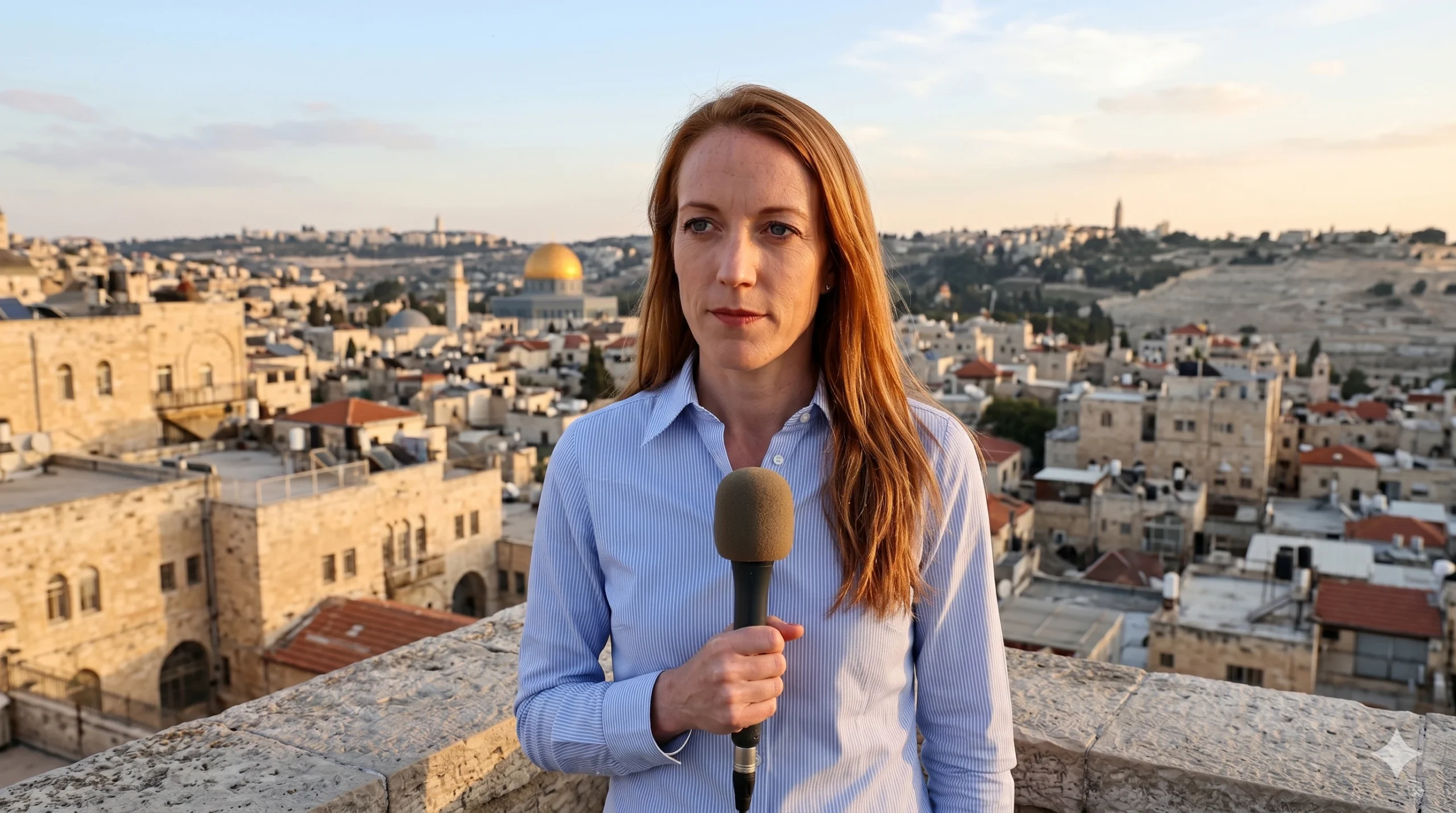
Yolande Knell is not a television personality in the usual sense. She is a working foreign correspondent whose name tends to appear when a story is already painful, urgent, and politically charged. For many viewers and readers, she is the BBC journalist reporting from Jerusalem, the West Bank, Gaza-related briefings, or regional flashpoints where every word is weighed by audiences with strong views.
That makes her a public figure of a particular kind. People search for Yolande Knell because they want to know who is behind the voice explaining Israel, Gaza, Palestinian politics, settler violence, humanitarian crisis, diplomacy, and regional conflict. They also want basic biographical answers: where she is from, how she became a correspondent, whether she is married, what her net worth is, and what she is doing now.
The reliable story is more disciplined than many search results suggest. Knell is best known as a BBC Middle East correspondent, widely associated with reporting from Jerusalem and across the region. Her private life is far less public, and many personal details repeated online are either thinly sourced or not confirmed at all.
Early Life and Background
Yolande Knell has kept much of her early life out of the public record. That is not unusual for foreign correspondents, especially those covering conflict, security, politics, and communities under pressure. Unlike actors, athletes, or elected officials, reporters are often visible through their work while remaining guarded about their families and private routines.
She is widely described as a British journalist, a description that fits her long public association with the BBC. Some online biography pages publish claims about her exact birth date, age, and family background, but those details are not backed by the kind of strong public sourcing a careful profile should require. A serious biography should say plainly that her early family life, parents, and childhood details are not reliably documented in major public sources.
That absence of personal information should not be mistaken for mystery or evasiveness. For many correspondents, privacy is a form of professional caution as well as a personal choice. Covering the Middle East can draw attention from governments, activists, media critics, and angry audiences, so there are practical reasons not to turn one’s family into public material.
What can be said with confidence is that Knell’s public identity has been shaped far more by journalism than biography. Readers looking for a dramatic childhood story or a carefully managed public brand will not find much that is verifiable. What they will find is a long record of reporting from one of the hardest beats in international news.
Education and Early Career
Public sources do not provide a fully verified, official account of Yolande Knell’s education. Some online profiles claim that she studied subjects connected to the Middle East, including Arabic or Islamic studies, but those claims should be treated with caution unless confirmed by a reliable institutional profile or interview. It is better to acknowledge the uncertainty than to turn repeated internet claims into fact.
What her career does show is a journalist with the language, regional knowledge, and professional stamina required for long-term foreign reporting. Middle East correspondence demands more than the ability to file quickly. It requires a working grasp of history, law, religion, geography, diplomacy, armed groups, local politics, and the lived experience of ordinary people caught inside those forces.
By the time she became widely recognizable to BBC audiences, Knell was already reporting with the habits of a seasoned correspondent. Her work moved between breaking news, radio features, live updates, and human-centered field reports. That range suggests the kind of training that happens in newsrooms, on location, and under pressure, rather than in a single public career milestone.
Her earlier career is less visible than her later BBC work, partly because many foreign correspondents build their reputations through years of reporting rather than one sudden breakthrough. There is no single widely known “arrival” moment attached to her name. Instead, her public profile grew through repeated appearances on stories that required calm explanation and careful language.
Becoming a BBC Middle East Correspondent
Yolande Knell is best known for her work as a BBC Middle East correspondent. That title carries real weight because the BBC’s Middle East coverage reaches audiences far beyond Britain. A correspondent in that role is expected to report for television, radio, digital platforms, and live broadcasts while working across stories that can change hour by hour.
Her reporting has been closely associated with Jerusalem, Israel, Gaza, the occupied West Bank, Egypt, and wider regional affairs. That geographic range matters because the Middle East beat is not one story. An escalation in Gaza can affect diplomacy in Cairo, politics in Washington, security calculations in Tel Aviv, public anger in Amman, and daily life in Bethlehem or Ramallah.
Knell’s work often sits at the point where official statements meet civilian experience. A government may describe a security operation, an army may speak of targets, an aid agency may warn of hunger, and a family may describe fear or loss. The correspondent’s job is to place those claims in context without pretending that all sides have equal power or equal access to the global microphone.
That balance is difficult, and no reporter on the beat escapes scrutiny. Knell’s name appears on stories that readers and viewers often approach with deep suspicion before they even start reading. Her public career is therefore not only a biography of one journalist, but also a window into how foreign reporting works under pressure.
Reporting from Jerusalem
Jerusalem is one of the most demanding cities in the world from which to report. It is sacred to Jews, Muslims, and Christians, claimed politically by Israelis and Palestinians in different ways, and watched closely by governments and communities far beyond the region. A correspondent based there is never reporting from a neutral stage.
Knell’s association with Jerusalem helps explain the range of her reporting. From the city, a journalist can move between Israeli political developments, Palestinian life under occupation, religious tensions, settlement disputes, diplomatic visits, court rulings, and the aftermath of violence. Few places compress so many historical and present-day conflicts into such a small geographic space.
Her work has often reflected that compression. Stories from Jerusalem and nearby areas can begin with an incident in a street, prison, village, checkpoint, refugee camp, hospital, or government office, then widen into questions about sovereignty, law, security, and identity. That movement from the local to the global is one of the main skills of foreign correspondence.
Readers sometimes underestimate how hard that kind of reporting is. Access can be restricted, witnesses may be traumatized, officials may be strategic, and facts may emerge slowly. In that setting, cautious wording is not weakness; it is often the only honest way to report what is known at the time.
Coverage of Israel, Gaza, and the West Bank
Yolande Knell’s public reputation is most strongly tied to coverage of Israel, Gaza, and the occupied West Bank. These are not simple assignments, even for reporters who have spent years in the region. The history is long, the legal disputes are sharp, the suffering is immediate, and the language used to describe events can itself become a source of anger.
Her reporting has covered the kind of subjects that define the current era of the conflict: Israeli security concerns, Palestinian civilian life, Gaza’s humanitarian crisis, hostage and prisoner issues, settler violence, diplomatic efforts, and the search for ceasefire terms. Each topic carries its own moral and political weight. Together, they form a beat where no single article can satisfy everyone.
The war that followed the Hamas-led attacks on Israel on October 7, 2023, made that pressure even more severe. Reporters had to explain the shock and horror of the attacks, the taking of hostages, Israel’s military response, Gaza’s devastation, and the wider regional risk. Knell was among the BBC correspondents whose work appeared as audiences tried to understand events that were unfolding faster than verification could always keep pace.
Her later reporting has also reflected the war’s wider consequences. Gaza’s food shortages, the fate of civilians, the status of Palestinian prisoners, and violence in the West Bank are not separate background issues. They are part of the same political and humanitarian crisis, and Knell’s public work has often returned to those links.
Egypt and Regional Reporting
Although Knell is now most closely associated with the Israeli-Palestinian conflict, her public reporting has also included Egypt. That part of her career matters because Egypt is central to the region’s politics and to Gaza’s fate in particular. Cairo has long been a diplomatic broker, a border power, and a state whose internal politics affect the wider Arab world.
During the years after Egypt’s 2011 uprising, foreign correspondents had to report a country in transition, uncertainty, and later renewed authoritarian control. The fall of Hosni Mubarak was initially treated by many outside observers as a moment of democratic possibility. What followed was far more complicated, involving elections, military power, protest, repression, and public exhaustion.
Knell’s Egypt-related work fits within that wider history of regional reporting. It shows that her expertise was not limited to one conflict or one capital. A reporter who has worked across Jerusalem, Cairo, the West Bank, and Gaza has to understand how local stories connect across borders.
That regional view is especially important now. Gaza’s border with Egypt, Israeli security policy, Palestinian politics, US diplomacy, Gulf influence, Lebanese instability, and Iranian power all form part of the same news environment. Knell’s career has unfolded inside that connected world.
Reporting Style and Public Voice
Yolande Knell’s reporting style is measured rather than theatrical. She tends to work in the BBC correspondent tradition: explain the latest development, describe the human impact, place the event in political context, and avoid overt personal opinion. That style can seem restrained during moments of extreme suffering, but it reflects the demands of institutional news reporting.
Her reports often rely on plain scenes rather than grand statements. A family’s account, a village under pressure, an aid warning, a political speech, a prisoner’s case, or a border crossing can become the entry point into a larger story. That approach helps readers and viewers understand the stakes without being overwhelmed by history at the start.
The best foreign correspondence does not only tell people what happened. It helps them understand why the same places and names return again and again. Knell’s work has often operated in that space, connecting a single day’s news to longer patterns of occupation, insecurity, displacement, diplomacy, and failed political settlement.
Still, her public voice remains that of a reporter, not a campaigner. She is not best understood as a commentator with an openly declared ideological project. Her influence comes through what she reports, what she explains, and how she frames facts under the BBC’s editorial rules.
Public Image and Criticism
Any journalist covering Israel, Gaza, and the occupied West Bank will attract criticism. Yolande Knell is no exception. Some media-monitoring groups and readers have challenged BBC coverage carrying her name, while others criticize the BBC from the opposite direction for what they see as insufficient attention to Palestinian suffering or too much reliance on official Israeli framing.
That kind of criticism should be understood in context. The BBC is one of the world’s most visible news organizations, and its Middle East reporting is examined intensely by governments, advocacy groups, academics, viewers, and rival media. A correspondent’s byline can become a target for wider frustration with the institution.
Criticism does not automatically prove bias, and institutional reputation does not automatically prove fairness. Serious readers should examine individual reports: who is quoted, what claims are verified, what context is included, what denials are reported, and what is left unresolved. That is a better standard than treating praise or outrage as evidence by itself.
For Knell, public scrutiny comes with the territory. The more visible a correspondent is on a charged beat, the more likely viewers are to project broader arguments onto that person. Her public image is therefore shaped not just by her own work, but by the larger battle over trust in Middle East coverage.
Private Life, Marriage, and Family
Yolande Knell has not made her private life a major part of her public identity. There is no strong, widely accepted public record confirming details about her spouse, children, or close family. Search results may offer claims, but many of those pages do not meet the standard needed for a responsible biography.
That privacy deserves respect. Journalists who cover conflict and politically sensitive subjects often keep family details offstage for safety, focus, and personal boundaries. The fact that readers are curious does not make private information newsworthy.
This distinction is especially important because biography websites often fill gaps with speculation. They may assign marital status, family details, or personal histories without showing where the information came from. A good profile should not reward that habit.
What can be said is that Knell’s public life appears centered on her work rather than celebrity. She has built recognition through reporting, not through social media performance or personal branding. That gives her biography a different shape from the profiles readers may expect of actors, influencers, or politicians.
Money, Salary, and Net Worth
There is no credible, verified public figure for Yolande Knell’s net worth. Some websites may publish estimates, but those numbers should be treated carefully unless they show a clear method and reliable source. In most cases, they do not.
Her known income source is her journalism work, most visibly through the BBC. A foreign correspondent’s compensation can depend on seniority, contract type, assignments, location, and institutional pay bands. But without official disclosure or a trustworthy financial record, it would be misleading to attach a specific wealth figure to her name.
It is also worth separating salary from wealth. Net worth includes assets, property, savings, investments, debts, and private financial arrangements that are not public for most journalists. A person’s job title alone cannot establish those details.
The honest answer is simple: Knell likely earns her living through her work as a professional journalist, but her personal finances are not publicly confirmed. Any exact net worth figure online should be read as an estimate at best and unsupported content at worst. Responsible biography writing should not pretend otherwise.
Career Standing and Influence
Yolande Knell’s standing comes from persistence on a demanding beat rather than celebrity recognition. She is part of a class of correspondents whose work helps global audiences understand events they may never see directly. That kind of influence is quieter than fame, but it can matter more in moments of crisis.
Her career also reflects the continued importance of field reporting. In an age of instant commentary, social media clips, and partisan interpretation, correspondents still do something basic and hard: they gather information from where events are happening. They speak to people, check claims, listen to officials, examine consequences, and turn a chaotic day into a report the public can follow.
Knell’s work has been especially visible because the Middle East remains central to global politics. Israel’s security, Palestinian statehood, Gaza’s humanitarian crisis, Egyptian mediation, US policy, Iranian influence, and regional war risks are not distant local matters. They affect elections, diplomacy, protests, aid policy, and international law debates around the world.
Her influence, then, is tied to trust. Readers may agree or disagree with a report, but they are often relying on correspondents like Knell to describe what is happening before historians, investigators, or courts can produce fuller accounts. That responsibility is heavy, and it explains why her work is watched closely.
Where Yolande Knell Is Now
Yolande Knell remains publicly associated with BBC Middle East reporting. Her recent work has continued to focus on Israel, Gaza, the occupied West Bank, Palestinian politics, humanitarian issues, and regional security. She is still best understood as an active correspondent rather than a retired journalist or media figure from a past era.
The stories around her beat remain unresolved. Gaza’s humanitarian situation, the future of Israeli hostages and Palestinian prisoners, violence in the West Bank, settlement expansion, ceasefire negotiations, and regional escalation all continue to demand careful reporting. These are not stories that end neatly after one news cycle.
For a correspondent, that means the work is repetitive in one sense and never the same in another. The places and themes may return, but each new crisis brings different victims, officials, documents, claims, and consequences. Knell’s current relevance comes from staying with those stories after global attention shifts elsewhere.
Her future public profile will likely remain tied to the region she covers. Unless she chooses to publish a memoir, give extended personal interviews, or move into commentary, the most reliable way to understand her will continue to be through her reporting. That is fitting for a journalist whose career has been defined less by self-presentation than by the difficult work of witnessing and explaining.
Frequently Asked Questions
Who is Yolande Knell?
Yolande Knell is a BBC journalist best known as a Middle East correspondent. Her reporting is closely associated with Jerusalem, Israel, Gaza, the occupied West Bank, Egypt, and wider regional affairs. She is known for covering conflict, diplomacy, humanitarian issues, and political developments in one of the world’s most closely watched regions.
What is Yolande Knell’s nationality?
Yolande Knell is widely described as British and is publicly associated with the BBC, the United Kingdom’s public broadcaster. While many online profiles state her nationality directly, a careful biography should avoid adding unsupported personal details beyond what is well established. Her professional identity is much clearer in the public record than her private background.
How old is Yolande Knell?
Yolande Knell’s exact age is not reliably confirmed in strong public sources. Some biography websites publish specific birth dates or estimates, but those claims are not consistently supported by authoritative records. The most responsible answer is that her age has not been publicly verified to a standard suitable for a serious profile.
Is Yolande Knell married?
There is no strong public confirmation of Yolande Knell’s marital status, husband, partner, or children. She appears to keep her family life private, which is common for journalists working on sensitive international assignments. Claims about her marriage or children should be treated as unverified unless confirmed by reliable sources.
What is Yolande Knell’s net worth?
Yolande Knell’s net worth is not publicly verified. Websites that publish exact estimates usually do not provide reliable evidence, and those figures should not be treated as fact. Her known professional income is connected to journalism, especially her work for the BBC, but her personal finances remain private.
What is Yolande Knell best known for?
She is best known for BBC reporting on the Middle East, especially Israel, Gaza, the occupied West Bank, Jerusalem, and Egypt. Her work has covered war, diplomacy, civilian suffering, political disputes, settler violence, aid access, and regional security. She is a correspondent rather than a commentator, which means her public role centers on reporting and explanation.
Where is Yolande Knell now?
Yolande Knell is still publicly associated with BBC Middle East coverage. Her recent public work continues to involve major regional stories, including Israel, Gaza, the West Bank, and diplomatic developments linked to the conflict. She remains a relevant figure because the beat she covers is still central to world news.
Conclusion
Yolande Knell’s biography is not the story of a celebrity who turned private life into public property. It is the story of a journalist whose name became familiar because she kept appearing on difficult stories from difficult places. Her public record is built through bylines, broadcasts, field reporting, and the patient work of explaining conflict to distant audiences.
The limits of what is known about her matter too. Her age, family, marriage, and finances are not firmly established in reliable public sources, and a respectful profile should not pretend otherwise. In that sense, the gaps in her biography are not flaws; they are reminders that public interest and private life are not the same thing.
What remains clear is her professional role. Knell has spent years reporting on the Middle East for the BBC, with particular attention to Israel, Gaza, the West Bank, Jerusalem, Egypt, and regional politics. That work places her in the middle of some of the most sensitive and closely examined journalism in the world.
For readers, the best way to understand Yolande Knell is not through rumor or thin biography pages. It is through the reporting itself: the places she covers, the voices she includes, the claims she tests, and the context she brings to stories that rarely offer easy answers. That is where her public significance lies, and that is why people continue to search her name.