
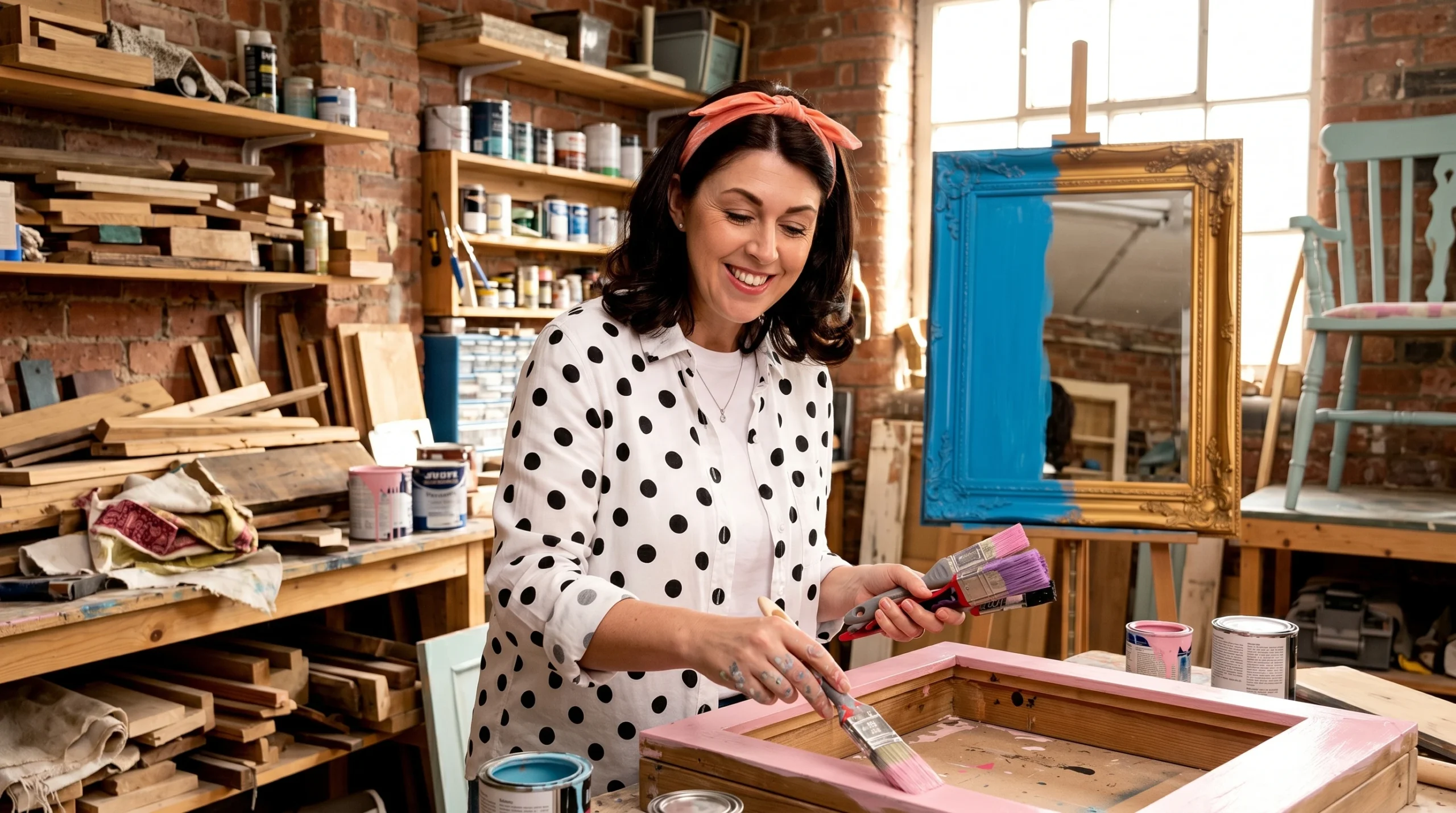
Gemma Longworth became familiar to many viewers through Find It, Fix It, Flog It, the British restoration series built around the pleasure of seeing neglected objects rescued from sheds, barns, garages, and back rooms. On screen, she is the creative eye who can look at a tired piece of furniture and see not waste, but possibility. Yet the television version of Gemma Longworth is only one part of a larger story. Her career has been shaped by Liverpool, art education, textiles, self-made work, upcycling, community projects, bereavement support, and a belief that making things by hand can help people feel steadier in the world.
For readers searching her name, the draw is understandable. Longworth is public enough to be recognizable, but private enough that much of her life has not been flattened into celebrity trivia. She is not a reality star built around scandal or confession. She is a working artist whose public reputation rests on skill, warmth, and an unusually personal idea of repair.
That makes her biography more interesting than a simple television profile. Longworth’s life and career sit at the crossing point of craft, sustainability, creativity, and emotional care. She has built a public identity around the idea that old materials can be saved, rooms can be changed, and people can find comfort in the act of making. The result is a career that feels modest in tone but meaningful in reach.
Early Life and Liverpool Roots
Gemma Longworth is strongly associated with Liverpool, the city that shaped much of her creative and professional identity. Public records place her birth in May 1984, though many personal details about her early family life remain private. That privacy is worth respecting, because Longworth has shared far more about her work than about the intimate details of her home life. What is clear is that her path into art began early and developed through formal study rather than sudden fame.
Her education began in the Liverpool area, where she studied art and design as a teenager. She attended the City of Liverpool College, completing art and design training before moving deeper into applied arts. That early stage matters because Longworth’s later work never feels separated from practical making. She was not simply interested in art as display; she was interested in materials, touch, surfaces, and objects that people could live with.
Liverpool also gave Longworth a strong community setting for her later work. Her projects have often been rooted in local groups, social spaces, charities, workshops, and families rather than in a distant media world. Even after national television raised her profile, she continued to be linked with hands-on work in and around Merseyside. That local grounding is one reason her public image has remained approachable.
Education and First Creative Ambitions
Longworth’s formal training took her beyond Liverpool into a broader art-school route. After her early art and design studies, she went on to study Drawing and Applied Arts in Bristol. She later completed a master’s degree in textiles in Manchester, building a foundation in craft, fabric, design, and visual problem-solving. That combination of drawing, applied arts, and textiles would become central to her later identity.
Her education helps explain why she is hard to place in a single category. She is not only a furniture restorer, not only a television presenter, and not only a workshop leader. Her work draws from textile practice, interior styling, painting, craft teaching, and emotional storytelling. That mix can look casual on television, but it rests on years of training and repeated practice.
Longworth’s early ambition appears to have been less about fame than about finding a sustainable creative life. Like many artists leaving higher education, she entered a world where paid creative work was uncertain. Instead of waiting for a conventional job to appear, she began building her own opportunities. That decision became one of the defining moves of her career.
The Button Boutique and Building Work from Scratch
Before she became a familiar face on television, Longworth founded The Button Boutique, a creative business connected to textile art, craft workshops, handmade products, and event-based making. The business began in the early 2010s, at a time when Longworth was creating her own work after university. It reflected the practical reality facing many creative graduates: talent alone was not enough. She had to build a business around her skills.
The Button Boutique gave Longworth a public platform long before Find It, Fix It, Flog It. Through workshops, craft sessions, and creative events, she learned how to teach people as well as make things herself. That teaching ability would later become one of her most useful strengths. Television rewards people who can explain a process clearly, and workshops demand the same skill in a more personal setting.
The business also showed Longworth’s interest in making craft accessible. Her work was not presented as something reserved for elite studios or expensive interiors. It was colourful, social, and based on the belief that ordinary people could make something worth keeping. That idea would run through nearly everything she did afterward.
Upcycling as a Career, Not a Trend
Longworth’s public profile grew at a time when upcycling was moving from a niche craft habit into mainstream British television and home culture. Upcycling can be easy to misunderstand. At its weakest, it is just a coat of paint on old furniture. At its best, it is a careful act of redesign that saves materials, respects function, and gives an object a second life.
Longworth’s work sits closer to the second version. Her training in textiles and applied art gives her a strong sense of colour, surface, and proportion. She can see how a chair, cabinet, table, or discarded object might work differently with new fabric, a repaired frame, a painted finish, or a more playful identity. The point is not only to make things look new, but to make them useful again.
There is also an emotional layer to this work. Many people keep objects because they carry memory, even when those objects no longer suit a room or feel usable. Upcycling can offer a way to keep the memory while changing the form. Longworth’s later work in creative healing makes that connection even clearer.
Television Breakthrough on Find It, Fix It, Flog It
Gemma Longworth became best known to a wider audience through Find It, Fix It, Flog It, a restoration and upcycling series associated with Henry Cole and Simon O’Brien. The show follows a simple but satisfying format: unwanted objects are found, repaired or redesigned, and then valued or sold. Its appeal comes from the drama of transformation without the artificial weight of celebrity competition. Viewers watch skill, taste, risk, and practicality collide.
Longworth’s role on the programme gave her a natural stage. She brought a softer craft-led energy to a format that also includes mechanical restoration, metalwork, and heavier workshop skills. Her projects often focus on furniture, decorative objects, fabrics, paint, and domestic design. That made her especially relatable to viewers who might not rebuild a motorcycle but could imagine repainting a cabinet.
The programme also suited her personality. Longworth comes across as warm, capable, and practical rather than showy. She explains ideas in a way that makes the viewer feel invited rather than judged. In a genre where presenters can sometimes overwhelm the object, her strength is that she keeps attention on the work itself.
What Made Her Screen Presence Work
Longworth’s screen presence is built around trust. She does not need to oversell a project or act as if every makeover is a miracle. She looks at old pieces with curiosity, then makes choices that viewers can follow. That steady approach is one reason she fits the rhythm of restoration television so well.
Her value to the show is partly technical and partly emotional. She understands materials, but she also understands why people become attached to them. A worn piece of furniture may be ugly to one person and meaningful to another. Longworth’s work often asks how an object can be changed without losing the reason someone cared about it in the first place.
That approach gives her television work a gentler mood than some makeover formats. The goal is not to shame the old or worship the new. The goal is to notice what is still possible. In a culture trained to replace things quickly, that is a quietly persuasive message.
Hidden Gems and Creative Healing
One of the most meaningful parts of Longworth’s career is Hidden Gems, the creative support service linked to her work as an artist and workshop leader. Hidden Gems offers art and craft workshops for groups, events, smaller gatherings, and one-to-one sessions. The service is built around the idea that making can support wellbeing, confidence, connection, and emotional expression. It reflects Longworth’s long-standing belief that creativity is not only decorative.
Longworth has described finding comfort through creative outlets from a young age. That personal connection helps explain why her work with Hidden Gems has a different tone from a standard craft business. It is still practical and project-based, but it also pays attention to mood, memory, stress, grief, and confidence. The aim is not perfection; the aim is participation and care.
This side of Longworth’s career should be described carefully. Craft is not a guaranteed cure for grief, anxiety, or trauma, and it should not replace professional mental health care when that care is needed. But creative activity can give people structure, expression, company, and a way to process difficult feelings. Longworth’s work belongs in that serious and increasingly recognized space between art, community, and emotional support.
Work with Alder Hey and Bereavement Support
Longworth’s collaboration with The Alder Centre at Alder Hey is one of the clearest examples of her work beyond television. Alder’s Hidden Gems has been described as a creative group for children and young people affected by the death of a child. The sessions include art, craft, music, dance, gardening, fashion, upcycling, and other creative activities shaped around the interests of young people. This work places Longworth’s skills in a sensitive setting where creativity needs care, patience, and trust.
Bereavement support for children is not simple. Young people do not always have the words to explain loss, and many cannot sit down and talk about grief in the way adults expect. Creative activity can lower that pressure. A child can paint, sew, plant, build, decorate, or draw while being near others who understand something about their experience.
That setting also shows why Longworth’s career has depth. She is not only using craft to create attractive objects or television moments. She is using it to help people, including children, find forms of expression when ordinary language may not be enough. The work is quiet, but its importance is hard to overstate.
Author of Craft Your Cure
Longworth’s book, Craft Your Cure: 25 craft and upcycling projects to heal and bring joy, brought her message into a form readers could use at home. The book gathers craft, DIY, and upcycling projects designed around comfort, creativity, repair, and mood. Its projects include accessible forms of making such as paper craft, doodling, clay work, knitting, mending, memory-based projects, and furniture upcycling. The title captures the central idea of Longworth’s public work: making can help.
The book does not need to be read as a promise that craft fixes every pain. Its more useful meaning is gentler. It gives readers a starting point when they need something practical, sensory, and manageable. For someone dealing with stress or grief, the act of choosing colours, stitching fabric, shaping clay, or repairing a small object can create a pocket of steadiness.
Publishing the book also broadened Longworth’s public profile. She was no longer only the upcycler from television or the Liverpool workshop leader. She became an author with a clear philosophy about creativity and care. That step turned her experience into a guide for readers who may never attend one of her workshops.
Community Projects and Public Contribution
Longworth’s public work has included community redesign and charity-linked projects, including work with Mencap Liverpool and Sefton. In one widely reported project, she helped transform a coffee shop space by upcycling furniture and involving members, volunteers, and artist friends. The project was not only about improving how a room looked. It was about making a shared place feel warmer, brighter, and more reflective of the people using it.
That type of work reveals a lot about Longworth’s values. In a commercial interiors project, the result might be judged mainly by style. In a community project, the process matters as much as the finished room. People learn skills, work together, make decisions, and see their own labour become part of the space.
Longworth’s career repeatedly returns to that idea of participation. She does not treat creativity as something handed down by an expert to passive viewers. Whether on television, in a workshop, or in a community setting, she often frames making as something people can join. That generosity has become part of her public image.
Marriage, Children and Private Life
Gemma Longworth keeps much of her personal life out of the public record. There are many online searches about whether she is married, who her husband is, whether she has children, and what her family life looks like. The responsible answer is that these details are not clearly confirmed in strong public sources. Longworth’s public identity is built much more around work, creativity, and community projects than around private relationships.
That privacy is not unusual for British factual television presenters. Many people in that world become familiar to viewers without turning their homes, partners, or children into public material. Longworth appears to have maintained that boundary. In an online culture that often treats every unanswered personal question as an invitation to speculate, her silence should not be filled with guesswork.
What can be said with confidence is that family, memory, and loss are themes that appear in her work, especially in her creative healing projects. That does not give the public a right to private details. It does show that Longworth understands the emotional weight people attach to relationships and objects. Her work often creates space for those feelings without turning her own personal life into the main subject.
Money, Business Interests and Net Worth
Gemma Longworth’s income appears to come from several professional sources, including television presenting, workshops, creative services, public projects, book publishing, and business activity connected to her art and craft work. She has been associated with The Button Boutique and Hidden Gems, both of which reflect different stages of her creative career. The Button Boutique grew from textile art and craft workshops, while Hidden Gems focuses more openly on creative wellbeing. Together, they show how Longworth has turned artistic skill into practical work.
As for net worth, no reliable audited figure is publicly available. Some online biography sites publish estimates, but these should be treated with caution because they rarely explain their methods or cite firm financial records. A credible profile should not pretend to know the private finances of a working artist and presenter without evidence. The safer conclusion is that Longworth has built a mixed creative career rather than a celebrity wealth story.
That distinction matters. Her public value is not best measured by a speculative money figure. It is better understood through the range of work she has created and the communities she has reached. Television gave her recognition, but her career is also sustained by teaching, making, writing, and social impact.
Public Image and Industry Standing
Longworth’s public image is warm, practical, and grounded. She is recognized by many viewers as a creative problem-solver rather than a conventional celebrity. That gives her a different kind of appeal from presenters whose fame rests on personality alone. Her reputation depends on visible skill and a clear connection between what she says and what she does.
In the wider world of British restoration television, Longworth stands out because her work is not only about objects. She connects furniture, craft, and repair to wellbeing, memory, and community. That gives her public role more emotional range than a standard upcycling presenter might have. Viewers may first notice the paint and fabric, but the deeper story is about restoration as a way of thinking.
Her industry standing is also tied to accessibility. She makes craft feel possible for people who may not have art-school confidence. That is a rare skill, because experts can sometimes make their fields feel smaller and more exclusive. Longworth’s strength is that she makes her field feel open.
Where Gemma Longworth Is Now
Gemma Longworth remains active as a television personality, artist, author, and workshop leader. Her public work continues to connect upcycling with creative wellbeing. Through Hidden Gems and related projects, she remains associated with workshops that use art and making as tools for connection, confidence, and emotional support. Her book has also extended that work to readers who want to try creative repair at home.
Her television presence continues to be linked most strongly with Find It, Fix It, Flog It. The show’s ongoing popularity reflects a public appetite for practical restoration, reuse, and stories of overlooked objects finding new value. Longworth’s role in that world remains clear: she brings colour, craft knowledge, and emotional intelligence to the process. She is not simply there to decorate; she helps reveal what an object could become.
The current chapter of her career seems less about chasing fame than deepening a recognizable mission. Longworth has found a way to connect the home, the workshop, the television studio, and the support group. That is a rare combination. It makes her story feel both public and deeply human.
Frequently Asked Questions
Who is Gemma Longworth?
Gemma Longworth is a British artist, upcycler, television presenter, workshop leader, and author based in Liverpool. She is best known to many viewers for her work on Find It, Fix It, Flog It, where she helps restore, redesign, and reimagine old furniture and objects. She is also the founder of Hidden Gems, a creative support service focused on art, craft, and wellbeing.
Her work spans television, community workshops, charity projects, creative healing, and publishing. That range is what makes her biography more than a simple screen career. Longworth has built her public identity around the idea that repair can be practical, creative, and emotionally meaningful.
How old is Gemma Longworth?
Public company records list Gemma Longworth’s date of birth as May 1984. Based on that record, she turned 42 in May 2026. Some websites give more exact personal details, but not all of them are supported by strong sourcing.
It is best to rely on the public record rather than repeat unsourced claims. Longworth has not made her age a major part of her public image. Her career details, training, and current work are better documented than many private biographical facts.
Is Gemma Longworth married?
There is no strong, widely verified public record confirming full details of Gemma Longworth’s marital status. Searches about her husband and family are common, but many online claims appear on low-quality biography sites that do not show reliable sourcing. A responsible account should not present those claims as fact.
Longworth keeps much of her private life separate from her public work. That choice is common among presenters and artists who become known for skill-based television rather than celebrity publicity. Her professional life is well documented, while parts of her personal life remain private.
What is Gemma Longworth known for on television?
Gemma Longworth is best known for Find It, Fix It, Flog It, the restoration and upcycling programme built around finding unwanted objects and giving them new use or value. Her role focuses heavily on creative redesign, furniture, decorative finishes, and craft-led transformations. She brings a practical and approachable style to the programme.
Her television work connects naturally with her wider career. Longworth’s background in textiles, art, workshops, and upcycling gives her the skills the format requires. Viewers respond to her because she makes creative repair feel possible rather than intimidating.
What is Hidden Gems?
Hidden Gems is Longworth’s creative support service, offering art and craft workshops for groups, events, smaller sessions, and one-to-one settings. The work is based on the idea that creativity can support wellbeing, self-confidence, expression, and social connection. It reflects Longworth’s belief that making things by hand can help people through difficult times.
The service has also been linked with bereavement support work, including creative sessions for children and young people affected by loss. This is one of the most meaningful parts of Longworth’s career. It shows how her craft practice extends beyond television and into real community care.
What is Gemma Longworth’s book?
Gemma Longworth is the author of Craft Your Cure: 25 craft and upcycling projects to heal and bring joy. The book brings together craft, DIY, and upcycling projects with a focus on comfort, creativity, and emotional wellbeing. It includes accessible projects such as paper craft, clay work, drawing, knitting, mending, and furniture upcycling.
The book reflects the central theme of Longworth’s work. It treats creativity as something people can use in ordinary life, especially during periods of stress, grief, or change. Its message is not that craft removes pain, but that making can offer focus, expression, and small acts of repair.
What is Gemma Longworth’s net worth?
There is no reliable public net worth figure for Gemma Longworth. Some websites publish estimates, but these figures should be treated as speculative unless backed by clear financial records. Longworth’s income likely comes from a mix of television work, workshops, creative services, book publishing, and business activity.
Her career is better understood as a mixed creative portfolio than as a celebrity wealth story. She has built work across several areas instead of relying on a single public platform. That variety is part of what makes her professional life interesting.
Conclusion
Gemma Longworth’s biography is a story of making, repairing, teaching, and steadily expanding what craft can mean. She entered public view through television, but her work began long before viewers knew her name. From art school to The Button Boutique, from upcycling workshops to Hidden Gems, she has built a career around creativity that is practical and emotionally aware.
Her public appeal comes from the fact that she does not make repair feel distant or precious. She makes it feel human. A chair can be mended, a room can be brightened, a child can make something while carrying grief, and an ordinary person can pick up tools or materials without needing permission from the art world.
That is why Longworth matters beyond the format of a television show. She represents a kind of creative life that values reuse, care, community, and hands-on confidence. In a culture often built around replacement, Gemma Longworth has made a persuasive case for looking again at what can still be saved.