
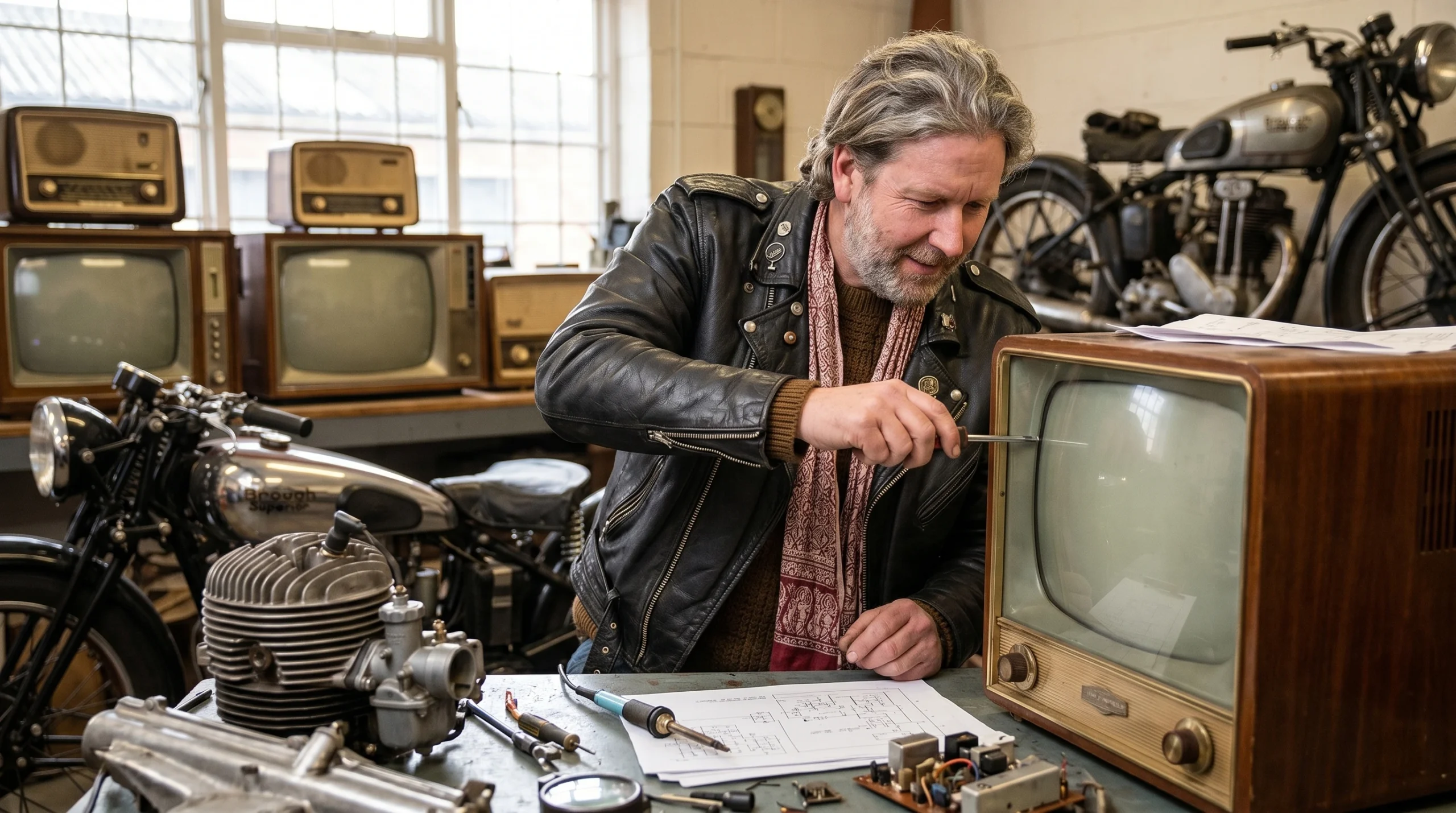
Sam Lovegrove became familiar to many viewers not because he chased fame, but because he looked completely at home beside an old motorcycle, a seized engine, or a half-forgotten machine dragged out of a shed. On television, he has often appeared as the calm mechanical counterweight to Henry Cole’s restless enthusiasm, the man who could look at a battered vehicle and see both the problem and the possibility. His appeal rests on a rare quality in factual entertainment: he seems less interested in performing expertise than in doing the work properly. That is why people continue to search for his name, asking who he is, what happened to him, and where his life and career stand now.
Lovegrove is best known as a British motorcycle engineer, restorer, collector, and television personality associated with shows such as Shed & Buried, Find It Fix It Drive It, The Motorbike Show, and Junk & Disorderly. His public image is tied closely to classic motorcycles, old vehicles, workshop problem-solving, and the culture of finding value in machinery other people might ignore. Unlike many television figures, he has kept much of his private life outside the public record. That makes him an interesting subject for biography, but also one that requires care, because the verified facts are stronger around his work than around his family, money, or personal history.
Early Life and Private Background
Sam Lovegrove’s early life is not documented in the way the early lives of actors, athletes, or politicians often are. His exact date of birth, birthplace, parents, schooling, and childhood circumstances have not been widely confirmed in reliable public material. That absence does not mean there is a mystery to solve; it more likely reflects the simple fact that Lovegrove became known through specialist craft and television work rather than through a publicity-managed celebrity career. He has not built his public identity around intimate autobiography.
What can be said with confidence is that Lovegrove belongs to a British tradition of practical engineering and mechanical restoration. His work suggests the kind of knowledge that is usually built over years in workshops, garages, barns, and specialist circles, rather than through a single public breakthrough. He appears to have entered television already carrying real technical authority, not as a presenter learning a subject for the camera. That distinction matters because viewers responded to him as a working expert first and a TV figure second.
The lack of public detail around his family background has also led some online profiles to overreach. Claims about his childhood, relatives, marriage, and home life circulate on websites that do not show how they know what they claim. A careful biography should not repeat those details as fact unless they come from Lovegrove himself, an official source, or a credible interview. In his case, restraint is not a gap in the story; it is part of telling the story honestly.
How Machinery Became His Public Language
Lovegrove’s public career makes the most sense when seen through his relationship with machinery. He is associated above all with motorcycles, especially classic and rare British bikes, but his screen work has also included cars, tractors, utility vehicles, and unusual mechanical finds. The common thread is not a single brand or vehicle type. It is the habit of understanding how old machines were made, why they fail, and what it takes to bring them back to life.
That kind of work requires more than nostalgia. A restorer has to judge metal fatigue, missing parts, bad previous repairs, safety risks, and the difference between patina and neglect. Old vehicles often arrive with uncertain histories, improvised fixes, and components that are no longer easy to source. Lovegrove’s value on screen came from making those realities visible without turning them into a lecture.
There is also a quiet ethic in restoration work. The best restorers do not simply make something shiny; they decide what should be preserved, what should be rebuilt, and what must be replaced for the machine to live again. Lovegrove’s reputation, especially around rare motorcycles, rests on that kind of judgment. He became interesting to viewers because he represented skill that could not be faked for long.
The Henry Cole Partnership
For most television viewers, Sam Lovegrove’s name is inseparable from Henry Cole. Cole brought the energy of a broadcaster, motorcycle enthusiast, and collector who could walk into a shed and turn a dusty object into a story. Lovegrove brought a different rhythm: measured, dry, technically grounded, and often more alert to the practical problems behind the excitement. Together, they created a partnership that felt lived-in rather than manufactured.
Their chemistry worked because the roles were clear without feeling scripted. Cole often supplied the momentum, the curiosity, and the appetite for taking a chance on a strange old vehicle. Lovegrove supplied the caution, the diagnosis, and the confidence that something could either be saved or should be left alone. Viewers liked the contrast because it mirrored the real push and pull in restoration: desire on one side, reality on the other.
That partnership became part of a broader television world built around Britain’s sheds, barns, workshops, autojumbles, and classic vehicle culture. Lovegrove did not need to dominate the screen to make an impression. A raised eyebrow, a short technical explanation, or a practical fix often told the viewer enough. His presence gave the programmes credibility because he looked like someone who would still be doing similar work even if no camera had arrived.
Television Career and Breakthrough
Lovegrove’s wider public recognition came through factual entertainment programmes centered on old machines and restoration. Shed & Buried introduced many viewers to the pleasure of searching private collections, outbuildings, and forgotten corners for motorcycles, cars, parts, and memorabilia. The show’s appeal lay in the mixture of treasure hunt, mechanical rescue, and British eccentricity. Lovegrove’s contribution was to make the mechanical side feel real.
He also appeared with Henry Cole in Find It Fix It Drive It, a programme built around buying neglected vehicles, restoring them, and putting them to use in practical challenges. That format suited Lovegrove because it gave the repairs a test beyond appearance. A vehicle did not merely need to look better by the end of an episode; it had to run, pull, climb, race, or survive the event set for it. That demand made engineering judgment central to the story.
Lovegrove’s involvement with The Motorbike Show connected him even more directly to the audience that cared about classic motorcycles. The programme mixed travel, restoration, interviews, and motorcycle history, often with Cole at the center. Lovegrove appeared in workshop settings where his mechanical ability gave depth to the restoration strands. For viewers who cared less about television polish and more about engines, frames, and the smell of old oil, those appearances helped define his appeal.
Why Viewers Trusted Him
Trust is a difficult thing to manufacture on television. Many presenters can sound enthusiastic, and many experts can explain a subject clearly, but Lovegrove gave the impression of someone who knew what could go wrong because he had already seen it go wrong before. He did not need to oversell his knowledge. His authority came from the way he looked at a machine and moved through a problem.
That quality mattered in shows where the entertainment could easily have drifted into pure nostalgia. Old motorcycles and vehicles are charming, but they are also difficult, expensive, stubborn, and sometimes unsafe. Lovegrove’s presence reminded viewers that restoration is not just romance. It is labor, experience, patience, and a willingness to admit when a part or idea will not work.
His manner also helped. He often appeared understated, sometimes wry, and rarely overexcited for the sake of a scene. That made him stand out in a television culture that rewards loud reactions and emotional peaks. Lovegrove’s style suggested a person more interested in the machine reaching the finish line than in becoming the center of attention.
Brough Superior and Specialist Reputation
One of the most meaningful markers of Lovegrove’s standing is his association with Brough Superior motorcycles. Brough Superior is one of the most storied names in British motorcycling, linked to hand-built quality, high performance, rarity, and collector passion. Restoring such machines is not casual work. It requires deep knowledge of the marque, careful sourcing or fabrication of parts, and respect for historical value.
Lovegrove has been described in Brough Superior circles as an expert restorer and collector of the brand. That connection helps explain why his television reputation carried weight beyond the screen. Viewers may have discovered him through programmes with an accessible tone, but the specialist world behind those programmes is demanding. A person trusted with rare motorcycles is being judged by people who know the difference between presentation and proper work.
Brough Superior also gives Lovegrove’s career a link to a wider story about British engineering heritage. These motorcycles are not simply old machines; they are cultural objects for enthusiasts who care about design, speed, craftsmanship, and the mythology of early motorcycling. Lovegrove’s interest in them places him in a line of restorers and collectors who keep that history running rather than sealed behind glass. That is a different kind of public contribution from ordinary television fame.
Family, Marriage, and Personal Life
Sam Lovegrove’s family life remains largely private. There is no reliable, widely available public record confirming the full details of his marriage, children, or close family circumstances. Some online biographies make claims about his wife or children, but those claims are often unsourced or repeated without proof. The responsible position is to say that Lovegrove has chosen not to make his private life a major part of his public identity.
That privacy is worth respecting. Lovegrove became known through work, not through reality television built around home life or personal drama. His screen appearances center on machinery, travel, restoration, and friendship, not domestic disclosure. In that sense, his public persona feels closer to a respected tradesman or specialist than to a modern celebrity brand.
The curiosity is understandable, because viewers often feel they know long-running factual television figures personally. Seeing someone in sheds, workshops, and informal conversations can create a sense of familiarity. But familiarity is not the same as access. With Lovegrove, the clearest and fairest story is still the professional one.
Money, Work, and Net Worth
Sam Lovegrove’s net worth is not publicly confirmed. Online estimates exist, but they should be treated with caution because they rarely explain their methods or show reliable financial records. A person in his position could earn money from engineering work, restoration projects, collecting, television appearances, and related specialist activity. That does not allow anyone to calculate a precise fortune from the outside.
Classic motorcycle restoration can involve valuable machines, especially when rare British marques are involved. Brough Superior motorcycles, for example, can command serious attention in collector circles, but owning, restoring, or working on high-value machines does not automatically translate into a simple personal wealth figure. Costs, workshop overhead, parts, insurance, storage, and long project timelines can all affect the economics. The public does not have enough verified information to reduce Lovegrove’s finances to a number.
What is credible is that Lovegrove’s income appears tied to skill rather than celebrity alone. His public value comes from technical knowledge, restoration experience, and specialist credibility. Television likely broadened his recognition, but it did not create the craft behind it. That is an important distinction in judging both his career and his financial profile.
Setbacks, Rumors, and Public Curiosity
Much of the online interest around Sam Lovegrove comes from questions about why he has appeared less prominently in some programmes over time. Viewers who remember him from earlier episodes of Shed & Buried often search for explanations, and the internet has supplied plenty of speculation. Some claims suggest illness, conflict, retirement, or a personal rupture with Henry Cole. The problem is that these claims are rarely backed by strong public evidence.
The more careful reading is less dramatic. Television lineups change, production formats evolve, and presenters or experts may appear in different combinations across related shows. Henry Cole’s television world has included several familiar specialists, among them Guy Willison, Allen Millyard, Fuzz Townshend, and others. Lovegrove’s reduced visibility in one format does not prove a falling-out or crisis.
Here’s where it gets interesting: the lack of public explanation may actually reflect Lovegrove’s normal approach to fame. He has never seemed to use television as a platform for constant personal updates. If a quieter professional life replaced a busier screen schedule, that would fit the way he has presented himself all along. Unless reliable evidence says otherwise, the rumors should remain rumors.
Public Image and Cultural Appeal
Lovegrove’s public image is built on competence, understatement, and a kind of old-school mechanical seriousness. He looks like someone who would rather solve the problem than talk around it. That has made him especially appealing to viewers tired of loud factual entertainment. His presence suggests that the job matters more than the reveal.
He also represents a version of British television that values character without forcing confession. Programmes such as Shed & Buried and The Motorbike Show work because they connect people, places, and objects in a way that feels local and specific. The sheds are full of personal histories, the machines carry old ambitions, and the repairs require trust. Lovegrove fits that world because he never seems to treat old machinery as disposable content.
There is something quietly democratic about his appeal too. Viewers do not need to own rare motorcycles to understand the satisfaction of seeing a neglected object made useful again. They recognize patience, skill, dry humor, and the pleasure of a machine finally starting after resistance. Lovegrove became memorable because he embodied those pleasures without making a fuss about them.
Where Sam Lovegrove Is Now
Sam Lovegrove’s current status is best described as active in the broader world of motorcycle restoration and associated with Henry Cole’s television orbit, though not always as prominently visible as he once was on certain shows. Public material has continued to connect his name with retrospective and related projects involving Cole and other well-known restorers. That suggests he remains part of the community that made him familiar to viewers. It does not support the more extreme claims that he disappeared from the scene entirely.
His day-to-day work is not publicly documented in detail. That is not unusual for a specialist whose main life may still revolve around workshops, private projects, and collector relationships rather than constant media appearances. Many skilled restorers operate through reputation, word of mouth, and long-running relationships with enthusiasts. Lovegrove’s public record points toward that kind of career.
For fans, the most realistic expectation is not a steady stream of personal updates. Lovegrove has never appeared to be that kind of public figure. His continuing relevance comes from the shows he helped shape, the specialist reputation he brought with him, and the lasting affection viewers have for his way of working. Whether on screen or off, he remains associated with a form of craft that feels increasingly rare.
Lesser-Known Details That Define Him
One of the most revealing things about Lovegrove is that his fame is secondary to his expertise. Many television personalities become attached to a subject after being cast in it, but Lovegrove seems to have entered television because the subject was already his life. That difference affects how audiences read him. He does not appear to be borrowing authority from the format; the format borrows authority from him.
Another meaningful detail is the range of machinery around him. While motorcycles define much of his identity, the shows linked to him have included tractors, cars, oddball vehicles, and mechanical finds that sit outside conventional collecting. That range suggests a mind interested in systems and function, not just one glamorous category. A person who can see potential in an unfashionable machine has a different eye from someone chasing obvious trophies.
His dry humor also matters more than it first appears. In restoration television, humor keeps frustration from turning sour. Old machines fight back, budgets get tight, parts break, and plans fail. Lovegrove’s manner often gives those setbacks a human scale, which is why viewers remember not only what he fixed but how he reacted.
Frequently Asked Questions
Who is Sam Lovegrove?
Sam Lovegrove is a British motorcycle engineer, restorer, collector, and television personality. He is best known for appearing with Henry Cole in programmes about classic vehicles, restoration, and mechanical finds. His reputation is strongest in the world of motorcycles, especially rare and historic British machines.
What is Sam Lovegrove famous for?
Lovegrove is famous for his work on shows such as Shed & Buried, Find It Fix It Drive It, The Motorbike Show, and related Henry Cole projects. Viewers know him for his practical engineering skill, dry humor, and calm presence around difficult restoration jobs. His television identity is closely tied to old motorcycles, sheds, barns, and the culture of rescuing neglected machinery.
Is Sam Lovegrove still on television?
Sam Lovegrove has appeared in Henry Cole’s wider television world, though he is not always as visible in current lineups as some viewers remember from earlier shows. Television formats and presenting teams change over time, and Cole has worked with several specialists across different series. There is no strong public evidence that Lovegrove left because of a major scandal or confirmed personal conflict.
What happened to Sam Lovegrove?
There is no verified dramatic explanation for Sam Lovegrove’s reduced visibility in some programmes. Online rumors have suggested illness, disputes, or retirement, but those claims are not well supported by reliable public evidence. The safest answer is that his television presence has changed while his reputation as a restorer and motorcycle specialist remains intact.
Is Sam Lovegrove married?
Sam Lovegrove’s marital status and family details are not clearly confirmed in reliable public sources. Some websites make claims about his wife or children, but many do not provide evidence. Because Lovegrove has kept his private life largely separate from his public work, those details should be treated carefully.
What is Sam Lovegrove’s net worth?
Sam Lovegrove’s net worth is not publicly verified. Any exact figure online should be treated as an estimate unless backed by credible financial records, which are not generally available. His likely income sources include restoration work, specialist engineering, television appearances, and activity connected to classic motorcycles.
Why do people like Sam Lovegrove?
People like Sam Lovegrove because he comes across as genuine, skilled, and uninterested in artificial drama. He explains machinery through action rather than performance, and his screen presence feels rooted in long experience. For many viewers, he represents the pleasure of practical knowledge in a world that often undervalues it.
Conclusion
Sam Lovegrove’s biography is not the story of a celebrity who carefully built a public brand. It is the story of a craftsman whose working knowledge carried him onto television and made him unexpectedly memorable. That is why the most important facts about him are not hidden in gossip or private speculation. They are visible in the way he approaches machines.
His appeal has always been grounded in trust. Viewers believed him because he sounded like someone who had spent years learning from stubborn engines, rare parts, and difficult restorations. He did not need to dramatize the work because the work itself had enough character.
The unanswered questions around his private life and current routine may frustrate some searchers, but they also preserve something fitting about him. Lovegrove belongs more naturally to the workshop than to the celebrity interview. His legacy, such as it is, rests in craft, patience, and the quiet authority of knowing how to make old machinery live again.