
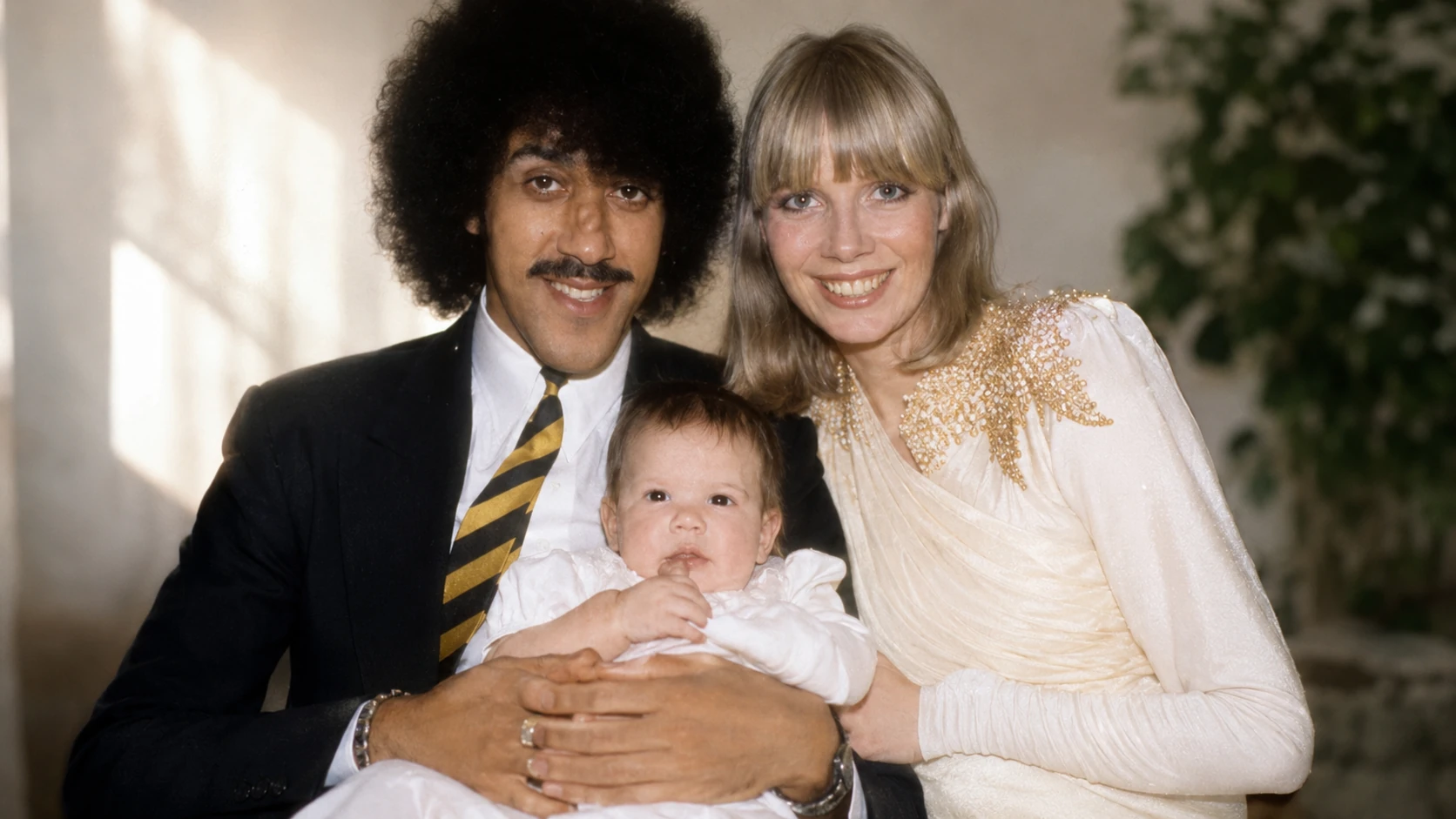
Caroline Crowther is best known to the public because of the man she married, but her story is not simply an appendix to Phil Lynott’s. She was the daughter of a famous British entertainer, worked close to the music business during one of rock’s most dramatic eras, and became part of the private world behind one of Ireland’s most loved performers. Her marriage to the Thin Lizzy frontman made her a figure of lasting curiosity, especially because she has spent much of her adult life outside the celebrity spotlight.
For many readers, the search for Caroline Crowther begins with Phil Lynott, the charismatic singer, bassist, and songwriter whose death in 1986 left rock music with one of its most painful losses. Yet Caroline’s name keeps appearing because she belonged to the part of Lynott’s life that fans still want to understand: his home, his children, his marriage, and the softer side behind the stage image. She was the mother of his daughters Sarah and Cathleen, both of whom inspired some of the most personal music associated with him.
The difficulty with writing about Caroline Crowther is that she is not a public celebrity in the modern sense. She has not lived by interviews, memoirs, brand deals, or constant public updates. A careful biography has to respect that boundary while still giving readers a clear account of what is publicly known, what is likely, and what should not be guessed.
Early Life and Family Background
Caroline Crowther was born into a family already familiar with performance, television studios, and public attention. Her father was Leslie Crowther, the English comedian, actor, and television presenter remembered for his work across British entertainment. He was a household name to many viewers, with a career that stretched through children’s television, game shows, variety performance, and charity broadcasting.
Being Leslie Crowther’s daughter placed Caroline near fame before she ever became linked with a rock star. That does not mean she grew up seeking attention herself, and it would be wrong to assume that a famous parent automatically creates a public child. What it does mean is that she understood celebrity culture from close range, long before her marriage made her part of a different kind of fame.
The Crowther household belonged to Britain’s mainstream entertainment world rather than the rougher, louder culture of rock touring. Leslie Crowther represented a polished form of television celebrity, the sort built around charm, timing, and broad family appeal. Phil Lynott, by contrast, came from a world of electric guitars, late nights, lyrical longing, and the restless identity of rock music.
That contrast became one of the quieter themes of Caroline’s public story. She stood at the meeting point of two entertainment cultures: one rooted in British television and one driven by Irish rock. It gave her life a distinctive public frame, even though she herself never became an entertainer in the same way her father or husband did.
Work in Music Publicity
Before her name became widely connected to Phil Lynott, Caroline Crowther had her own link to the music industry. She worked in music publicity, a field that sits close to celebrity but often behind the scenes. Publicists helped manage artists’ press coverage, interviews, appearances, and public presentation at a time when newspapers, magazines, radio, and television could shape a musician’s image with enormous force.
This detail matters because it makes Caroline more than a passive observer of rock fame. She knew something about how the industry worked, how artists were promoted, and how public stories were built. That knowledge would have given her a clearer view of Lynott’s world than someone meeting it from the outside.
The music business of the late 1970s and early 1980s was glamorous from a distance, but demanding up close. Bands toured heavily, press cycles moved fast, and personal lives were often bent around recording schedules, management pressures, and public expectation. A person working in that environment would have seen both the excitement and the strain.
Caroline’s publicity background also helps explain how she could move in the circles where Thin Lizzy operated. Her connection with Lynott was not simply a society romance or a chance meeting across unrelated worlds. It grew from a setting where media, music, and personality were constantly crossing paths.
Meeting Phil Lynott
Phil Lynott was already a major figure by the time Caroline Crowther entered his life. Born in England and raised in Dublin, he had become the defining face of Thin Lizzy, the band behind songs such as “The Boys Are Back in Town,” “Whiskey in the Jar,” “Jailbreak,” and “Dancing in the Moonlight.” He was a rare kind of rock frontman: romantic and tough, theatrical and shy, Irish in spirit yet shaped by a mixed cultural identity.
Lynott’s appeal was never only musical. He had a striking stage presence, a poet’s instinct for phrasing, and a voice that could make hard rock feel intimate. Fans saw the leather, the bass guitar, and the swagger, but his songs often carried longing, memory, family, and vulnerability.
Caroline met him inside a world where image and reality were always close together. She would have seen the charm that made Lynott magnetic, but also the pressures that came with being a bandleader, songwriter, and public symbol. He was not just a musician with fame; he was the emotional center of Thin Lizzy.
Their relationship developed during a period when Lynott’s life was already crowded with work, travel, attention, and temptation. That context is essential because their marriage would later be shaped by the same forces. Love entered a world that did not easily make room for ordinary domestic peace.
Marriage to Phil Lynott
Caroline Crowther married Phil Lynott on 14 February 1980, a Valentine’s Day wedding that has remained one of the most memorable personal dates in Lynott’s biography. The marriage brought together the daughter of a British television star and one of Ireland’s most charismatic rock musicians. It also came at a time when Lynott was balancing family life with a demanding creative career.
The wedding photographs have lived on because they capture more than a celebrity event. They show Lynott at a moment when his public and private lives seemed briefly aligned. He was a rock star, a husband, and already a father, trying to build a home life while still moving through the machinery of fame.
Caroline’s marriage to Lynott placed her in a difficult position. She was close enough to understand the person behind the stage persona, yet the public knew him mainly through performance, press coverage, and myth. That gap between private reality and public image is one of the reasons people remain curious about her.
The marriage also took place during the final major chapter of Thin Lizzy’s classic run. The band was still active, Lynott was also making solo music, and the pressures around him were rising. Caroline did not marry a man stepping away from fame; she married someone still deeply inside it.
Motherhood and Family Life
Caroline Crowther and Phil Lynott had two daughters, Sarah and Cathleen. Sarah was born before the marriage, and Cathleen followed during the early years of their family life. Their daughters became central to Lynott’s emotional world and to the way fans later understood his softer side.
Sarah Lynott is closely associated with the Thin Lizzy song “Sarah,” one of Lynott’s most tender recordings. The song gave fans a glimpse of him as a father rather than only a frontman. It remains one of the clearest examples of how family entered his music without losing its simplicity or sincerity.
Cathleen, too, became part of Lynott’s musical legacy. His affection for his daughters appeared in songs, interviews, and later family memories. Their names gave shape to the private life that existed behind the public drama of tours, records, and headlines.
For Caroline, motherhood meant raising children in the shadow of a famous and increasingly troubled father. That was not a simple role, and it should not be reduced to romantic rock biography. She had to manage real family life while the public continued to see Lynott through a very different lens.
Life Between Home and the Road
The life Caroline and Lynott shared was marked by distance as much as affection. Rock careers in that period required constant movement, and Thin Lizzy’s work took Lynott away from home for long stretches. Recording, touring, press duties, and social demands all competed with the ordinary needs of marriage and parenthood.
Accounts of Lynott’s later life often describe his attempts to create a family base. He had deep emotional ties to Dublin, to his mother Philomena, and to the idea of home. But he was also bound to London, to the record industry, and to the circles that came with his career.
That split placed pressure on Caroline. A young family needs presence, routine, and dependability, not only love. Lynott may have cared deeply for his daughters, but affection could not always overcome the instability of his working life and personal struggles.
This is where Caroline’s story becomes especially human. She was not living inside a fan’s dream of rock fame. She was living the practical consequences of it, including separation, uncertainty, and the emotional burden of loving someone whose life was becoming harder to control.
The Breakdown of the Marriage
By the mid-1980s, Caroline Crowther’s marriage to Phil Lynott had broken down. Public accounts generally place the collapse of the relationship around 1984, before Lynott’s death in January 1986. Some sources describe a divorce, while others use less exact wording, so the safest way to state it is that the marriage had effectively ended before his final illness.
The reasons are usually connected to Lynott’s worsening drug use and the instability of his final years. That subject needs care because addiction is often flattened into scandal after a famous person dies. In Lynott’s case, the record shows talent, charm, love, and damage existing together, not one simple moral lesson.
Caroline’s decision to separate from that life should be understood in the context of motherhood and self-preservation. She had two daughters to raise, and the pressures around Lynott were not abstract. They affected the home, the marriage, and the emotional safety of the family.
Lynott’s death on 4 January 1986, at the age of 36, turned a private family fracture into part of a public tragedy. For fans, it was the loss of a rock icon. For Caroline and her daughters, it was the loss of a husband, former partner, and father whose life had ended painfully young.
Phil Lynott’s Death and Its Aftermath
Phil Lynott’s final illness followed years of reported drug dependency and declining health. His death became one of the defining tragedies in Irish and British rock history. It also meant that Caroline Crowther’s connection to him would never fade into the normal privacy that might have followed a divorce or separation.
The public often remembers dead musicians in a fixed way. They remain young, talented, photogenic, and unfinished. Families have to live with something more complicated: grief, memory, practical affairs, and the ongoing retelling of the person’s life by strangers.
Caroline’s public role after Lynott’s death remained limited. She did not turn herself into a regular media commentator or celebrity widow figure. That choice has kept much of her later life private, but it has also created space for inaccurate claims to circulate.
The aftermath of Lynott’s death was also shaped by his mother, Philomena Lynott, who became a powerful keeper of his memory. Philomena’s devotion to her son’s legacy was public, emotional, and long-lasting. Caroline’s place in that legacy was quieter, but no less connected to the family story.
Caroline Crowther, Sarah and Cathleen
Sarah and Cathleen Lynott grew up with a famous father whose public memory only became larger after his death. Their names were already part of his music, but the reality of being his daughters carried more weight than any song title. Caroline’s role was to raise them beyond the mythology while the world continued to claim pieces of their father.
This is one of the most overlooked parts of Caroline’s life. Fans often approach Lynott through admiration, nostalgia, and loss, but his children had to understand him as a parent who was both loving and absent, gifted and troubled. Caroline stood closest to that difficult inheritance.
Over time, Sarah and Cathleen have appeared in projects connected to their father’s memory, including documentary work that gave family voices a place in the story. Their participation helped widen the public understanding of Lynott beyond the familiar arc of rock success and early death. It also showed how family memory can challenge the simpler version of celebrity history.
Caroline’s presence in that context is meaningful because she connects the adult Lynott to the father Lynott. She knew the man behind the music during a period of intense change. Her perspective helps fill in the domestic side of a life often told through albums, tours, and decline.
Connection to Leslie Crowther
Caroline Crowther’s father, Leslie Crowther, gives another dimension to her biography. He was not a minor showbusiness name, but a familiar British television personality with decades of public recognition. His career gave the Crowther family a place in entertainment long before Caroline became linked to rock history.
Leslie Crowther was associated with light entertainment, comedy, presenting, and charitable broadcasting. He represented a period of British television when presenters could become trusted figures in family homes. His public warmth and professional polish made him a recognizable presence across generations of viewers.
For Caroline, being his daughter likely meant growing up around performance culture, but not necessarily inside the same type of fame Lynott inhabited. Television fame and rock fame carried different rhythms, risks, and demands. Her life eventually touched both, which is one reason her biography sits at an unusual cultural crossing point.
The Crowther connection also explains why her marriage to Lynott drew attention beyond music circles. It was not only a rock star wedding. It linked two well-known entertainment families, one from British television and one from Irish rock.
Public Image and Private Choices
Caroline Crowther’s public image is defined largely by restraint. Unlike many people connected to famous musicians, she has not built a public platform around her past. She has appeared in relation to Lynott’s legacy, but she has not lived in constant public view.
That restraint makes her difficult to profile in the usual celebrity-biography style. There are no regular interviews to mine, no public social media persona to analyze, and no steady stream of personal updates. What remains is a set of verified connections and a long silence around the rest.
The truth is, that silence deserves respect. Public curiosity does not turn a private person’s entire life into public property. Caroline’s importance comes from her place in a major music story, but her personal boundaries still matter.
This also means readers should be cautious with claims about her current relationships, wealth, address, or daily life. Unless such details come from reliable public records or direct reporting, they should not be repeated as fact. A good biography of Caroline Crowther has to be as disciplined about what it leaves out as what it includes.
Name, Records and Later Life
In later public records and credits, Caroline Crowther appears under the name Caroline Taraskevics. That name has appeared in connection with formal company records and projects related to Phil Lynott’s legacy. The use of another surname has contributed to online confusion, but it is a normal part of tracing public records across decades.
One documented connection is Lynott Limited, a company associated with the Lynott family name. Caroline Susan Taraskevics appeared as a former director, and Sarah and Cathleen Lynott have also appeared in related records. The company record confirms a formal link, but it does not reveal the full details of music rights, estate management, or private family arrangements.
That distinction matters because many online biographies make broad claims from narrow evidence. A company directorship can show involvement, but it does not explain every financial or legal detail. Without estate filings, contracts, or direct family statements, stronger claims would be speculation.
As for where Caroline Crowther is now, the honest answer is that she appears to live privately. She is not a regular public figure, and there is no reliable public account of her daily life. Her known later public role remains tied mainly to Lynott’s family history and documentary legacy.
Net Worth and Income Sources
There is no credible public record that establishes Caroline Crowther’s personal net worth. Any precise number attached to her name online should be treated with caution unless it comes from reliable financial documents, court records, or direct reporting. Most celebrity net worth pages use estimates, and in cases like Caroline’s they often lack enough evidence to be useful.
Her possible income sources across her life may have included work in publicity, family or business interests, and any private arrangements connected to the Lynott estate or related companies. But “possible” is not the same as proven. A responsible account should not convert assumptions into figures.
Phil Lynott’s music has continued to earn attention and value through recordings, licensing, documentaries, reissues, and the lasting popularity of Thin Lizzy. Still, that does not allow outsiders to calculate Caroline’s finances. Music rights can be divided in complex ways among estates, publishers, labels, heirs, companies, and contractual partners.
For readers searching “Caroline Crowther net worth,” the best answer is clear but unsatisfying: no reliable public figure is available. Her financial life is private, and there is not enough verified information to give a meaningful estimate. Guessing would not add value; it would only create another shaky claim for other sites to copy.
Cultural Legacy and Why People Still Search Her Name
Caroline Crowther remains a subject of interest because Phil Lynott remains culturally alive. Thin Lizzy’s music still reaches new listeners, and Lynott’s image remains powerful in Ireland, Britain, and beyond. Every new documentary, anniversary, reissue, or article brings fresh attention to the people closest to him.
She also interests readers because she represents the part of Lynott’s life that fame did not fully explain. The songs for Sarah and Cathleen, the marriage, the family home, and the breakdown all reveal a man more complex than the leather-clad frontman of rock memory. Caroline’s story helps readers understand the emotional cost behind the music.
There is also a larger reason her name keeps returning. Rock history has often treated wives and partners as background figures, even when they carried much of the private burden. Caroline’s life shows how close family members can become part of a legend without choosing the legend for themselves.
Her quiet public presence is not a lack of story. It is the story. Caroline Crowther’s biography is about proximity to fame, the strain of loving a troubled artist, and the long discipline of privacy after a public loss.
Frequently Asked Questions
Who is Caroline Crowther?
Caroline Crowther is best known as the former wife of Phil Lynott, the lead singer, bassist, and songwriter of Thin Lizzy. She is also the daughter of British entertainer Leslie Crowther and the mother of Lynott’s two daughters, Sarah and Cathleen. Her name appears often in searches about Lynott because she was part of his closest family life.
She worked in music publicity before becoming widely known through her relationship with Lynott. That background placed her near the music industry before her marriage made her part of rock history. She has since kept a mostly private life and is not a public celebrity in the modern sense.
Was Caroline Crowther married to Phil Lynott?
Yes, Caroline Crowther married Phil Lynott on 14 February 1980. Their wedding is one of the better-known personal events in Lynott’s biography because it joined two entertainment families and took place during a major period in his career. They had already begun building a family by the time of the marriage.
The relationship later broke down before Lynott’s death in January 1986. Public accounts commonly place the separation around 1984, though wording varies between sources. The safest description is that the marriage had effectively ended before Lynott’s final illness and death.
How many children did Caroline Crowther have with Phil Lynott?
Caroline Crowther and Phil Lynott had two daughters together, Sarah and Cathleen. Sarah inspired the Thin Lizzy song “Sarah,” which remains one of Lynott’s most personal and tender recordings. Cathleen was also honoured in Lynott’s music and remains part of his family legacy.
Both daughters have been connected to later projects about their father’s life and memory. Their presence helps show Lynott as more than a rock star or tragic figure. Through them, the public sees more of him as a father and family man.
Is Caroline Crowther Leslie Crowther’s daughter?
Yes, Caroline Crowther is the daughter of Leslie Crowther, the British comedian, actor, and television presenter. Leslie was a familiar figure in British entertainment, especially through television and light entertainment work. His career made the Crowther name known before Caroline’s connection to Phil Lynott.
This family background is important because Caroline was not unfamiliar with public life. She grew up close to entertainment culture, though she chose a much quieter public path herself. Her marriage to Lynott connected the Crowther family’s television world with the rock world of Thin Lizzy.
What does Caroline Crowther do now?
Caroline Crowther appears to live privately, and there is no reliable public record giving a detailed account of her current daily life. She has appeared in later contexts connected to Phil Lynott’s legacy, including documentary-related material and public records under the name Caroline Taraskevics. Beyond that, she has not maintained a high media profile.
Because she is a private person, claims about her present home, relationships, or routine should be treated carefully. Many online summaries recycle unsourced details without proof. The most accurate answer is that she remains publicly known mainly through her family connection to Lynott and their daughters.
What is Caroline Crowther’s net worth?
Caroline Crowther’s net worth is not publicly confirmed. There is no reliable financial disclosure that establishes a precise figure, and online estimates should be treated as guesses. A private person’s finances cannot be calculated accurately from a famous marriage alone.
Possible sources of income across her life may have included publicity work, private business interests, and any family arrangements connected to Lynott’s legacy. But those details are not public enough to support a firm estimate. The most honest answer is that her net worth is unknown.
Is Caroline Crowther the same as Professor Caroline Crowther?
No, Caroline Crowther connected to Phil Lynott should not be confused with Professor Caroline Crowther, the medical researcher. They are different people who share a similar name. This confusion appears in search results because both names have public records in different fields.
The Caroline Crowther in Phil Lynott’s biography belongs to music and entertainment history. Professor Caroline Crowther belongs to academic and medical research. Mixing the two leads to inaccurate biographies and should be avoided.
Conclusion
Caroline Crowther’s life sits at the edge of fame rather than at its center. She was born into a known entertainment family, worked near the music business, married one of rock’s most charismatic figures, and raised the daughters whose names became part of Phil Lynott’s musical legacy. Yet she chose privacy in a world that often rewards exposure.
Her story matters because it restores scale to the Phil Lynott legend. Behind the songs, stage lights, and tragedy was a family living with real pressures. Caroline’s place in that family gives readers a fuller understanding of Lynott as a husband, father, and flawed human being.
What stands out most is not scandal or spectacle, but restraint. Caroline Crowther did not turn proximity to fame into a public career. She remains a reminder that some of the most important people in famous lives are the ones who carry memory quietly, outside the spotlight.
That is why readers still search her name. They are not only looking for facts about a former rock star’s wife. They are looking for the human story behind the music, and Caroline Crowther is central to that story whether or not she ever sought the attention.