
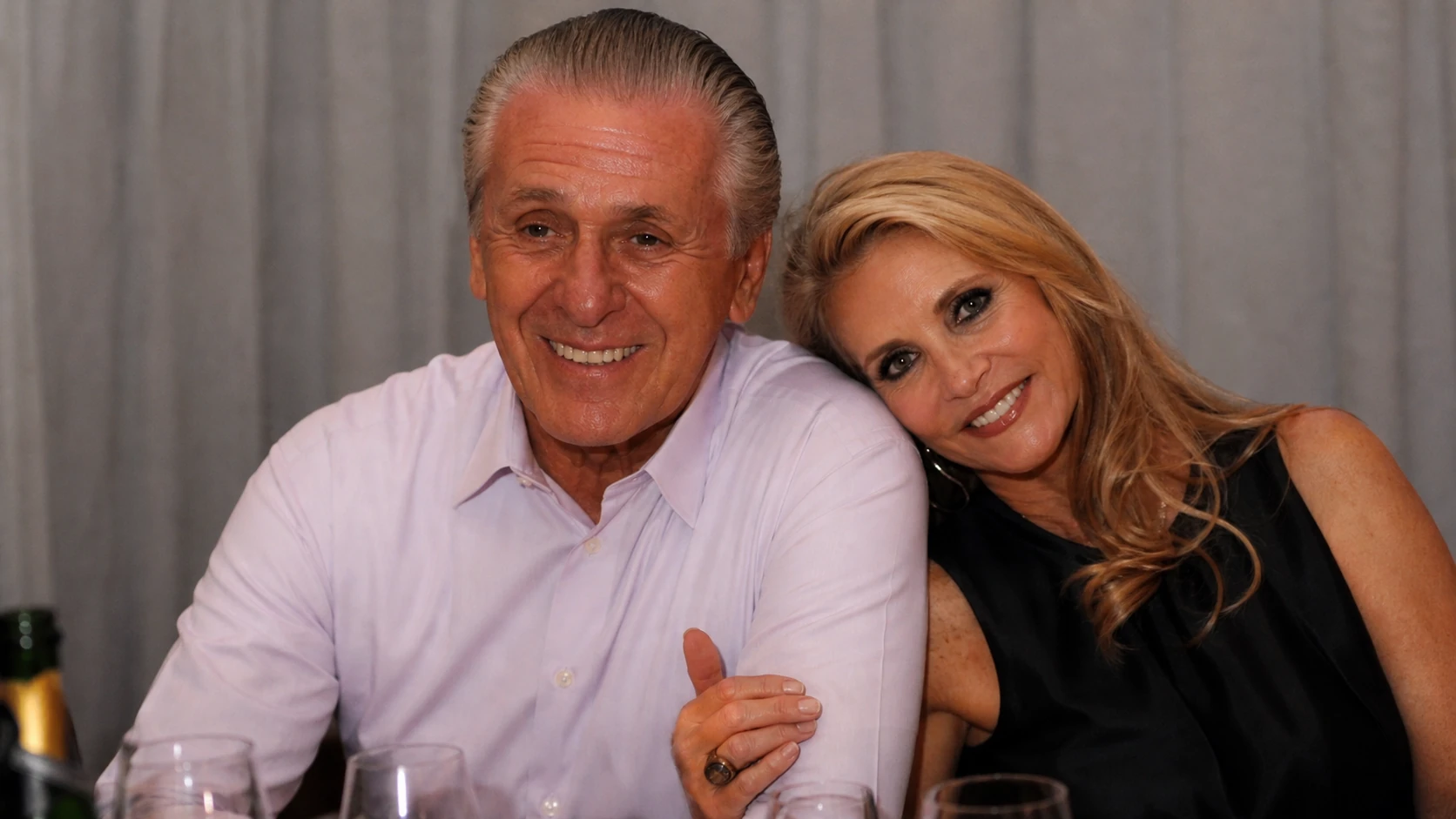
Chris Rodstrom has spent more than half a century near one of basketball’s most polished and powerful public figures, yet she has never seemed interested in becoming famous herself. As the wife of Pat Riley, the Hall of Fame coach and longtime Miami Heat executive, she has been present for dynasties, reinventions, championships, relocations, and public honors that helped shape modern NBA history. Her name appears whenever people search for the private side of Riley’s life, especially because their marriage has lasted since 1970, long before the suits, the slicked-back hair, the Lakers parades, and the Heat empire.
But Chris Rodstrom is not simply a footnote in a sports biography. Public accounts describe her as a former therapist or psychology-trained professional, a mother, a charity supporter, and a stabilizing partner through Riley’s demanding career. Much of her life remains private, and that privacy has led many online profiles to fill gaps with repeated claims that are not always well sourced. The more honest story is quieter but more interesting: Rodstrom built a life beside fame without turning herself into a public figure.
Early Life and Publicly Known Background
Chris Rodstrom is often identified in biographical accounts as Christine Rodstrom, though she is more commonly known publicly as Chris Rodstrom or Chris Riley. Many online sources say she was born in 1951 in Maryland, but that detail is not as firmly documented as the basic facts of her adult life with Pat Riley. Unlike Riley, whose playing and coaching records are preserved in sports archives, Rodstrom’s early life has not been covered in depth by major newspapers or official biographical institutions. That creates a challenge for any serious profile: her public story begins mostly through her marriage.
Several accounts describe Rodstrom as coming from a family connected to the military, with a father said to have served in the Navy. That detail appears often in entertainment and biography sites, but it should be treated carefully because it is not widely confirmed through primary public records. What can be said with more confidence is that she grew into adulthood outside the celebrity culture that later surrounded Riley. Her public identity was not created by entertainment, sports media, or business branding.
Her reported academic path has also drawn interest because of the way it fits the role she later occupied in Riley’s life. Rodstrom is widely described as having studied psychology and as having worked in counseling or therapy. Those descriptions appear across many secondary profiles, and they align with Riley’s own later comments about her emotional intelligence and support within team family circles. Still, exact degree information, licensing status, and workplace history are not clearly established in the public record.
Meeting Pat Riley Before the Fame
The most important relationship in Chris Rodstrom’s public biography began before Pat Riley became a coaching icon. Riley was a young athlete from Schenectady, New York, who had starred at the University of Kentucky before entering professional basketball. He was selected by the San Diego Rockets in the 1967 NBA Draft, and his early playing years placed him in California during a period of transition for both his career and personal life. It was during those years that he met Chris.
Their relationship began before Riley became the image-conscious leader later known for sharp tailoring and championship standards. At that time, he was still trying to establish himself as a player in a league that looked very different from the NBA of today. Professional basketball was not yet the global entertainment machine it would become, and players did not have the same celebrity ecosystem around them. That early timing matters because Rodstrom knew Riley before his name carried institutional weight.
Chris Rodstrom and Pat Riley married in June 1970. That year places their marriage before Riley’s coaching career, before Magic Johnson joined the Los Angeles Lakers, and before the “Showtime” label became part of basketball language. Their partnership has endured through more than five decades of career pressure and public scrutiny. In sports, where long marriages often face the stress of travel, fame, and constant reinvention, that longevity is one of the clearest facts that keeps readers curious about her.
Life During Pat Riley’s Playing Years
When Rodstrom married Riley, he was still close to the beginning of his NBA playing career. Riley played for the San Diego Rockets and then became part of the Los Angeles Lakers, where he was a member of the 1971-72 championship team. That Lakers group, led by stars such as Jerry West and Wilt Chamberlain, produced one of the most celebrated seasons in league history. For Rodstrom, it meant entering the rhythms of professional sports at a young age.
The life of an NBA spouse in that era was far less public than it is now. There were no social media accounts to monetize, no reality shows built around athletes’ families, and far fewer public channels for spouses to craft their own public identities. Travel and team life still demanded flexibility, but the visibility was different. Rodstrom’s public silence seems rooted partly in that older sports culture, where the family often remained behind the curtain.
Riley’s playing career did not make him a superstar, but it gave him access to the world that would later define him. He learned from coaches, veterans, locker rooms, and pressure-filled playoff environments. Rodstrom witnessed that evolution up close while remaining largely outside the media frame. That early chapter set the pattern for much of her public life: near the center of basketball history, but rarely in the foreground.
Reported Career in Psychology and Counseling
Chris Rodstrom is most often described professionally as a former therapist, psychologist, or marriage counselor. The exact title varies depending on the source, which is why careful wording matters. Some profiles say she earned a master’s degree in educational psychology, while others describe her work more broadly in counseling. Because official career documentation is limited, those claims should be understood as widely reported rather than fully verified in detail.
The reported background is still meaningful because it helps explain how people around Riley have described her presence. Counseling work requires listening, patience, emotional control, and the ability to read stress before it becomes conflict. Those qualities would have been useful in the high-pressure world Riley entered as a coach. They also help explain why stories about her often focus less on glamour and more on steadiness.
At some point, according to common accounts, Rodstrom stepped away from formal professional work as Riley’s coaching career grew more demanding. That would not have been unusual for a spouse managing family responsibilities during an era when coaching jobs required extreme hours and frequent moves. Still, it would be unfair to reduce that choice to sacrifice alone. Private families often make practical decisions that cannot be fully understood from the outside.
The Showtime Lakers Years
Pat Riley became head coach of the Los Angeles Lakers in 1981, a career shift that changed the course of his life and indirectly brought more public attention to Chris Rodstrom. The Lakers of the 1980s were a cultural force built around Magic Johnson, Kareem Abdul-Jabbar, James Worthy, Hollywood courtside glamour, and a fast, glamorous style of basketball. Riley’s image hardened during that period into something almost cinematic. Behind that image, his family life remained guarded.
Rodstrom’s public role during those years was not operational in the way assistant coaches, scouts, or executives shaped the team. There is no credible basis for saying she designed strategy or made basketball decisions. Her role, based on Riley’s own reflections in later accounts, appears to have been more personal and relational. She helped support the environment around him at a time when the Lakers were living under constant expectation.
That distinction matters because spouses of famous men are often described in exaggerated terms. They are either erased entirely or credited with vague, sweeping influence that cannot be measured. Rodstrom’s story sits between those extremes. She was not running the Lakers, but she was part of the emotional structure around a coach whose public life demanded discipline, focus, and control.
Marriage Under Championship Pressure
Championship success can look glamorous from the outside, but inside a household it can be consuming. Riley’s coaching style was intense, and his teams were expected to win. During the Lakers years, every playoff run carried national attention, and every loss invited criticism. A marriage living alongside that pressure needed more than ceremonial support.
Rodstrom’s reported background in counseling makes her long partnership with Riley especially interesting to readers. She would have understood stress, conflict, and the cost of ambition in a way that many people outside elite sports might not. Riley has often been described as demanding, exacting, and deeply committed to standards. Living beside that kind of drive for decades required resilience from both partners.
Their marriage survived major professional transitions after Los Angeles as well. Riley left the Lakers, coached the New York Knicks, then moved to the Miami Heat, where he became the defining architect of the franchise. Each move brought a new city, a new public identity, and new pressure. Through those changes, Rodstrom remained part of his private foundation.
Motherhood and Family Life
Chris Rodstrom and Pat Riley have two children, James Patrick and Elisabeth Marie. Publicly available family references identify them as the couple’s son and daughter, and many secondary accounts say both children were adopted. The family has kept those personal details largely private, which is consistent with the way Rodstrom has handled most aspects of her life. Their children have not pursued the same level of public visibility as their father.
The couple’s path into parenthood came while Riley’s coaching career was already intense. That timing would have shaped daily family life, especially during long NBA seasons. Coaches travel constantly, work late, study film, manage athletes, and live under public evaluation. In that setting, the home life around the coach often carries burdens that fans rarely see.
Rodstrom’s privacy as a mother appears intentional. She has not used her children as public extensions of the Riley brand, and the family’s personal details are not widely displayed. That restraint stands out now because celebrity culture often rewards exposure. In Rodstrom’s case, privacy seems less like absence and more like a family value.
The Move to New York and Miami
After the Lakers, Riley coached the New York Knicks from 1991 to 1995. The Knicks years were a sharp contrast to Showtime, defined by physical defense, playoff battles, and the pressure of Madison Square Garden. New York sports media is famously intense, and Riley’s move placed him in one of the most demanding markets in American sports. Rodstrom again remained largely out of the public spotlight.
In 1995, Riley moved to the Miami Heat, taking on the role that would define the second half of his basketball life. He became head coach and team president, building Miami into one of the NBA’s most respected organizations. The Heat won the 2006 NBA championship with Riley as head coach and later built the LeBron James, Dwyane Wade, and Chris Bosh era with Riley in the front office. Miami became not just his workplace but a long-term home base.
Rodstrom’s connection to Miami is visible mostly through family and charity settings. She has appeared with Riley at public events, Heat functions, and community efforts. Her life there reflects a different phase from the Lakers years: less show business, more institution-building. As Riley became an executive elder statesman, Rodstrom remained the steady private figure beside him.
Charity Work and Public Contributions
One of the clearest areas where Chris Rodstrom appears in the public record is philanthropy. She and Pat Riley have been associated with Miami Heat charitable efforts, including work connected to the Miami HEAT Charitable Fund and Miami HEAT Family Outreach. These efforts have supported South Florida organizations focused on families, children, health, education, and crisis services. The exact totals raised vary by year and source, but the charitable direction is well established.
Rodstrom’s public contribution in this area fits her broader profile. She is not usually the person at the microphone, but her name appears in connection with causes that reflect family support and community care. The Heat organization has long used its platform for charity events, and the Rileys have been part of that culture. This is one of the few public-facing spaces where Rodstrom’s work is more visible.
Pat and Chris Riley have also been connected to causes supporting military families and veterans. That interest aligns with the commonly reported military background in Rodstrom’s family, though the connection should not be overstated without direct confirmation from her. What can be said is that their philanthropy has not been limited to basketball-related branding. It has included people facing serious personal and family hardship.
Public Image and Media Portrayal
Chris Rodstrom’s public image is built on restraint. She appears at major events, but she does not behave like a celebrity spouse seeking an audience. That makes her unusual in the modern sports-media age, where public visibility can easily become its own business. Her name circulates because of Riley, but her identity has not been shaped by constant interviews, memoirs, or social media.
This limited visibility has created space for inaccurate or weakly sourced claims. Many online biographies repeat the same details about her age, education, career, and net worth without offering clear evidence. Some may be accurate, but repetition alone does not make a fact reliable. A respectful biography has to avoid pretending that every search result is equally trustworthy.
Her portrayal in popular culture added another layer of interest. HBO’s series about the Showtime Lakers included a dramatized version of Chris Riley, introducing her name to viewers who knew little about Riley’s personal life. Dramatized television can spark curiosity, but it should not be mistaken for a factual record. The real Chris Rodstrom has given the public far less access than any scripted version suggests.
Money, Lifestyle, and Net Worth
Readers often search for Chris Rodstrom’s net worth, but there is no reliable public financial disclosure that establishes an individual figure for her. Many websites publish estimates, sometimes ranging widely, but those numbers should be treated as guesses. Rodstrom’s personal finances are closely tied in public imagination to Pat Riley’s long and lucrative NBA career. That does not mean anyone outside the family can accurately separate or calculate her individual wealth.
Pat Riley’s wealth is much easier to discuss in general terms because his career earnings came from decades as a player, coach, executive, author, speaker, and rights holder. He also benefited from one of the most famous phrases in sports marketing: “three-peat,” a term connected to trademark income over the years. Those earnings belong to Riley’s broader business and family story, but they do not prove a precise personal net worth for Chris. Serious reporting should avoid treating unsourced celebrity-finance pages as fact.
The couple’s lifestyle appears comfortable, as expected for a family connected to one of the NBA’s most successful executives. Yet Rodstrom has never built her public identity around luxury display. That silence is itself part of the story. Her value in the public imagination comes from longevity, discretion, and proximity to history, not from showing off wealth.
Relationship With Pat Riley’s Legacy
Pat Riley’s legacy is enormous by any basketball measure. He won as a player, became one of the defining coaches of the 1980s, pushed the Knicks into bruising contention in the 1990s, and built the Miami Heat into a championship organization. His career has spanned eras, styles, stars, and business models. Few figures have remained so influential in the NBA for so long.
Rodstrom’s relationship to that legacy is intimate rather than institutional. She is part of the private continuity behind a public career defined by change. Riley reinvented himself several times, but the marriage remained constant. That is why she continues to interest readers even though she rarely speaks publicly.
The most revealing public moments involving Rodstrom often come when Riley acknowledges her. During major honors, including ceremonies tied to his Heat tenure, he has spoken of her with gratitude. Those moments matter because they show that Riley sees his story as shared, even if the world mostly records his name. Rodstrom’s place in his legacy is not about trophies on a shelf; it is about the life surrounding the pursuit of them.
Where Chris Rodstrom Is Now
Chris Rodstrom is believed to live a private life with Pat Riley, connected primarily to family, charitable appearances, and major public events involving the Heat or Riley’s career. She does not appear to maintain a public professional platform or active media presence. That makes updates about her current life limited, but it also reflects a consistent pattern across decades. She has chosen privacy even as the public’s curiosity has grown.
Riley has remained active in basketball into his eighties, especially through his role with the Miami Heat. As long as he remains a major NBA figure, Rodstrom’s name will continue to surface around honors, family references, and retrospectives. She is part of the living memory of several NBA eras, even if she experienced them from a private vantage point. Her current status is best described as retired from public professional life, private, and still closely associated with Riley’s family and charitable world.
There is no credible sign that Rodstrom seeks a separate public comeback, media project, or celebrity profile. That is important because many search-driven biographies imply there must always be a new development. Sometimes the truest update is continuity. Chris Rodstrom remains who she has long appeared to be: a private person attached to a very public story.
Frequently Asked Questions
Who is Chris Rodstrom?
Chris Rodstrom is the longtime wife of Pat Riley, the Hall of Fame basketball coach and Miami Heat executive. She is often described as a former therapist or psychology-trained professional, though detailed records of her career are not widely public. Her public identity is tied to Riley’s family life, NBA journey, and charitable work.
She has stayed mostly out of the media despite being connected to one of basketball’s best-known figures. That privacy is why many readers search for her and why reliable information about her can be harder to separate from repeated online claims. The most firmly established facts involve her marriage, children, public appearances, and philanthropy.
How long have Chris Rodstrom and Pat Riley been married?
Chris Rodstrom and Pat Riley married in June 1970. Their marriage began before Riley became a famous coach and before the Los Angeles Lakers’ Showtime era turned him into a major sports figure. That makes their relationship one of the longer-lasting marriages connected to modern NBA history.
Their partnership has lasted through Riley’s playing career, coaching career, front-office career, and major moves from Los Angeles to New York and Miami. The length of the marriage is one reason Rodstrom remains a subject of public curiosity. It also gives her a unique place in the personal history behind Riley’s professional success.
Did Chris Rodstrom work as a therapist?
Chris Rodstrom is widely reported to have worked in therapy, counseling, or psychology before stepping away from formal professional life. Some profiles describe her as a former marriage counselor or psychologist. The exact details of her education, licensing, and career timeline are not clearly documented in the strongest public sources.
Because of that, the fairest wording is that she is commonly described as having a counseling or psychology background. That reported background fits public descriptions of her support role during Riley’s coaching years. Still, it should not be treated as a fully documented professional biography unless stronger records are produced.
Do Chris Rodstrom and Pat Riley have children?
Yes, Chris Rodstrom and Pat Riley have two children, James Patrick and Elisabeth Marie. Public family references identify them as the couple’s son and daughter. Many accounts say both children were adopted, though the family has kept personal details relatively private.
Neither child has lived with the same public profile as Pat Riley. That privacy appears consistent with the way Rodstrom has approached family life. The Riley family has generally kept personal matters separate from Pat Riley’s highly visible basketball career.
What is Chris Rodstrom’s net worth?
Chris Rodstrom’s individual net worth is not reliably confirmed. Many websites publish estimated figures, but those estimates are not based on public financial disclosures that clearly separate her personal assets from the Riley family’s broader wealth. For that reason, any exact number should be treated with caution.
Pat Riley has earned substantial wealth through his long NBA career, executive roles, books, speaking, and business interests. That does not make it possible to state Chris Rodstrom’s personal net worth with confidence. A responsible answer is that she is likely financially secure, but no verified individual figure is available.
Was Chris Rodstrom portrayed on television?
Yes, a dramatized version of Chris Riley appeared in HBO’s series about the Showtime Lakers. The character introduced many viewers to Pat Riley’s marriage and private life during the Lakers era. Like any dramatized series, it should not be treated as a strict biography.
Television often compresses real people into story functions, especially when the main focus is a sports dynasty. The real Chris Rodstrom has maintained a much lower public profile than a scripted portrayal can suggest. Viewers interested in her life should separate entertainment from documented fact.
Why is Chris Rodstrom so private?
Chris Rodstrom appears to have chosen privacy throughout her adult life. She has attended major public events and been connected to charitable work, but she has not built a media identity around her marriage. That choice has kept many details about her early life, career, and daily life out of public view.
Her privacy also reflects an older model of sports family life. She married Riley before celebrity spouses became public brands in their own right. In her case, discretion has remained consistent across decades, even as public curiosity has increased.
Conclusion
Chris Rodstrom’s biography is not the story of a person chasing fame. It is the story of someone who lived beside fame for more than fifty years and still kept much of herself private. That restraint can frustrate readers looking for easy details, but it also gives her public image a rare kind of dignity.
What is known is enough to understand why she matters. She married Pat Riley before his great public ascent, raised a family with him, supported life around his demanding career, and appeared in charitable and ceremonial spaces connected to the Miami Heat. Her reported background in counseling adds depth to the picture, even though the exact details should be treated carefully.
The better way to see Chris Rodstrom is not as a hidden celebrity or a mystery to be solved. She is a private woman whose life intersects with one of basketball’s most famous careers. Her continuing relevance comes from that contrast: near the center of NBA history, but still largely in control of what the public gets to know.