
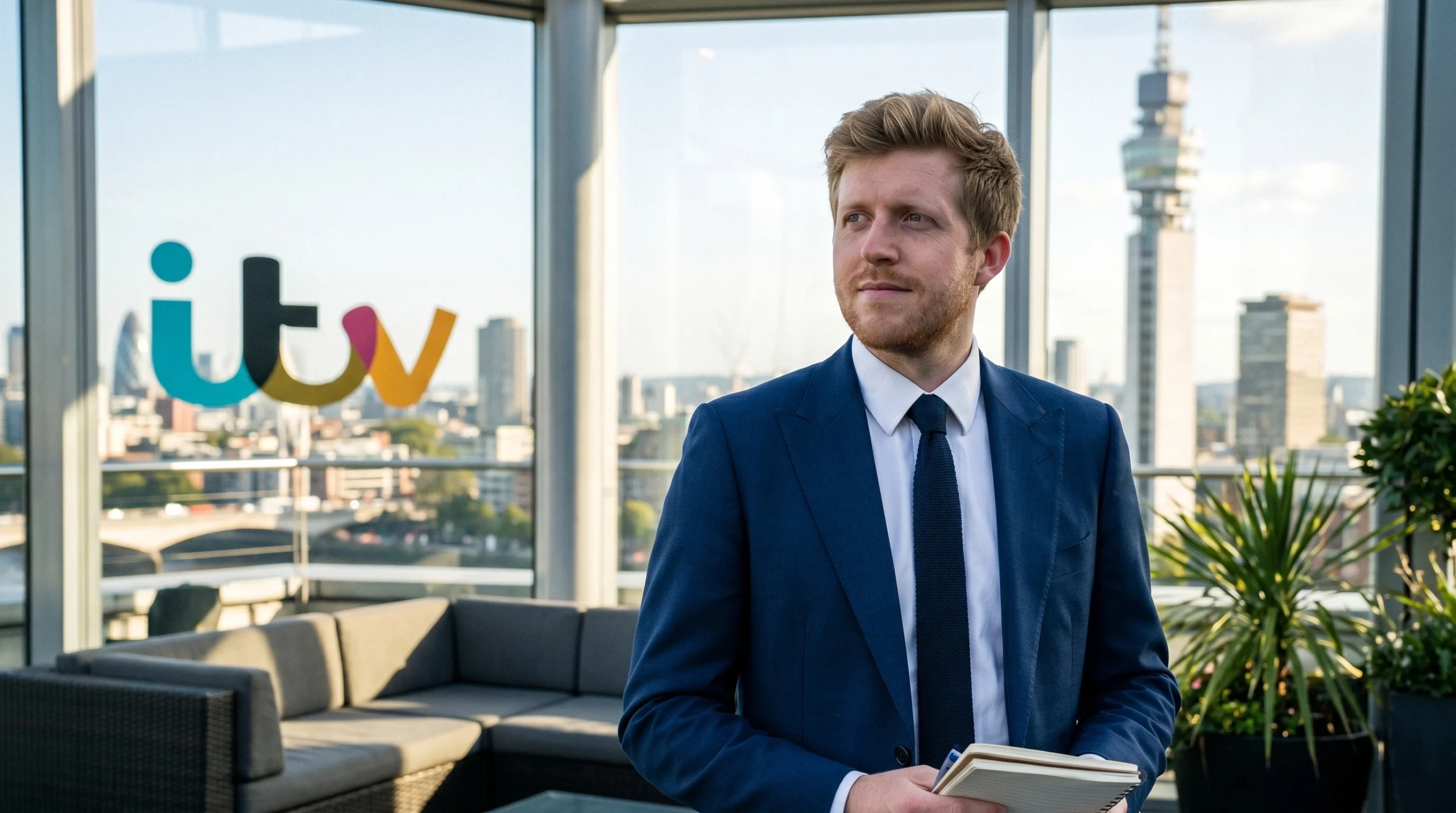
Fred Dimbleby arrived in British journalism with a surname that already carried decades of broadcasting history. For many viewers, the name Dimbleby immediately calls up election nights, state occasions, political interviews, and a particular tradition of serious public-service journalism. Yet Fred Dimbleby’s own career is not simply an inherited footnote to that story. He is a working television journalist in his own right, best known publicly as a political correspondent for ITV News Calendar, with experience across regional news, national production, and international bureau work.
That combination makes him a quietly interesting figure. He is not a celebrity broadcaster in the old mold, and he has not built his public image through self-promotion. Most of what is known about him comes through his reporting, his ITV profile, and a few reliable public records from his education and early journalism. The result is a biography that has to be written with care: clear on confirmed facts, cautious about private life, and alert to the way a famous family name can both illuminate and distort a young journalist’s story.
Early Life and Family Background
Fred Dimbleby is widely known as the son of David Dimbleby, one of Britain’s most recognisable broadcasters. David Dimbleby spent decades at the BBC, where he became closely associated with general election coverage, Question Time, documentaries, royal events, and major moments in national life. That makes Fred part of one of the few British families whose name has become almost shorthand for broadcast authority. It also means public curiosity about him often begins before readers know anything about his own work.
The Dimbleby family’s place in British media goes back further than David. Fred’s grandfather, Richard Dimbleby, was one of the defining figures of early British broadcast journalism. He was the BBC’s first war correspondent, reported from Europe during the Second World War, and later became a major voice of national broadcasting. His report from Bergen-Belsen after its liberation in 1945 remains one of the most powerful moments in BBC history.
That legacy gives Fred Dimbleby an unusual background for a young journalist. In many families, a career in television news would be a bold departure. In the Dimbleby family, it sits inside a long public tradition, with all the opportunity and pressure that implies. A famous surname can help people remember you, but it can also make them assume they already understand you.
Fred’s upbringing was shaped by that public family context, though he has not made a habit of discussing his private life in detail. Available reporting places him at Brighton College before Oxford, which suggests a well-resourced and academically strong education. Beyond that, the responsible record becomes thinner. He has kept much of his personal background outside the spotlight, and there is no good reason to fill those gaps with guesswork.
Education and First Ambitions
One of the clearer early records of Fred Dimbleby’s life comes from his academic path. In 2016, he was reported to have achieved A* grades in government and politics, religious studies, and history at Brighton College. He was then expected to read history at Keble College, Oxford. The subject choice fits naturally with a later move into political journalism, though it would be too neat to claim it made that path inevitable.
At Oxford, Dimbleby became involved in student journalism. Cherwell, the university’s long-running student newspaper, identifies him as a historian at Keble College and records that he served as editor during Trinity Term 2018. Before becoming editor, he had also worked as comment editor. Those roles matter because they show him engaging with journalism before he entered a professional newsroom.
Student newspapers are often dismissed as training grounds, but they can be demanding places. Editors have to commission pieces, judge tone, deal with deadlines, handle sensitive campus issues, and make decisions that will be challenged by readers. For someone moving toward political reporting, that kind of early editorial work offers more than a line on a CV. It gives practice in weighing evidence, shaping arguments, and understanding how public debate actually sounds when people disagree.
Dimbleby’s academic background also helps explain the style of journalism he appears to have pursued. History rewards context, chronology, and attention to how institutions behave over time. Political reporting, at its best, needs exactly those habits. It asks not only what happened today, but why today’s event is connected to decisions made months or years earlier.
Joining ITV and Learning the Newsroom
Fred Dimbleby’s professional journalism career is most clearly linked with ITV. His ITV profile identifies him as Political Correspondent for ITV News Calendar and says he previously worked as a producer on ITV’s national news team in London. It also says he worked in ITV’s Washington, DC bureau. That path suggests a grounding in the practical machinery of television news before a more visible reporting role.
Producer experience is important because television news is not only what viewers see on screen. Producers shape running orders, prepare scripts, check facts, coordinate crews, brief correspondents, and make fast decisions when stories change. A reporter who has spent time in production usually understands how fragile a broadcast can be and how much unseen labor sits behind a clean two-minute package. That knowledge can make on-air journalism sharper and less careless.
The Washington experience also adds weight to his early career. A US bureau exposes journalists to international news, American politics, diplomatic stories, elections, and breaking events that often move quickly across time zones. Even if a producer is not the face of that coverage, the bureau environment teaches urgency and scale. It also broadens a journalist’s sense of how domestic politics looks from outside Britain.
This part of Dimbleby’s career is less publicly documented than his current ITV role, but the broad outline is credible because it comes from ITV’s own profile. It is also consistent with the way many broadcast journalists develop. They do not begin as household names. They learn the job through production shifts, field work, regional assignments, difficult scripts, and editors who push them to be clearer.
Reporting for ITV Channel
Before becoming closely associated with ITV News Calendar, Fred Dimbleby appeared in bylines and reports for ITV Channel. That work included local and political stories from Jersey and the Channel Islands. ITV Channel reporting requires a journalist to cover a distinctive patch, where local identity, Crown Dependency status, UK politics, tourism, finance, sport, and community life often overlap. For a developing reporter, it is a useful place to learn how national themes land in a smaller jurisdiction.
One of his more visible ITV Channel reports came in May 2024, when he interviewed Baroness Arlene Foster during her visit to Jersey. Foster, the former First Minister of Northern Ireland and former leader of the Democratic Unionist Party, discussed unionism and rejected the suggestion that a united Ireland was politically near. That was not a routine soft interview. It connected Northern Irish politics, the constitutional position of the Crown Dependencies, and wider debates about identity and sovereignty.
Dimbleby also reported lighter local stories, including a feature on Jersey’s Seawolves inline hockey team. Pieces like that may seem far removed from political correspondence, but they are part of the same craft. Local television reporters often need to move from public policy to sport to community life in the same week. The test is whether they can treat each story with proportion, clarity, and enough curiosity to make viewers care.
This range is worth noticing because it keeps the biography honest. Fred Dimbleby did not appear fully formed as a political correspondent. Like many reporters, he built experience across different kinds of assignments. The public may be drawn to his surname, but the work itself shows a more ordinary and instructive route through regional journalism.
Political Correspondent for ITV News Calendar
Fred Dimbleby is now best known publicly as Political Correspondent for ITV News Calendar. ITV News Calendar serves audiences across Yorkshire, Lincolnshire, North Nottinghamshire, and North Derbyshire. It is a large and politically varied region, with major cities, rural communities, coastal towns, university centres, former industrial areas, and local authorities facing very different pressures. Covering politics for that audience is not the same as sitting in Westminster and describing party tactics.
The role asks a correspondent to translate national politics into regional consequence. A government announcement about transport, housing, health, farming, policing, or local government finance becomes meaningful only when viewers can see who is affected. Regional political journalism has to answer practical questions: what changes, who pays, what has been promised, what has been delayed, and whether local leaders have the power they claim to have. That is a demanding form of reporting because it leaves little room for vague political theatre.
ITV Calendar’s patch also matters electorally. Yorkshire and Lincolnshire include areas that have changed political hands in recent election cycles, as well as places with deep local loyalties and long memories of industrial decline. A political correspondent working there has to understand Westminster, but also councils, mayors, public services, local campaigns, and regional identity. The best reporting in that space does not assume London is the centre of the story.
For Dimbleby, the Calendar role gives him a more defined public identity. He is no longer only a producer with bureau experience or a reporter moving across general assignments. He has a beat, a region, and a clearer responsibility to viewers. That is often the stage at which a journalist begins to develop a recognisable voice.
The Dimbleby Name and the Weight of Comparison
No biography of Fred Dimbleby can ignore the family name, but it should not let that name take over the story. Richard Dimbleby and David Dimbleby belong to different eras of British broadcasting, when television and radio had a more central place in shared national life. Richard’s wartime reporting and later commentaries helped define the authority of the BBC. David’s election nights and long run on Question Time made him a familiar presence in millions of homes.
Fred Dimbleby is working in a different media age. Television news still matters, but it competes with social media clips, podcasts, newsletters, partisan commentary, and a public that is often more sceptical of institutions. Authority is no longer granted so easily. A surname may earn recognition, but it does not guarantee trust.
That comparison can be unfair if handled lazily. Earlier generations of Dimblebys worked in a broadcasting world with fewer channels, larger shared audiences, and a stronger sense of national appointment viewing. Fred’s generation has to find viewers in a more scattered and impatient media culture. The old path to becoming a national broadcaster is no longer as clear.
Still, the family connection does give his career a particular public charge. People notice him partly because they recognise the name. That is not something he can avoid, and it is not something a profile should pretend away. The more useful question is whether his work shows the habits associated with serious journalism: accuracy, fairness, context, and a willingness to ask plain questions.
Public Image and Professional Style
Fred Dimbleby’s public image is still relatively low-key. He does not appear to have built a large celebrity presence, and the strongest public information about him comes from his journalistic work rather than personal branding. That makes him different from media figures who turn private life, social media visibility, and commentary into part of the job. In his case, the image is more traditional: reporter first, public personality second.
His reporting record suggests a journalist moving through the standard disciplines of television news. There is the production background, which teaches structure and timing. There is the regional reporting experience, which demands range and local sensitivity. There is the political correspondent role, which requires the ability to explain power without becoming absorbed by political performance.
The most interesting thing about his public image may be its restraint. In an era when many journalists are encouraged to become brands, Dimbleby’s profile remains mostly attached to his newsroom role. That may change as his career develops, but for now it gives the available biography a certain plainness. The work, rather than the persona, is the strongest evidence.
There is also a reputational benefit in that restraint. Political journalism can be damaged when reporters appear too eager to perform certainty or cultivate ideological tribes. A quieter professional profile allows the reporting to carry more of the weight. For someone with a famous surname, that may be especially useful.
Personal Life, Relationships, and Privacy
Publicly confirmed information about Fred Dimbleby’s personal life is limited. There is reliable reporting that he is the son of David Dimbleby, and there are records of his education and journalism career. Beyond that, details about relationships, marriage, children, or day-to-day private life have not been clearly established in strong public sources. A responsible biography should say that plainly rather than dress up absence as mystery.
This restraint is not just a legal or ethical formality. Fred Dimbleby is a journalist, not an actor or reality television figure whose private life is part of the public product. His work is public, and his family background is relevant because it connects to a major broadcasting dynasty. But private relationships should not be treated as open territory without evidence and a clear public-interest reason.
Readers often search for personal details because biography websites have trained them to expect a full set of answers. Age, partner, salary, net worth, parents, siblings, education, and height are now common search categories, even for people whose public profile is modest. The problem is that many of those answers are either unavailable or not reliable. Better to leave a blank than fill it with fiction.
What can be said is that Dimbleby appears to have chosen a professional path close to his family’s public legacy. That does not reveal his private motivations, but it does place him within a recognisable tradition. He has entered the same broad field as his father and grandfather, though under very different conditions.
Money, Salary, and Net Worth
There is no credible public record establishing Fred Dimbleby’s net worth. Any precise figure attached to his name online should be treated with caution unless it comes from a reliable financial disclosure, a reputable publication, or direct confirmation. Early and mid-career broadcast journalists do not usually have public wealth records. For that reason, specific net worth claims about Dimbleby are best understood as guesses, not facts.
His likely income sources are easier to identify in general terms. He earns his living through journalism, chiefly through his work with ITV. If he has other paid work, investments, business interests, or speaking engagements, those have not been clearly documented in reliable public sources. A profile should not invent them for the sake of completeness.
The temptation to assign a net worth number is strong because search audiences often ask for it. Yet doing so would create a false sense of knowledge. There is a difference between saying that a journalist with a national broadcaster likely earns a professional salary and claiming to know his personal wealth. The first is a broad inference; the second requires evidence.
The more meaningful financial point is not his money but his position within a competitive profession. Broadcast journalism is difficult to enter, and visible reporting roles are limited. Dimbleby’s ITV position indicates professional progress, but it does not support celebrity-style assumptions about wealth. His career is better measured by newsroom responsibility than by speculative figures.
Achievements and Industry Standing
Fred Dimbleby’s achievements so far are best understood as career-building milestones rather than lifetime honours. He studied history at Oxford, edited Cherwell, worked in ITV production, gained experience linked to the Washington bureau, reported for ITV Channel, and became Political Correspondent for ITV News Calendar. Those are concrete steps in a serious journalism career. They do not need to be exaggerated to be meaningful.
There is no strong public record of major national awards attached to his name. That may change, but at present it would be misleading to write as though he has already reached the level of public recognition associated with older members of the Dimbleby family. His standing is that of a working correspondent whose career is still developing. That is not a slight; it is the accurate frame.
His most valuable achievement may be simpler: establishing himself in a profession where his surname could easily overshadow his work. The public may first notice the family connection, but editors and viewers judge a correspondent by output. Scripts have to be clear, interviews have to land, and reports have to withstand scrutiny. A famous background does not file the package.
For readers trying to understand his place in British journalism, this distinction matters. Fred Dimbleby is not yet a national institution. He is part of a new generation of journalists working through regional and political news at a time when trust in media is under pressure. That makes his career worth watching without overstating what has already happened.
Current Status and What He Is Doing Now
Fred Dimbleby’s current public role is with ITV News Calendar as a political correspondent. That places him inside one of the UK’s established commercial television news operations and gives him a defined audience in northern and eastern England. His work is tied to current affairs, regional politics, and the practical effect of public decisions on communities. For a journalist with his background, it is a role that connects family tradition with present-day reporting.
The current status of his career is best described as active and developing. He is visible enough to attract search interest, but not so overexposed that every detail of his life is documented. That middle space is common for television correspondents. Viewers may recognise them from reports without knowing much about their private lives.
What happens next will depend on the work itself. He could remain a strong regional political reporter, move into a larger national political role, specialise further, or broaden into documentary and current-affairs programming. British broadcasting careers rarely follow a single clean line. They are shaped by newsroom needs, editorial opportunities, public trust, and the ability to keep improving under pressure.
For now, Fred Dimbleby is best understood as a journalist at an important stage rather than a finished public figure. His surname explains why people look him up. His reporting will decide whether they keep paying attention.
Why Fred Dimbleby Matters
Fred Dimbleby matters because his career sits at the meeting point of legacy and present-day media. The Dimbleby family represents an older model of British broadcasting, built around authority, public service, and major shared events. Fred’s career is unfolding in a more fragmented moment, when viewers have more choices and less automatic trust. That contrast gives his story more interest than a standard professional biography.
He also matters because regional political journalism matters. National politics often becomes a fight over personalities, slogans, and party management. Regional reporting can pull the conversation back toward public consequences. It asks what policy means for a hospital, a school, a council, a town centre, a farm, or a family trying to get by.
There is a quiet seriousness in that kind of work. It does not always produce fame, but it can produce public value. If Fred Dimbleby’s career continues to grow, the measure should not be whether he matches his father or grandfather in public stature. The better test is whether he earns trust in the conditions of his own time.
Frequently Asked Questions
Who is Fred Dimbleby?
Fred Dimbleby is a British television journalist best known as Political Correspondent for ITV News Calendar. His public profile has grown because of his ITV work and because he belongs to the well-known Dimbleby broadcasting family. He has also worked as a producer on ITV’s national news team and has experience connected to ITV’s Washington, DC bureau.
He is often searched by viewers who recognise the surname and want to know whether he is related to David Dimbleby. The answer is yes, but Fred’s own career is separate from the achievements of earlier generations. He is building his public record through reporting rather than through inherited fame alone.
Is Fred Dimbleby related to David Dimbleby?
Fred Dimbleby is the son of David Dimbleby, the veteran British broadcaster associated with BBC election coverage, Question Time, documentaries, and major national broadcasts. That connection is one of the main reasons his name attracts public curiosity. David Dimbleby himself is the son of Richard Dimbleby, one of the most important figures in early British broadcast journalism.
The relationship places Fred within a family with rare media history. Still, it should not be used to make assumptions about his private life or professional views. It is a relevant family fact, not a complete explanation of who he is.
What does Fred Dimbleby do for ITV?
Fred Dimbleby works as Political Correspondent for ITV News Calendar. That role involves reporting on politics for a regional audience across Yorkshire, Lincolnshire, North Nottinghamshire, and North Derbyshire. It requires explaining how decisions made by governments, councils, parties, and public bodies affect local communities.
Before that role, he worked in other parts of ITV journalism, including production and regional reporting. His career has included both behind-the-scenes newsroom work and on-screen reporting. That background gives him experience in how television news is built as well as how it is presented.
Where did Fred Dimbleby study?
Fred Dimbleby studied at Brighton College before going on to Keble College, Oxford, where he read history. During his time at Oxford, he was involved with Cherwell, the university’s student newspaper. He served as comment editor and later as editor during Trinity Term 2018.
That student journalism record is one of the clearest early signs of his professional direction. It shows that he was working with editorial judgment, deadlines, and public argument before joining ITV. His history degree also fits naturally with his later work in political journalism.
What is Fred Dimbleby’s age?
Fred Dimbleby’s exact date of birth is not widely confirmed in reliable public sources. A 2016 report described him as 18 at the time, which suggests he was born around 1998. Without a confirmed full birth date, it is better to treat that as an approximate age marker rather than a precise biographical fact.
Many online profiles may present exact ages without strong evidence. Readers should be careful with those claims. The confirmed public record is stronger on his education and career than on personal data such as birthday or private family details.
Is Fred Dimbleby married?
There is no strong public record confirming Fred Dimbleby’s marital status. He has not made his personal relationships a major part of his public profile. Because of that, claims about a spouse, partner, or children should be treated carefully unless supported by reliable reporting or direct public confirmation.
This is an area where privacy matters. Fred Dimbleby is a journalist whose work is public, but that does not mean every part of his personal life is public property. A fair biography should not invent or repeat unsupported relationship details.
What is Fred Dimbleby’s net worth?
Fred Dimbleby’s net worth has not been credibly established in public records. Any precise figure found online should be viewed as an estimate at best and possibly as unsupported speculation. Journalists in roles like his do not usually have public financial disclosures.
His known income source is journalism, particularly his work with ITV. There is no reliable public evidence of major business ventures, investments, or outside income streams connected to his name. The most honest answer is that his net worth is not publicly confirmed.
Conclusion
Fred Dimbleby’s biography is a story of inheritance, discipline, and a career still taking shape. He comes from a family with deep roots in British broadcasting, but the available evidence shows a journalist building his own path through education, student editing, production work, regional reporting, and political correspondence. That path is serious enough to stand on its own without exaggeration.
His public life also reminds readers how biography should be handled when the record is still developing. Some facts are clear: his family connection, Oxford background, ITV experience, and current role with ITV News Calendar. Other details, including private relationships and personal wealth, are not reliably public and should not be treated as known.
The most grounded way to view Fred Dimbleby is as a working journalist rather than a finished media legend. His name connects him to one of British broadcasting’s most familiar families, but his professional reputation will depend on what he reports, how carefully he reports it, and whether viewers come to trust his judgment. For now, that is where the real story is.