
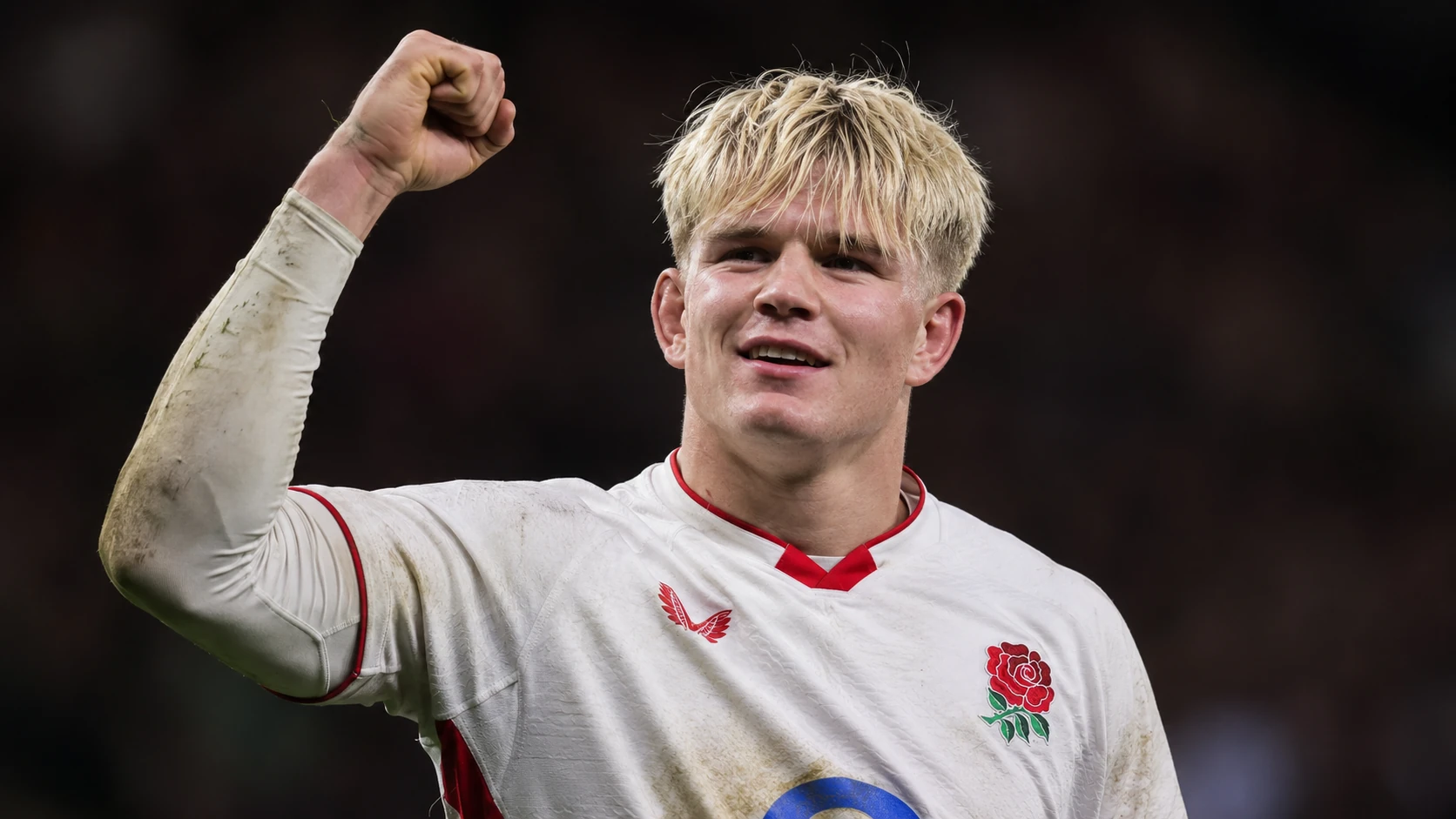
Henry Pollock announced himself to a wider rugby audience with the kind of performance young players dream about but rarely deliver. In March 2025, still only 20, he came off the bench for England against Wales in Cardiff and scored twice on his senior international debut. It was not just the tries that made people look again. It was the speed, the confidence, the blond hair flashing through open field, and the sense that England had found a back-row forward who played with old-fashioned edge and modern attacking ambition.
Pollock is a professional rugby union player for Northampton Saints and England, best known as a dynamic back-row forward. He has played across the back row, with most of his reputation built around his work as a flanker and No. 8. Before his senior England breakthrough, he had already been one of the standout players in world age-grade rugby, helping England’s Under-20 side win major titles and building a reputation as one of the most exciting young forwards in the country. His rise has been fast, but it has not come from nowhere.
What makes Pollock interesting is not only that he is talented. Rugby has plenty of talented teenagers who fade when the collisions become heavier and the pressure becomes real. Pollock has attracted attention because his game has substance beneath the noise: speed, appetite for contact, support running, breakdown work, and a visible love of competition. He looks like a player built for the modern game, but his story also belongs to the older rugby values of club loyalty, school development, family competitiveness, and earning trust one match at a time.
Early Life and Family Background
Henry Pollock was born on 14 January 2005 in England. He grew up in a sporting family, and that competitive setting appears to have shaped much of the personality now visible in his rugby. Public profiles have noted that his mother, Hester, competed at a high level in triathlon, while his siblings have also been involved in sport. That kind of home environment does not guarantee a professional career, but it often creates the habits that make elite sport feel normal rather than distant.
Pollock’s early rugby life took shape in Buckinghamshire and through the schools and clubs that fed his development. He played for Buckingham RUFC and attended Beachborough Prep School before moving on to Stowe School, a well-known independent school with a strong sporting culture. Northampton Saints identified him early and brought him into their academy pathway while he was still young. By the time many players are still deciding how seriously to take rugby, Pollock was already being shaped inside a professional system.
The family details available about Pollock remain limited, and that is worth respecting. He is a young athlete, not a celebrity whose private life has been extensively documented. What is clear from public interviews and club material is that his family has been an important support structure, especially during the demanding move from promising schoolboy to professional player. His parents have been credited in his own comments as part of the foundation behind his rise.
Education and Rugby Development
Stowe School played a central part in Pollock’s development. The school has produced a number of high-level athletes, and for Pollock it offered both rugby exposure and a competitive environment. School rugby in England can be a powerful stage for young players, especially those already connected to academy programmes. It gives them regular fixtures, structured coaching, and the kind of leadership responsibility that can speed up maturity.
Pollock also progressed through Northampton Saints’ academy, one of the more respected development systems in English rugby. The Saints pathway has produced and supported several important English players, and the club has shown a willingness to trust young talent when form justifies it. Pollock captained Northampton’s Under-18 side to the Premiership Rugby Under-18 Academy League final in 2023. That detail matters because it shows he was not only seen as a gifted athlete, but also as a player with leadership qualities.
His early promise was built around a rare athletic profile for a back-row forward. Pollock had the pace to appear in wide channels, the engine to keep arriving in support, and enough physical appetite to enjoy the contest close to the ball. He was not simply a big schoolboy overpowering smaller opponents. The parts of his game that stood out then still define him now: speed into contact, directness, confidence, and a sharp instinct for where the next break might happen.
Northampton Saints Breakthrough
Pollock made his senior debut for Northampton Saints as a teenager in the Premiership Rugby Cup. His first appearances came before he was a regular Premiership name, but he quickly showed that senior rugby did not intimidate him. In one early start against Saracens, he scored two tries, offering a glimpse of the attacking threat that would later become a key part of his reputation. For a young forward, scoring is not everything, but it often reveals timing and confidence.
Northampton did not rush him without purpose. The club used the cup pathway, academy fixtures, and gradual senior exposure to build his experience. He signed his first professional contract before the 2023/24 season and began to move from prospect to first-team option. His Premiership debut came against Leicester Tigers at Welford Road, a fierce setting for any young Northampton player because of the long rivalry between the clubs.
By the 2024/25 season, Pollock had become much harder to ignore. He was no longer being discussed only as a future player but as someone already influencing matches for Saints. His attacking output, energy, and presence in big European fixtures pushed him into wider rugby conversations. Northampton rewarded his progress with a multi-year contract extension, a sign that the club viewed him as a central part of its future rather than a short-term academy success.
England Under-20s and the First Big Statement
Before Pollock became an England senior international, he was one of the leading figures in England’s Under-20 side. In 2024, he helped England win the Under-20 Six Nations and was named Player of the Championship. That award reflected more than reputation. Pollock’s performances combined try-scoring, defence, and the kind of visible intensity that made him stand out even in a strong age-grade team.
The same year, England won the World Rugby Under-20 Championship in South Africa. Pollock was part of a side that defeated France in the final, ending a run of French dominance at that level. Age-grade rugby is not the same as senior Test rugby, but it can reveal how players handle pressure against the best of their generation. Pollock handled that stage with unusual comfort.
The Under-20 success helped change his public status. He moved from being a Northampton prospect known mainly to academy watchers into a national rugby story. Supporters started seeing him as part of a new English generation alongside other young players pushing toward senior honours. The truth is, that age-grade year was the bridge between promise and serious expectation.
Senior England Debut
Pollock’s senior England debut came against Wales in the 2025 Six Nations. England won heavily in Cardiff, and Pollock scored two tries after coming off the bench. A debut try is memorable enough, but two tries from a young forward instantly changed the temperature around him. He became a headline name, not just among rugby followers but among casual sports fans who saw clips of a fearless young player making the most of his chance.
That match did not make him a complete international overnight. It did, though, show that his strengths could translate to Test rugby under the right conditions. He ran sharp support lines, stayed alive around the ball, and brought energy at a stage of the match when space began to open. England have often searched for forwards who can add threat beyond set-piece and collision work, and Pollock looked like exactly that kind of option.
The response was intense because England rugby supporters are always alert to a young player who appears to offer something different. Pollock’s blond hair, expressive celebrations, and direct style made him easy to notice. But the more serious point was tactical. He gave England pace and unpredictability in the back row, two qualities that can change matches when used well.
British & Irish Lions Recognition
One of the clearest signs of Pollock’s rapid ascent came when he was selected for the British & Irish Lions tour to Australia in 2025. Lions selection is one of rugby’s highest honours because it pulls together elite players from England, Ireland, Scotland, and Wales. For Pollock to be chosen so early in his senior international career showed how highly coaches rated his ceiling. It also showed how rare his skill set looked compared with more established back-row forwards.
He was the youngest player in the Lions squad and travelled more as a high-upside tourist than as a guaranteed Test starter. That distinction matters. Pollock did not go to Australia as a finished product expected to dominate the Test series. He went as a player whose energy, athletic ability, and temperament were valuable enough for the coaches to want him inside the environment.
On tour, he featured in several non-Test matches and added to his reputation as a bold carrier and lively competitor. The experience gave him exposure to the standards, travel demands, and scrutiny that come with one of rugby’s most intense short tours. Even without a Test appearance, the Lions experience became part of his education. For a player still near the beginning of his career, that kind of environment can speed up development in ways ordinary seasons cannot.
Playing Style and Strengths
Pollock plays with a style that makes him easy to spot. He is quick for a forward, comfortable in space, and unusually dangerous when he appears outside the tight exchanges. Many back-row players are praised for work rate, but Pollock’s work rate has an attacking edge. He does not only chase and tackle; he looks for chances to support breaks, carry into gaps, and turn loose phases into points.
His game also has a confrontational streak. Pollock enjoys the physical contest, and his best performances usually include a mix of carries, tackles, breakdown pressure, and visible emotional energy. That fire is part of what supporters enjoy about him. It can also be something he has to manage carefully, because Test rugby punishes poor discipline more severely than age-grade or club rugby.
The modern back row demands more than one skill. Coaches want players who can defend, carry, jackal, support, pass, and make good decisions under fatigue. Pollock has already shown signs that he can contribute across that range. The next step is consistency, especially in matches where the game is tight, slow, and heavily tactical rather than open and fast.
Public Image and Personality
Pollock’s public image has grown quickly because he plays with personality. He does not look like a player trying to disappear into systems and patterns. He celebrates, competes, talks, and brings visible emotion to the field. In a sport often searching for marketable young stars, that matters more than some traditionalists might admit.
That said, public image can become a trap for young athletes. The same confidence that makes Pollock compelling can be judged harshly if results turn or discipline slips. Rugby culture often enjoys bold characters but also polices them closely. Pollock will need to keep proving that the attitude is backed by performance, humility, and steady improvement.
So far, the strongest impression is of a player who enjoys pressure rather than shrinking from it. He has spoken in public settings with the confidence of someone raised around competition and used to being challenged. That confidence will be useful, because the spotlight around him is unlikely to fade quickly. The better he becomes, the more opponents and media will look for ways to test him.
Private Life, Relationships, and Family
Henry Pollock’s private life is not widely documented, and there is no need to pretend otherwise. As of publicly available information, he has not made his romantic life a central part of his public profile. There are no widely confirmed public records of a wife or children. Most reliable coverage focuses on his rugby career, family sporting background, and rapid professional rise.
That privacy is understandable. Pollock is still a young player at the start of his senior career, and much of his life outside rugby has remained away from major media attention. Readers searching for details about his girlfriend, dating life, or family should be cautious with unsourced claims. Unless such information comes from Pollock himself, his club, or a reliable interview, it should be treated as unconfirmed.
His family influence, by contrast, is a legitimate part of his story because it has been mentioned in public rugby profiles. The image that emerges is of a competitive sporting household that encouraged ambition and resilience. That background helps explain the ease with which he appears to meet high-pressure moments. It does not tell the whole story, but it gives his rise a more human shape.
Money, Contracts, and Net Worth
Henry Pollock’s exact net worth is not publicly confirmed. Any precise figure attached to his name should be treated with caution unless it comes from a reliable financial disclosure, contract report, or direct statement. Rugby salaries are rarely made public in full, and young players’ earnings can vary widely based on club contracts, national agreements, appearance fees, sponsorship, and bonuses. For Pollock, the safer statement is that his earning power has grown sharply since his senior England and Lions breakthroughs.
His income sources are likely to include his Northampton Saints contract, England match involvement, and potential commercial opportunities. His multi-year Northampton deal gave him club security, while England recognition and Lions selection increased his profile beyond domestic rugby. As his public image grows, brand interest may follow, especially because he is young, distinctive, and easy for supporters to recognize. Still, there is no credible basis for publishing a firm net worth figure as fact.
The commercial side of Pollock’s career will be worth watching. Rugby does not usually create the same individual earnings as football, basketball, or tennis, but high-profile internationals can build meaningful value through sponsorship and media work. Pollock’s challenge will be to let the rugby drive the brand, not the other way around. For a player at his age, long-term performance matters far more than short-term publicity.
Setbacks, Pressure, and What He Still Has to Prove
Pollock’s career has risen so quickly that the main pressure now comes from expectation. Young players are often judged unfairly after early success because supporters start treating promise as a finished product. That is especially true in England rugby, where a strong debut can turn into heavy scrutiny within weeks. Pollock will need time to develop without every performance becoming a referendum on his future.
There are rugby questions he still has to answer. Can he control the emotional edge that makes him so effective? Can he dominate against the best Test packs when the match is slow, wet, and decided by breakdown accuracy rather than open running? Can he stay fit across long seasons while carrying the physical burden of back-row play? These are not criticisms as much as the normal tests every elite forward must pass.
His discipline and decision-making will be watched closely. Back-row forwards operate close to the referee’s whistle, and Pollock’s aggressive style naturally places him near flashpoints. The best players learn how to live on that edge without slipping over it too often. If he manages that balance, his ceiling remains very high.
Where Henry Pollock Is Now
By 2026, Henry Pollock is firmly established as one of the major young names in English rugby. He is no longer just a Northampton prospect or an age-grade star. He has played for England, toured with the Lions, and become a player supporters discuss when imagining the next version of the national team. That is a significant position for someone born in 2005.
At club level, Northampton remain central to his development. Saints give him a familiar environment, a strong coaching structure, and a style of rugby that lets his athletic gifts show. The club also offers the grounding he needs while outside attention grows. For young players, staying connected to the habits and people that built the rise can be just as important as chasing the next milestone.
The next stage of Pollock’s story will be about staying power. It is one thing to break through with energy and surprise; it is another to become a player opponents plan for and still fail to contain. Pollock has the traits that make coaches excited and supporters hopeful. Now he has to turn early impact into a long international career.
Frequently Asked Questions
Who is Henry Pollock?
Henry Pollock is an English professional rugby union player for Northampton Saints and England. He plays in the back row, mainly as a flanker or No. 8, and is known for his pace, carrying, support running, and competitive edge. He became widely known after starring for England Under-20s and then scoring twice on his senior England debut against Wales in 2025.
How old is Henry Pollock?
Henry Pollock was born on 14 January 2005. That means he turned 21 in January 2026. His age is one reason his rise has attracted so much attention, because he has already achieved senior England recognition and Lions selection at a point when many forwards are still developing at club level.
Which club does Henry Pollock play for?
Henry Pollock plays for Northampton Saints. He came through the club’s academy pathway after being identified as a young player and later signed professional terms with the club. Northampton have been central to his development from academy captain to senior first-team player.
What position does Henry Pollock play?
Henry Pollock is a back-row forward. He has been used as a flanker and at No. 8, which gives coaches flexibility in how they select him. His game combines speed, physicality, support running, and breakdown involvement, making him a modern back-row option rather than a narrow specialist.
Has Henry Pollock played for England?
Yes, Henry Pollock has played for England at senior level. He made his senior debut during the 2025 Six Nations against Wales in Cardiff and scored two tries. Before that, he had been a standout player for England Under-20s, helping them win major age-grade titles.
Was Henry Pollock picked for the British & Irish Lions?
Yes, Henry Pollock was selected for the British & Irish Lions tour to Australia in 2025. He was the youngest player in the squad and featured in tour matches, although he was not a Test starter. The selection confirmed how highly he was rated across British and Irish rugby.
What is Henry Pollock’s net worth?
Henry Pollock’s net worth has not been reliably confirmed in public. His earnings likely come from his Northampton Saints contract, England involvement, and possible commercial opportunities, but exact figures are private. Any specific net worth number should be treated as an estimate unless backed by a trusted financial source.
Conclusion
Henry Pollock’s story is still early, which is part of what makes it compelling. He has already done enough to be taken seriously, but not so much that the shape of his career is fixed. The best reading of him is neither blind hype nor caution for its own sake. He is a rare young forward with real achievements, real edge, and real work still ahead.
His background explains some of the confidence. A competitive family, a strong school rugby environment, and Northampton’s academy pathway all helped form a player comfortable with pressure. His senior rise then gave the public a clearer view of what coaches had seen earlier. Pollock did not suddenly arrive; he became visible after years of structured development.
What happens next will depend on durability, discipline, and growth. If Pollock keeps sharpening his decision-making while preserving the speed and personality that make him special, he can become a long-term figure for Northampton and England. For now, he stands as one of rugby’s most exciting young players, not because the story is complete, but because the opening chapters already carry weight.