
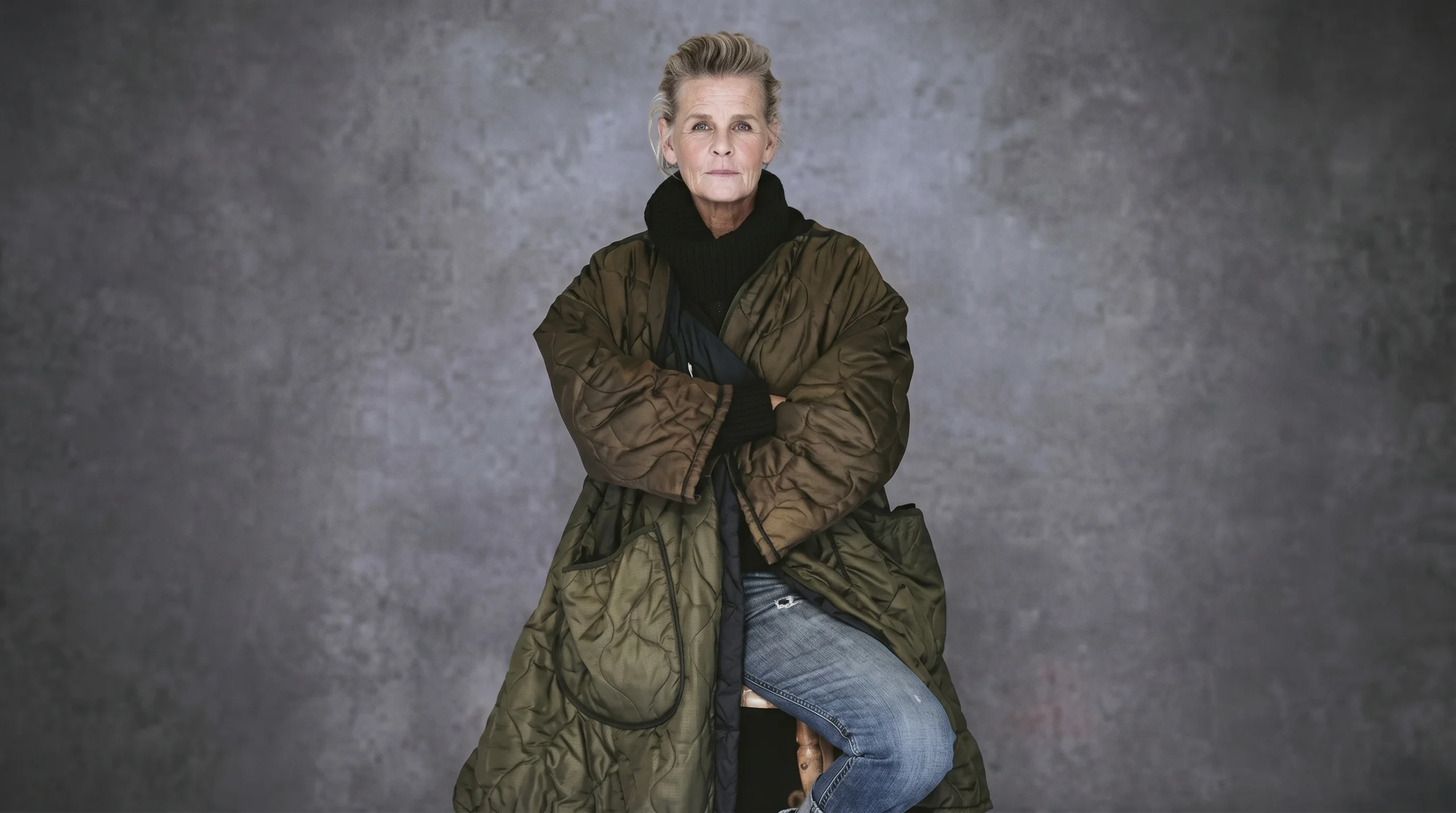
Jeny Howorth is one of those fashion figures whose image stayed sharper than the public record around her. She was not the kind of model who built a career on confession, celebrity scandal, or constant self-promotion. Instead, she became memorable through a look: cropped blonde hair, cool restraint, a face that could carry tailoring, beauty, and attitude without seeming to ask for attention. For readers searching her name now, the appeal is partly curiosity and partly correction, because Howorth’s real story is more interesting than the scattered, often thin biographies that circulate online.
She is best known as a British fashion model associated with the 1980s, a decade when modeling began shifting from polished anonymity toward stronger character and personal style. Her career connected her with major photographers, magazines, stylists, and designers, including names linked to Vogue, i-D, Arthur Elgort, Steven Meisel, Edward Enninful, Naomi Campbell, Chloé, Burberry, and Love Magazine. She also belongs to a smaller but important group of models whose influence can’t be measured only by household fame. In fashion, some faces become part of the visual memory of an era, and Howorth is one of them.
Early Life and Family Background
The publicly available record around Jeny Howorth’s early life is limited, and that should be said clearly. Unlike many modern public figures, she did not grow up in an age when interviews, school details, childhood photos, and family histories were endlessly archived online. The strongest available accounts place her upbringing in London, with Hampstead often mentioned in relation to her early life. She has described a family background that was not built around show business, with an engineer father and a mother who taught.
That detail matters because it places her outside the usual myth of a model carefully prepared for glamour from childhood. Howorth’s path appears to have come through style, youth culture, and chance rather than a long-planned pursuit of fame. London in the late 1970s was a powerful place for a visually adventurous teenager, especially one drawn to hair, clothes, and self-invention. Punk, new wave, club culture, and street fashion were all pushing against older rules about beauty.
Accounts of her discovery often return to a hairdresser’s on Baker Street, where her look attracted attention. She has recalled being young and experimental with her hair, including dyeing it green before her modeling career took shape. That small detail says a lot about the kind of model she would become. She was not simply found because she fit a standard; she was noticed because she already looked like someone.
Discovery and First Steps Into Modeling
Howorth’s entry into modeling is usually dated to around 1979, when she was discovered through the orbit of a London hair salon. The story has the feel of a pre-digital fashion origin: a striking teenager, an unusual haircut, a chance connection, and an industry hungry for faces that looked new. A sister of someone connected to the salon reportedly worked in modeling, and the introduction helped open the door. In that period, scouting could happen in exactly that informal way.
Her early career came at a time when British fashion was feeding on street energy. A model did not need to look like a society beauty to be interesting. She needed presence, adaptability, and something in her appearance that a photographer could build an image around. Howorth had all three, and her cropped hair gave her an immediate signature.
The early lessons of modeling also seem to have shaped how she understood the work. She has spoken about learning from photographers such as Arthur Elgort and Steven Meisel, two figures with very different styles and strong demands of their subjects. Elgort’s work often prized movement and naturalness, while Meisel became known for control, character, and editorial drama. For a young model, working around that kind of talent was more than exposure; it was an education in how fashion images are made.
The Haircut That Became a Signature
The most repeated fact about Jeny Howorth is also one of the most visually important: her short bleached-blonde crop. It gave her a look that was androgynous, graphic, and instantly readable in photographs. Hair stylist Sam McKnight has often been connected to that cut, and fashion references have credited Howorth with helping define a style later echoed by younger models. In an industry built on recognition, that haircut became part of her professional identity.
The crop worked because it stripped away softness without making her look severe. It made clothes look cleaner, especially tailoring, knitwear, and pared-back silhouettes. It also helped her move between feminine and boyish styling without seeming dressed up as either. That kind of flexibility was valuable in the 1980s, when fashion magazines were experimenting with mood, character, and contrast.
There is a temptation to treat a haircut as a small beauty choice, but in modeling it can change a career. Hair can decide what designers see, what editors imagine, and what kind of story a photographer can tell. For Howorth, the blonde crop made her modern in a way that still reads clearly decades later. It is one reason vintage images of her continue to circulate among fashion followers today.
Career Breakthrough and 1980s Fashion Work
By the early 1980s, Howorth had become part of the fashion world’s working circuit, moving through editorial shoots, runway work, and magazine culture. She was associated with a period when models were becoming more individually recognizable, even before the full supermodel era took over popular culture. Her name appears in relation to major fashion titles and photographers, but her career was never built around tabloid celebrity. It was built in the pages of magazines and in the memory of those who followed fashion closely.
Her presence fit the visual mood of the decade. The 1980s could be glamorous and loud, but it also had a cooler, sharper side, especially in London and New York editorial circles. Howorth’s look belonged to that second category. She could make a strong outfit feel relaxed, and she could bring personality without taking the focus away from the clothes.
One reason she remains interesting is that she seems to have understood modeling as craft rather than pure self-display. She has recalled being told she was a good “clothes hanger,” a phrase that might sound cold outside fashion but carries real meaning inside the profession. The best models know how to let a garment live while still giving the image a human charge. Howorth’s career shows that kind of control.
Work With Major Photographers
Arthur Elgort is one of the key names linked to Howorth’s modeling career. His photographs often gave models a sense of motion, as though they had been caught mid-life rather than frozen inside a studio formula. A 1989 image of Howorth in Rome for Italian Vogue has been preserved in gallery contexts, which shows how fashion photography can later become collectible art. That afterlife matters because it keeps a model’s work visible long after the original magazine issue has disappeared.
Steven Meisel is another major figure associated with her professional development. Meisel’s fashion work became central to the visual identity of late twentieth-century editorial photography, especially through his long relationship with Vogue Italia. For Howorth to have learned in that world meant working inside a demanding, idea-driven culture. The model was not just expected to look good; she had to understand character, mood, and transformation.
These associations do not mean every detail of her work is easy to reconstruct. Many fashion archives from the 1980s and early 1990s remain scattered across print collections, vintage dealers, fan scans, runway databases, and agency records. That makes Howorth’s career harder to map than that of models who became mass-market celebrities. Still, the names connected to her work point to serious industry standing.
Jeny Howorth and i-D Magazine
One of the more meaningful parts of Howorth’s career is her connection to i-D, the British magazine that helped define the relationship between fashion, street style, youth culture, and identity. i-D was not just another magazine; it was a place where photographers, stylists, models, musicians, and young creatives could shape a new language of cool. Howorth’s presence in that world makes sense. Her look had the kind of edge that i-D valued.
Howorth has also been connected to photography work for i-D, including a Naomi Campbell shoot from the early 1990s styled by Edward Enninful. Enninful later recalled that Howorth wanted to shoot Campbell after reading about her and that they went to Paris in search of her outside Chanel. It is a vivid fashion-world story because it shows how informal, bold, and relationship-driven parts of the industry could be. It also places Howorth close to people who would become central to modern fashion history.
That connection gives her biography more depth than a simple model profile. She was not only an image in front of the camera; she moved among people making images, choosing clothes, forming taste, and defining what the next generation of fashion might look like. In London fashion circles, roles often overlapped. A model could become a photographer, a stylist could become an editor, and a magazine could function as both workplace and creative family.
Public Image and Personal Style
Howorth’s public image has always rested on restraint. She never seemed to chase broad fame, which may be one reason her name feels both familiar and elusive to fashion readers. Her style was strong but not noisy, and her best images carry a sense of ease. Even in highly styled fashion photographs, she often looked like a person with her own taste rather than a blank surface.
That quality has helped her age well in the public imagination. Some model images from the 1980s feel locked inside their decade, but Howorth’s sharper photographs can still look current. The cropped hair, clean lines, and androgynous styling fit easily into today’s archive-driven fashion mood. Younger viewers may not know the original magazine context, but they can immediately understand the image.
Her later interviews and brand appearances also suggest a woman more interested in making, taste, and craft than in fame for its own sake. She has described sewing, quilting, cooking, and making objects by hand. Those details match the impression left by her modeling work. Her career was always connected to the physical intelligence of clothes, fabric, proportion, and texture.
Marriage, Children, and Family Life
Howorth’s private life has not been documented in the same public way as her professional career, and responsible biography should respect that boundary. There are many online pages that attempt to fill in blanks about her relationships, family details, or finances, but much of that material is weakly sourced. The safest and fairest approach is to focus on what has been publicly confirmed. Her daughter Georgia Howorth is part of the public fashion record and has modeled in her own right.
Georgia Howorth’s career has brought renewed attention to Jeny’s history. Vogue has written about the two as part of a broader interest in model mothers and daughters, noting Georgia’s entry into modeling in the mid-2010s. Their pairing is visually interesting because Georgia’s image differs from her mother’s rather than copying it. Where Jeny was often remembered for a cropped, androgynous look, Georgia has been framed through a softer and more romantic beauty.
The mother-daughter connection also shows how fashion now handles lineage. Older models are no longer treated only as nostalgic references; they are often invited back into the frame as living links between eras. Jeny and Georgia together offer that kind of continuity. Their shared appearances give younger readers a reason to discover the earlier work, while reminding older fashion followers that Howorth’s influence did not vanish with the 1980s.
Later Work and Return to Fashion Visibility
Howorth’s later visibility shows that her career did not end neatly after her first period of fame. In recent years, she has appeared in or been credited with fashion work connected to magazines and brands interested in age, memory, family, and archive culture. Models.com records recent activity involving British Vogue, Love Magazine, Burberry, and other projects. That record places her in the present tense rather than treating her only as a vintage reference.
This matters because fashion has changed its attitude toward older models. For decades, the industry often treated youth as the default and maturity as an exception. More recently, editors and brands have shown greater interest in faces that carry history. Howorth benefits from that shift, but she also contributes to it because her look remains distinct.
Her continued relevance is not about chasing a comeback in the usual celebrity sense. It is more like a second reading of a career that was always respected by people who understood the work. As archives become easier to search and fashion audiences become more visually literate, figures like Howorth gain new visibility. The public catches up with what insiders and collectors had not forgotten.
Creative Life Beyond Modeling
One of the most appealing things about Howorth is that her creativity appears to extend beyond modeling. She has spoken about making quilts, sewing, cooking, and creating handmade objects. That gives her life story a more grounded texture than the usual image of a model passing from shoot to shoot. It suggests that her eye for fashion was part of a wider way of seeing and handling materials.
This creative side also helps explain why she could move behind the camera and into other image-making spaces. Modeling can look passive from the outside, but good models learn composition, light, fabric, movement, and timing through constant practice. They watch photographers work, see how stylists build a frame, and understand what makes a picture succeed. Howorth’s later creative identity seems to come from that same visual training.
Not many people know this, but some of the most influential fashion figures have worked across several roles without making a loud announcement about it. Howorth belongs to that tradition. She may be best known as a model, but her story includes photography, making, styling culture, and long-term taste. That is why her biography feels richer than a simple list of covers and runway shows.
Net Worth, Income Sources, and Public Claims
There is no reliable, publicly confirmed net worth figure for Jeny Howorth. Various websites may publish estimates, but those numbers should be treated with caution because they usually do not show access to financial records, contracts, assets, or verified business income. A model’s earnings can vary widely by era, market, agency, editorial work, campaigns, runway fees, usage rights, and later licensing. Without documentation, any exact figure would be guesswork.
Her income over time likely came from modeling assignments, editorial work, advertising jobs, runway appearances, possible photography or creative projects, and later brand or magazine work. That is a reasonable description of income sources based on her career, but it is not the same as a verified financial profile. Fashion careers also do not always map neatly onto public wealth. A model may have had major cultural visibility without the kind of celebrity earnings people assume.
The truth is, net worth is often the weakest part of online celebrity biography. It can attract search traffic, but it rarely tells readers much unless the figure is tied to credible reporting. In Howorth’s case, the better measure of value is professional influence, not speculative money. Her lasting worth to fashion lies in the images, relationships, and style language attached to her name.
Public Record, Rumors, and Common Errors
Jeny Howorth is a good example of why online biography needs care. Some pages repeat exact birth dates, family details, or business claims without showing where the information came from. Others confuse spellings, using “Jeny,” “Jenny,” “Howorth,” or even variant surnames in ways that blur search results. Because fashion archives are already inconsistent, careless repetition can quickly turn a mistake into an apparent fact.
The most responsible version of her biography accepts the limits of the record. It is clear that she is British, that she emerged in fashion around the late 1970s and early 1980s, that she became known for a cropped blonde look, and that she worked in serious editorial and fashion circles. It is also clear that she is connected publicly to Georgia Howorth, who has modeled as well. Beyond those confirmed points, personal claims should be handled with restraint.
That restraint is not a failure of reporting; it is part of accuracy. Public figures do not owe readers every private detail, especially when their careers were built before the modern culture of constant disclosure. Howorth’s public life is most visible through work, not confession. For a biography, that means the work has to carry the story.
Cultural Influence and Industry Standing
Howorth’s influence is easiest to understand through the way fashion remembers her. She is often discussed through images, hair, mood, and association rather than awards or mass celebrity. That is common in modeling, where the work is visual and collaborative. A model’s contribution may be powerful even when the public cannot easily separate it from the photographer, stylist, designer, or magazine.
Her androgynous presentation also helped widen what fashion beauty could look like. She was not alone in that shift, but she belonged to a group of models whose appeal challenged softer or more conventional standards. Her look could feel boyish, elegant, cool, and intelligent at once. That made her useful to designers and editors who wanted fashion to look modern rather than merely pretty.
The renewed interest in Howorth also reflects the way current fashion audiences read the past. People no longer look only for the biggest names; they look for the faces that shaped mood and style. In that sense, Howorth’s position has strengthened with time. The more the archive matters, the more figures like her come back into view.
Where Jeny Howorth Is Now
Based on available public information, Jeny Howorth remains connected to fashion, though not in the noisy way associated with celebrity culture. Recent credits and features place her in magazine, brand, and model-database records well beyond her original 1980s prominence. She appears to live a creative life that includes fashion, craft, family, and selective public work. That pattern fits the way she has always appeared: visible through taste rather than constant publicity.
Her current status is best described as that of a respected fashion figure with a long afterlife in the archive. She is not simply a former model remembered for one haircut, though that haircut remains central to her image. She is a woman whose career touched several important parts of fashion culture: modeling, editorial image-making, London style, magazine history, and intergenerational casting. That gives her name more weight than a casual search result might suggest.
For readers discovering her now, the best way in is through the images and the confirmed stories around them. Look at the cropped hair, the 1980s editorials, the i-D connection, the later appearances with Georgia, and the continued interest from fashion databases and magazines. Together, they form a portrait of someone who never needed to be everywhere to matter. Howorth’s career shows that fashion memory often works through precision, not volume.
Frequently Asked Questions
Who is Jeny Howorth?
Jeny Howorth is a British fashion model best known for her work during the 1980s and for her short bleached-blonde crop. She became associated with a cool, androgynous look that made her stand apart in editorial and runway fashion. Her career connects her to major photographers, magazines, and later fashion projects that have kept her name active in archive culture.
What is Jeny Howorth famous for?
She is most famous for her modeling career and her distinctive cropped hair. The look became one of her signatures and has often been referenced in discussions of later short-haired models. She is also remembered for her links to 1980s fashion photography, i-D magazine culture, and a wider London creative circle.
Is Jeny Howorth related to Georgia Howorth?
Yes, Georgia Howorth is publicly known as Jeny Howorth’s daughter. Georgia has modeled as well, and the two have appeared in fashion coverage about model mothers and daughters. Their public connection has helped bring renewed attention to Jeny’s earlier career.
How old is Jeny Howorth?
Jeny Howorth’s exact age is not reliably confirmed in the strongest public sources. Some online pages give specific dates, but those claims are often weakly sourced or inconsistent. A careful biography should avoid presenting an exact age unless it comes from a credible primary or well-documented source.
What is Jeny Howorth’s net worth?
There is no verified public net worth figure for Jeny Howorth. Online estimates should be treated as guesses unless they are backed by financial records or serious reporting. Her known income sources would have included modeling, editorial work, advertising, runway jobs, and later fashion-related projects.
Did Jeny Howorth work with Naomi Campbell?
Howorth has been linked to Naomi Campbell through i-D magazine and Edward Enninful’s early fashion work. Accounts from fashion sources describe Howorth wanting to photograph Campbell and being part of the creative circle around that moment. That connection places her close to one of the most important model-editor relationships in modern fashion.
Is Jeny Howorth still active in fashion?
Yes, public fashion records show that Howorth has continued to appear in later magazine and brand projects. Her recent visibility is tied partly to the renewed interest in fashion archives and partly to the industry’s broader embrace of older models. She remains a respected figure for readers who follow fashion history closely.
Conclusion
Jeny Howorth’s biography is not built from the usual celebrity materials. There is no overexposed childhood story, no public marriage drama, no heavily documented fortune, and no constant stream of interviews explaining herself. What exists instead is a body of fashion work, a memorable visual identity, and a set of connections that place her inside an important period of British and international style.
That makes her story quieter, but not smaller. Howorth helped define a kind of modern fashion presence: sharp, cool, and self-possessed. Her cropped hair became a signature, but the real staying power came from how she wore clothes and how well she understood the camera. Those are the qualities that keep a model alive in the archive.
The renewed interest in her name says something about fashion now as much as it says about fashion then. Readers are looking beyond the most famous supermodels to the people who shaped mood, attitude, and visual memory. Jeny Howorth belongs in that conversation because her best work still feels clear. She remains proof that a lasting image does not need to shout.