
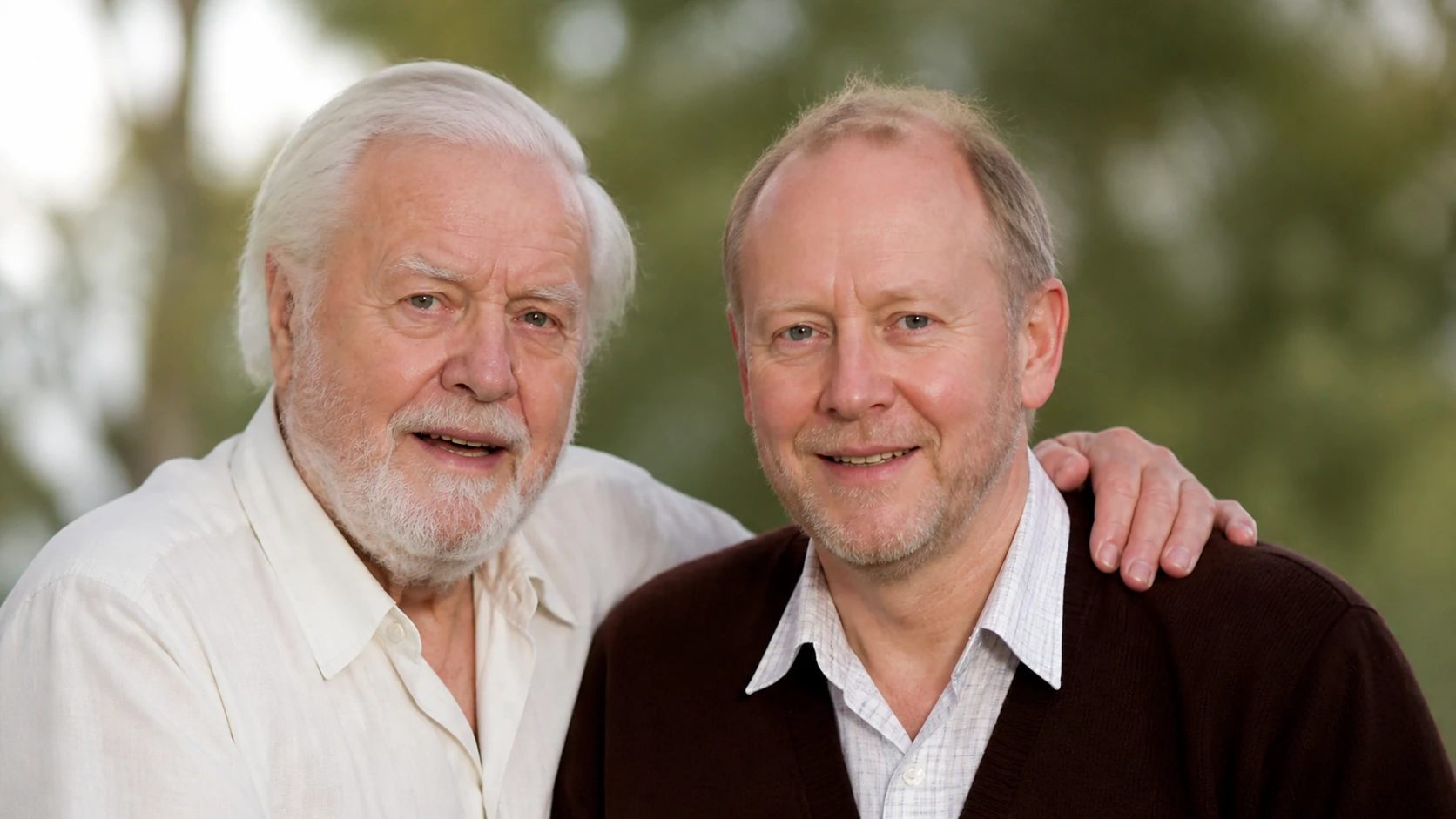
While the name Attenborough is instantly recognizable around the world, most people would associate it with Sir David Attenborough, the renowned broadcaster and naturalist. What many may not realize is that David’s son, Robert Attenborough, has quietly carved his own path, far removed from the limelight that follows his father. A biological anthropologist by training, Robert has remained relatively private, avoiding the spotlight that has followed his famous family for decades.
Unlike the global icon that his father became through pioneering documentaries such as Planet Earth and The Blue Planet, Robert Attenborough’s achievements lie within the realm of academia. He is not a household name, but his career in anthropology offers a fascinating glimpse into the life of someone who has worked tirelessly in the shadow of fame, pursuing a career rooted in research, academia, and a deep understanding of human evolution.
Early Life and Family
Robert Attenborough was born in the early 1950s to Sir David Attenborough and his wife, Jane Elizabeth Ebsworth Oriel. The family lived in an environment that, while not one of overt luxury, was filled with intellectual rigor and public service. Robert grew up in the shadow of a famous father, which no doubt shaped his approach to his own life and career. However, it is important to note that while David was busy making history with the BBC, Robert’s upbringing focused less on fame and more on fostering an education that would prepare him for a life outside the media spotlight.
Robert’s sister, Susan Attenborough, also grew up in this environment. Both siblings shared the privacy that their parents valued, especially when compared to other children of famous figures. Jane, Robert’s mother, was a significant influence in his life. Known for her elegance and her own quiet public service, she died in 1997, a loss that deeply affected the family, though little about the personal grief has been publicly disclosed.
While much of Robert’s early life remains private, it is clear that the family’s focus on education, culture, and academic achievement provided a strong foundation for his future. Robert was not merely the child of a famous figure, but someone raised with an expectation of making his own contributions to the world—without the use of celebrity or public spectacle.
Education and First Ambitions
From an early age, Robert showed an interest in subjects far removed from the world of television. His passion for biology and human evolution took root during his academic years, where he pursued studies in anthropology. It was during his time at university that Robert decided to dedicate himself to biological anthropology, a field concerned with the biological aspects of humanity, including genetics, evolution, and human behavior.
After earning his undergraduate degree, Robert continued his education with advanced studies in anthropology, eventually finding his niche in biological anthropology, focusing on human evolution and the biology of past and present populations. Unlike his father, whose career was shaped by the world of television and film, Robert’s work would largely take place in academic institutions and research environments, away from the cameras and public stages.
His decision to become a biological anthropologist was guided by his deep curiosity about human origins and the complex ways in which biological and environmental factors shape our species. Robert’s interest in human populations was likely fueled by his exposure to the broader work of anthropology, and his academic journey led him to establish himself as a researcher who would make contributions to the understanding of human diversity and evolution.
Career Breakthrough
Robert Attenborough’s professional career took shape at the Australian National University (ANU), where he became associated with the School of Archaeology and Anthropology. His role there allowed him to dive deeper into his research on human evolution, with a particular focus on biological variation and population history. It is at ANU where Robert’s expertise flourished, as he conducted research in Papua New Guinea—a region of critical importance for anthropological and genetic studies due to its high levels of diversity and unique evolutionary pathways.
Though Robert is not a household name like his father, his work in anthropology is respected within academic circles. He has worked with populations in Papua New Guinea, examining human variation in terms of genetics and evolutionary adaptation. His research has made contributions to understanding how human populations evolved and adapted to different environmental challenges over thousands of years.
In his academic role, Robert worked to integrate scientific approaches to understanding human genetics, culture, and history. While his father’s career was marked by educating the public through documentaries, Robert’s role is to educate the next generation of anthropologists, guiding students in their own research and exploration of human history.
Major Works and Achievements
Though Robert Attenborough’s work remains mostly under the radar, it is not without merit. He has authored and contributed to research that deals with complex subjects such as human biological variation and population genetics. His research has helped to deepen the understanding of how various factors—including environment, genetics, and migration—have shaped human populations over time.
In addition to his academic articles, Robert is known for his involvement in a wide range of projects related to anthropology. His contributions are particularly noted in the field of human biology, where he has worked extensively to understand the complex relationships between biology, culture, and environment in different populations.
While Robert’s work may not have garnered widespread media attention, it has been highly regarded by his peers in the field of anthropology. His focus on the biological aspects of humanity has provided valuable insights into the evolutionary process and human diversity.
Public Image and Privacy
Unlike his father, Robert Attenborough has chosen to live a private life, which has resulted in his relative obscurity despite his academic achievements. The public knows little about his personal life, and Robert has avoided seeking the media attention that so often accompanies the children of famous figures. While his father became an icon through his documentaries, Robert chose a different path—one that was rooted in research, academia, and a commitment to scientific discovery.
This preference for privacy extends to his relationship with his father. While David Attenborough’s life has been an open book in the public eye, Robert’s has remained largely shielded from public scrutiny. The Attenborough family, while publicly supportive of each other, has clearly prioritized their private lives over media exposure. It’s clear that Robert’s choice to remain largely out of the public eye was a deliberate one, and one that has allowed him to work with more freedom and less external distraction.
Where Robert Attenborough Is Now
As of 2025, Robert Attenborough is still a respected figure in the world of biological anthropology. Though his academic work has slowed, his contributions to the field continue to resonate within the scholarly community. There is no indication that he has sought to retire or step back from his academic roles, although he may now be less involved in day-to-day research and teaching compared to his more active years.
Given his preference for privacy, it’s difficult to say what the future holds for Robert Attenborough. While his career has been marked by substantial academic achievements, Robert is not the type of person to court public attention or pursue the limelight. Instead, he has left a quiet but meaningful legacy within the field of anthropology, ensuring that his work will continue to be valued by those within his academic circles.
Frequently Asked Questions
Who is Robert Attenborough?
Robert Attenborough is the son of Sir David Attenborough, the famed broadcaster, and Jane Elizabeth Ebsworth Oriel. He is a biological anthropologist who has worked at the Australian National University and contributed significantly to research in human evolution and population genetics.
What does Robert Attenborough do?
Robert Attenborough is a biological anthropologist. His work focuses on understanding human variation, population history, and evolutionary biology. He has worked in Papua New Guinea and has contributed to academic literature on these topics.
Is Robert Attenborough involved in television like his father?
No, Robert Attenborough is not involved in television. Unlike his father, who became a famous broadcaster and naturalist, Robert has chosen a career in academia, where he focuses on anthropological research.
Is Robert Attenborough married?
There is limited publicly available information regarding Robert Attenborough’s personal life, including his marital status. Like much of his private life, he has kept these details out of the public eye.
What is Robert Attenborough’s relationship with his father?
While details of their personal relationship are private, Robert and his father, Sir David Attenborough, share a strong familial bond. David’s fame has always been separate from Robert’s academic pursuits, allowing Robert to lead a quieter life.
Where does Robert Attenborough live now?
There is no widely available information about Robert Attenborough’s current residence. His private life, including his personal whereabouts, is kept out of the public eye.
Conclusion
Robert Attenborough’s life, while not marked by the same public recognition as his father’s, is a testament to the quiet strength of pursuing one’s own passions in the shadow of fame. His work in biological anthropology has contributed significantly to our understanding of human evolution and population genetics. However, it is his choice to live a private life, free from the glare of the media, that truly sets him apart.
While the Attenborough name will always be linked to public achievements, Robert’s story shows that there are many ways to make a lasting impact—quietly, thoughtfully, and without the need for public acclaim. His legacy will be defined not by the public accolades of his father, but by the quiet contributions he has made to the world of science.